

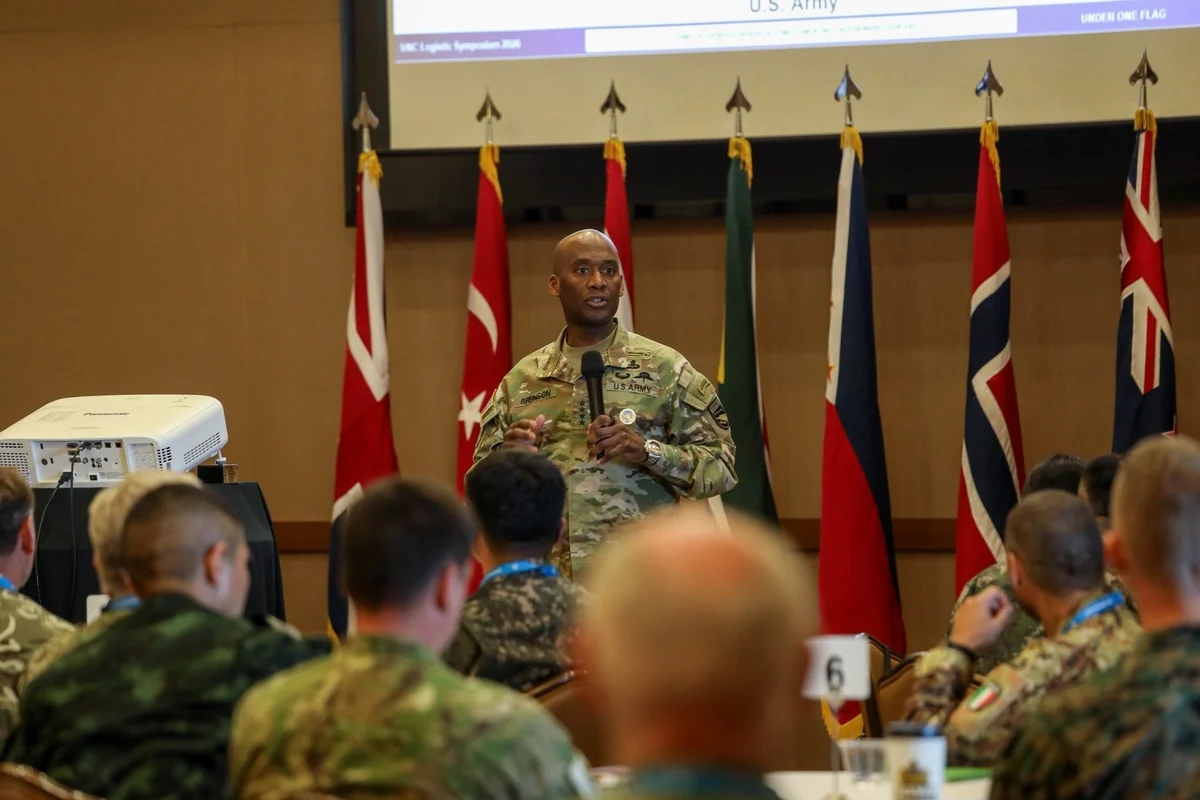
U.S. Forces Korea (USFK) Commander Gen. Xavier Brunson, who also leads the United Nations Command (UNC) and the South Korea-U.S. Combined Forces Command (CFC), has signaled a strategic shift toward prioritizing logistics and sustainment as the backbone of military deterrence. Following a United Nations Command logistics symposium held this week, Gen. Brunson utilized social media to underscore a fundamental military doctrine: the necessity of robust sustainment to ensure operational success in the Indo-Pacific theater. This push for modernization and efficiency is not merely an administrative upgrade; it is a calculated effort to leverage South Korea’s formidable defense industrial base to overcome the logistical challenges inherent in the "tyranny of distance" that characterizes the vast Pacific region.
The Strategic Imperative of Sustainment
In his post on X (formerly Twitter) following the symposium, Gen. Brunson articulated a philosophy that challenges the traditional perception of logistics as a secondary support function. "Sustainment is not support to the fight. It is what enables us to fight and win," he stated. By framing logistics as the primary enabler of combat operations, Brunson is aligning USFK with broader U.S. Department of Defense (DoD) initiatives focused on "contested logistics."
Contested logistics refers to the ability to maintain supply chains, repair critical assets, and sustain military forces even when faced with sophisticated, multi-domain threats from near-peer adversaries. In the context of the Korean Peninsula and the wider Indo-Pacific, this involves ensuring that the U.S. military can maintain its presence and capability to respond rapidly to contingencies without relying solely on long, vulnerable supply lines stretching back to the continental United States.
Chronology of the Regional Sustainment Hub Initiative
The focus on logistics is the culmination of months of policy development and high-level coordination between Washington and Seoul. The timeline of this initiative reflects a growing urgency to integrate regional industrial capacity into the U.S. military’s operational framework:
- Early 2024: Initial discussions regarding the expansion of Maintenance, Repair, and Overhaul (MRO) capabilities in South Korea gain momentum as U.S. defense officials express concerns over shipyard capacity in the United States.
- April 2026: Gen. Brunson submits formal documentation to the U.S. Congress, outlining the conceptual framework for a "regional sustainment hub." This document officially codifies the intent to leverage South Korea’s industrial base to support the U.S. Indo-Pacific Command (INDOPACOM).
- Summer 2026: Increased cooperation between the U.S. Department of State, the U.S. military services, and South Korean defense firms begins to formalize. Technical assessments of South Korean facilities are conducted to determine compatibility with U.S. military equipment standards.
- October 26, 2026: The United Nations Command hosts a logistics symposium in Seoul, bringing together experts from member nations to discuss cross-border logistics, interoperability, and the introduction of advanced technologies into exercises. Gen. Brunson uses this platform to issue a call to action for military logisticians to modernize their practices.
South Korea’s Industrial Capacity as a Strategic Asset
South Korea’s defense industry has rapidly evolved from a recipient of foreign technology to a global exporter. According to data from the Stockholm International Peace Research Institute (SIPRI), South Korea’s share of the global arms trade has grown significantly over the past decade, driven by its ability to mass-produce high-quality artillery, armored vehicles, and naval platforms.
Gen. Brunson has characterized South Korea’s production capabilities as "one of the finest military production capabilities in the world." For the U.S. military, this represents a unique opportunity. By establishing a regional sustainment hub in South Korea, the U.S. can perform MRO on ships, aircraft, and ground vehicles locally. This reduces the time assets spend in transit or waiting for repairs, effectively increasing the "force availability" of the U.S. fleet in the Pacific.
Furthermore, this integration addresses the logistical bottleneck created by the "tyranny of distance"—a military term referring to the logistical difficulty of projecting power across the vast expanses of the Pacific Ocean. By localizing the supply chain, the U.S. reduces its dependence on trans-Pacific shipping lanes, which could be subject to blockade or interdiction in a conflict scenario.
Modernizing Military Exercises
Beyond physical infrastructure, Brunson’s directive emphasizes the introduction of "modern technology" into military exercises. This is interpreted by analysts as an integration of digital logistics, Artificial Intelligence (AI) for predictive maintenance, and autonomous supply chains.
Current military exercises in the region, such as the annual Ulchi Freedom Shield (UFS), have historically focused on tactical maneuvering and joint strike capabilities. Moving forward, Brunson is signaling that these exercises will increasingly stress-test logistics chains. This includes the use of real-time data analytics to manage fuel, ammunition, and medical supplies during simulated high-intensity combat. By incorporating these elements, the USFK aims to ensure that its personnel are not only trained in combat but are also adept at managing the complex, technology-driven logistics required to maintain combat endurance.
Implications for Regional Stability and Deterrence
The emphasis on logistics is a clear signal to regional actors, particularly North Korea and other adversaries in the Indo-Pacific, that the United States and its allies are prepared for long-term, high-intensity operations. The credibility of a deterrent is often tied to the logistical capacity to sustain a conflict; if an adversary believes that U.S. forces can be quickly depleted or logistically overwhelmed, the deterrent effect is diminished.
"Endurance in theater is how we deter," Brunson noted. This statement captures the shift toward "resilience-based deterrence." It suggests that the U.S. and South Korea are building a force structure that is not only capable of winning a decisive first engagement but is also capable of sustaining that momentum over weeks or months of sustained operations.
Official Responses and Broader Context
While the U.S. military has been vocal about the importance of this initiative, the reaction from the South Korean government and local defense industry leaders has been largely positive. South Korean officials have long advocated for a deeper, more equitable security partnership that goes beyond simple military presence to include industrial and technological cooperation.
Analysts at the Center for Strategic and International Studies (CSIS) note that this initiative is a "win-win" for both nations. For the U.S., it solves a critical maintenance capacity gap. For South Korea, it secures a long-term role as a key logistics provider for the world’s most powerful military, deepening the bilateral security alliance and providing a steady stream of revenue and technological exchange for its defense sector.
However, some experts warn that the initiative will require significant regulatory and legal adjustments. Integrating U.S. military standards with South Korean industrial processes requires overcoming barriers related to technology transfer, intellectual property rights, and stringent security protocols required for handling sensitive defense technology.
Conclusion
The push for logistical modernization under Gen. Brunson marks a pragmatic evolution in the U.S.-South Korea alliance. By focusing on the "nuts and bolts" of military power—maintenance, supply chain resilience, and technological integration—the USFK is ensuring that the alliance remains relevant in an era of heightened geopolitical competition. As Gen. Brunson’s recent symposium remarks suggest, the future of deterrence in the Indo-Pacific will be won as much in the repair shops and logistics depots as it will be on the training fields and the front lines. The transition toward a regional sustainment hub in South Korea stands as a testament to the deepening strategic integration between Seoul and Washington, aimed at ensuring that the U.S.-led coalition in the Pacific remains agile, sustainable, and ready for any challenge.
