

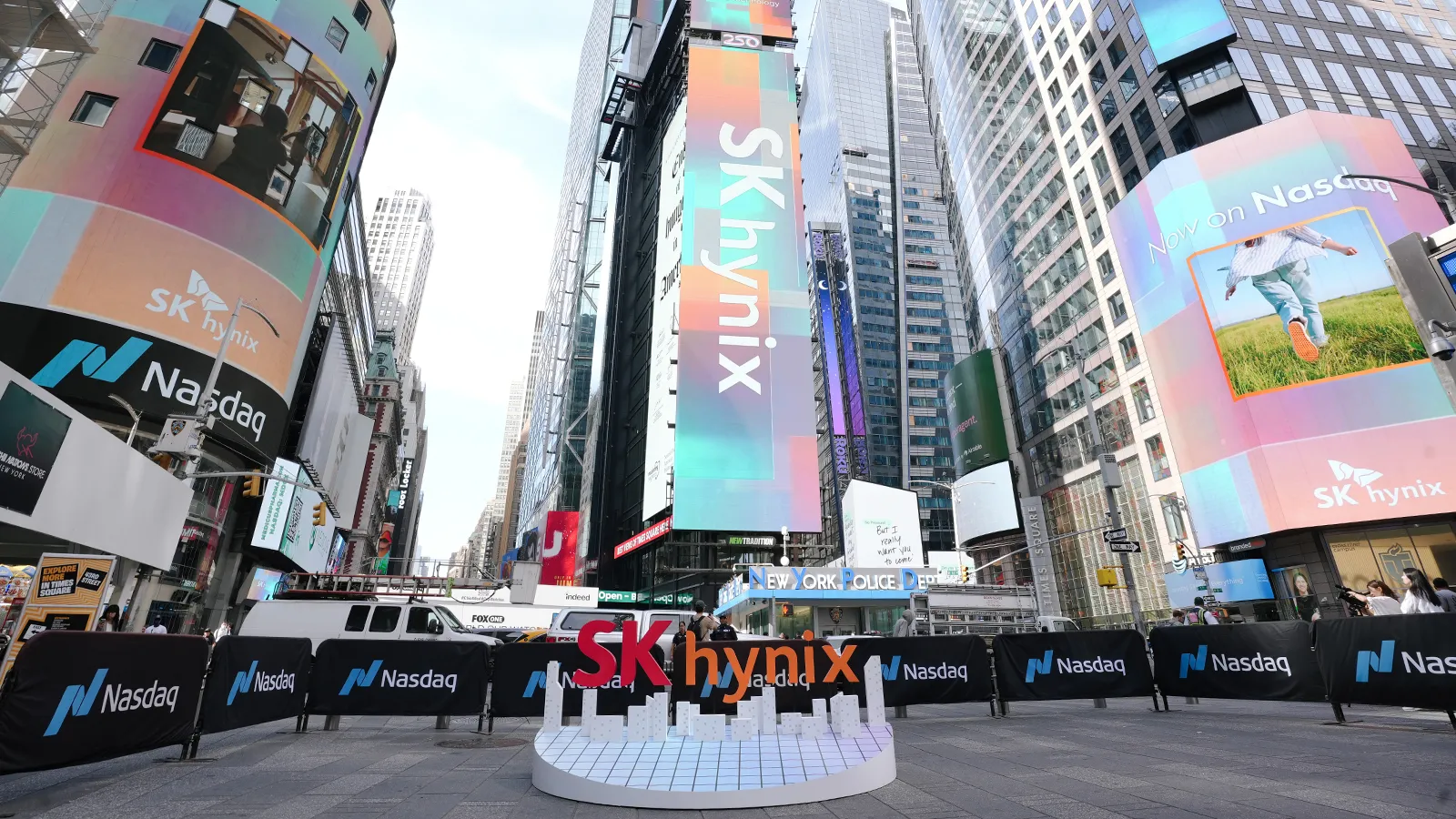
The global artificial intelligence hardware boom reached a historic milestone on Wall Street as South Korean memory chip manufacturing giant SK Hynix completed a massive $26.5 billion U.S. market debut. This landmark financial event represents the largest-ever U.S. market entry by a non-American company, shattering long-standing records and decisively outperforming Alibaba Group’s legendary $25 billion initial public offering in 2014. The transaction underscores the absolute criticality of advanced semiconductor components in the current technological landscape, where AI infrastructure spending continues to scale exponentially.
The triumphant U.S. trading commencement on the Nasdaq exchange highlights a profound shift in investor sentiment toward semiconductor manufacturers, particularly those deeply embedded in the generative artificial intelligence supply chain. By capitalizing on an unprecedented surge in demand for high-bandwidth memory, SK Hynix has successfully bypassed historical valuation hurdles that have traditionally depressed the stock prices of South Korean corporations on the global stage.
Structure and Mechanics of the Record-Breaking Offering
SK Hynix structured its monumental U.S. market debut by offering 177.9 million American Depositary Receipts (ADRs) at a precise price of $149 per share. The financial vehicle was meticulously engineered to allow U.S.-based institutional and retail investors to participate easily, pricing each ADR at roughly one-tenth of the cost of a full common share traded on the Korea Stock Exchange in Seoul.
Despite pricing these international shares at a 2.7% premium relative to its three-day average back home in Seoul, investor appetite proved to be astonishingly robust. Financial reports indicate that the offering was more than seven times oversubscribed, reflecting an insatiable global demand for direct exposure to the AI hardware ecosystem. When trading commenced under the temporary ticker symbol SKHYV, the stock immediately surged 14% above its initial public offering price, maintaining an upward trajectory through early trading sessions. The temporary ticker is scheduled to transition to the permanent symbol SKHY upon the full settlement of regular trading operations.
This enthusiastic reception stands in sharp contrast to the prevailing market phenomenon known as the "Korea Discount." For decades, financial analysts have applied a valuation discount to South Korean equities compared to their global peers, citing structural complexities such as intricate corporate governance frameworks, historically lower shareholder returns, lingering regulatory uncertainties, and the constant geopolitical shadow cast by North Korea. However, SK Hynix has effortlessly shrugged off these systemic concerns, proving that specialized technological dominance can completely override regional market discounts.
The Critical Role of High-Bandwidth Memory in the AI Revolution
The driving force behind SK Hynix’s extraordinary market valuation is its undisputed leadership in the production of high-bandwidth memory, commonly known as HBM. As artificial intelligence models grow exponentially in parameter size and complexity, standard memory architectures have proven insufficient to handle the staggering data throughput required by modern processors. HBM serves as an indispensable foundational component for advanced AI graphics processing units (GPUs).
Currently, market titan Nvidia relies heavily on SK Hynix as one of its primary, mission-critical suppliers of these advanced memory stacks. Without a reliable and voluminous supply of HBM, the production bottlenecks for high-performance AI accelerators would severely throttle the global expansion of artificial intelligence infrastructure. Consequently, institutional investors view SK Hynix not merely as a traditional memory cyclical play, but as an irreplaceable linchpin of the twenty-first-century digital economy.
Strategic Deployment of Capital and Manufacturing Expansion
Management at SK Hynix has moved swiftly to outline the precise allocation of the staggering $26.5 billion amassed from the U.S. public markets. According to regulatory filings submitted to financial authorities, the capital infusion will be funneled directly into three core infrastructural pillars designed to alleviate the worldwide semiconductor shortage:
- Advanced Fabrication Facility: The construction of a massive new semiconductor manufacturing fab in South Korea, specifically engineered to expand production lines dedicated to cutting-edge memory architectures.
- Advanced Packaging Facility: The establishment of a specialized packaging plant within South Korea to address the intricate technical demands of stacking and interconnecting modern high-bandwidth memory solutions.
- Extreme Ultraviolet (EUV) Technology: The procurement and installation of state-of-the-art Extreme Ultraviolet lithography scanners, the ultra-precise optical machines required to manufacture next-generation semiconductor nodes.
These strategic investments arrive at a critical juncture for the industry. Both major South Korean memory manufacturers—SK Hynix and its domestic rival Samsung—recently shocked global markets by collectively pledging more than $550 billion in domestic manufacturing investments aimed at easing the chronic global memory shortages colloquially referred to by industry insiders as "RAMageddon."
Geopolitical Pressures and the Push for Onshore U.S. Production
Even as SK Hynix celebrates its triumphant entry into American capital markets, the geopolitical landscape surrounding semiconductor manufacturing is undergoing intense scrutiny from Washington. On the eve of the public offering, U.S. Commerce Secretary Howard Lutnick addressed industry leaders during a high-profile event hosted by Micron Technology, one of SK Hynix’s foremost global competitors.
Secretary Lutnick conveyed an unambiguous message regarding the geographical concentration of advanced semiconductor manufacturing. Reports indicate that the Commerce Department is already engaged in active high-level negotiations with both Samsung and SK Hynix, strongly urging the South Korean conglomerates to establish and expand heavy-duty memory production facilities directly on U.S. soil. The strategic objective of the United States government is to reduce systemic dependency on East Asian manufacturing hubs for critical national security and economic infrastructure.
American memory maker Micron is already leading by example in this arena. The company recently reaffirmed its massive commitment to domestic manufacturing, announcing plans to pour an astounding $250 billion into new U.S.-based fabrication facilities. According to projections released by Micron, this multi-decade investment initiative is expected to generate upwards of 90,000 high-paying jobs while ensuring that leading-edge semiconductor production remains firmly anchored within American borders.
Market Implications and Industry Outlook
The staggering success of SK Hynix’s U.S. market debut signals a profound maturation of the artificial intelligence investment cycle. Wall Street has demonstrated that it is willing to break historical valuation molds for foreign corporations that hold monopolistic or oligopolistic control over vital technological choke points.
As the global race for artificial intelligence supremacy accelerates, the spotlight will remain fixed on how efficiently SK Hynix deploys its unprecedented capital war chest. The delicate balance between domestic manufacturing expansion in South Korea and mounting political pressure from Washington to localize supply chains will undoubtedly shape the semiconductor landscape for the remainder of the decade. For now, however, SK Hynix stands triumphant at the epicenter of the global tech economy, having permanently altered the playbook for international tech listings on major American exchanges.
