

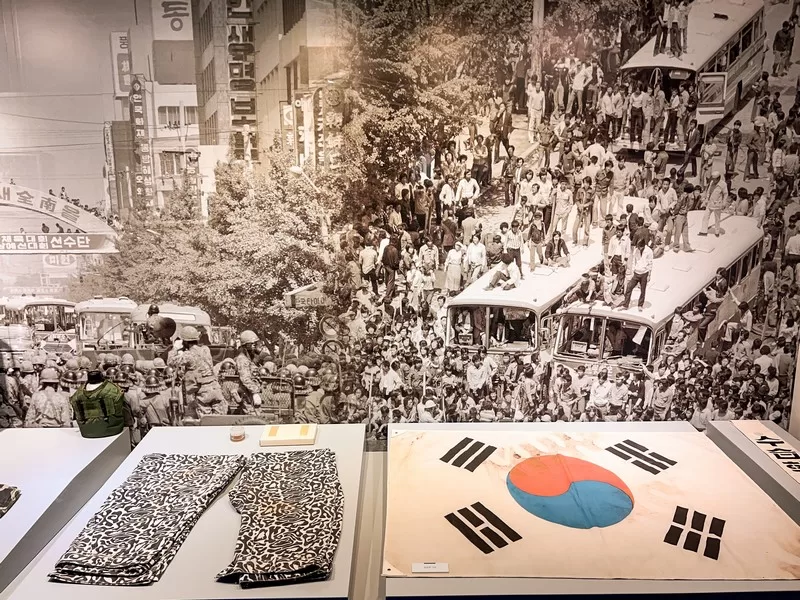
The 5.18 Democratization Movement Archives, located along the historic thoroughfare of Geumnam-ro in Gwangju, South Korea, stands as an institutional cornerstone dedicated to preserving the documentation, testimonies, and collective memory of the May 1980 Gwangju Uprising. Recognized internationally for its profound historical value—including its inclusion in the UNESCO Memory of the World Register—the archive captures a pivotal ten-day period of civil resistance against military dictatorship that fundamentally shaped modern South Korean democracy. Through primary sources, photographic evidence, declassified government records, and victim statistics, the institution maintains a rigorous factual record of a watershed moment in contemporary East Asian political history.

Background Context and Political Climate of 1980
The roots of the May 1980 uprising trace back to a volatile period of political transition following the assassination of authoritarian President Park Chung-hee on October 26, 1979, after nearly two decades of absolute rule. While civil society and pro-democracy student movements anticipated a transition toward a representative government, a faction of military officers led by Major General Chun Doo-hwan orchestrated a military coup on December 12, 1979, effectively seizing control of the military apparatus.

Throughout the spring of 1980, nationwide demands for political reform, the lifting of emergency decrees, and the establishment of direct presidential elections intensified. In response, the military-dominated government enacted sweeping repressive measures. On May 17, 1980, the military expanded martial law nationwide, shuttering universities, banning political gatherings, and arresting prominent opposition leaders, student activists, and journalists. These actions set the stage for direct confrontation in Gwangju, the capital of South Jeolla Province and a historic center of regional activism.
Chronology of the Ten-Day Uprising (May 18–27, 1980)

The confrontation began on the morning of May 18, 1980, when students gathered outside Chonnam National University and were met by elite paratrooper units deployed under martial law. Initial skirmishes involved disproportionate military force, with troops using bayonets and batons against unarmed students and civilian bystanders.
As news of the violence spread across the city, ordinary citizens—including workers, taxi drivers, merchants, and teenagers—joined the demonstrations, transforming localized student protests into a mass civic uprising. The critical escalation occurred on May 21, when martial law troops opened direct fire on crowds gathered in front of the South Jeolla Provincial Office on Geumnam-ro. Faced with lethal military suppression, citizens from Gwangju and surrounding municipalities traveled to nearby police stations and reserve armories to secure firearms for self-defense.

Following the withdrawal of military forces from central Gwangju on May 21, the city entered a brief period of autonomous self-governance lasting from May 22 to May 26. During this period, often referred to by historians as a community of mutual responsibility, citizens organized administrative committees, maintained public order, managed traffic, operated broadcasting vehicles, and established blood donation drives to supply overwhelmed hospitals. Concurrently, local publishing efforts such as the newsletter Tusahoebo emerged to counter state-imposed media blackouts.
The autonomous period ended in the early hours of May 27, when heavily armed martial law forces launched Operation Sangmu to retake central Gwangju. Supported by armor and infantry, military units secured the Provincial Office, the YWCA, and surrounding strongholds within hours, effectively bringing the ten-day uprising to a bloody conclusion.

Casualties and Statistical Documentation
Official figures compiled by the 5.18 Archives and related investigative bodies provide precise empirical data regarding the human toll of the military crackdown. Archive records confirm at least 166 civilian deaths during the May 21 shootings, with 135 fatalities resulting directly from gunshot wounds. Statistical analysis of the casualties reveals that the vast majority of victims were ordinary citizens rather than armed combatants: nearly 50 percent were in their twenties, and over 24 percent were teenagers, spanning occupations including high school students, factory workers, drivers, and service employees. An additional 25 individuals were killed during the final military assault on May 27. Total estimates compiled by advocacy groups and subsequent government investigations suggest higher overall figures, accounting for disappearances and unreported deaths.

Censorship, Media Suppression, and International Reporting
During the uprising, the military government enforced strict censorship through the Security Command, restricting domestic media outlets from reporting accurate casualty figures or military aggression. State-run and regional broadcasters frequently characterized the demonstrators as communist rioters or violent criminals, leading to public anger directed at media infrastructure, including the burning of the Gwangju MBC and KBS buildings.

Despite domestic isolation, international journalists succeeded in documenting the military atrocities. German journalist Jürgen Hinzpeter, alongside reporters from international wire services such as the Associated Press and The New York Times, captured visual evidence of the violence and transmitted reports abroad. Hinzpeter’s documentation, later depicted in media such as the 2017 feature film A Taxi Driver, proved instrumental in alerting the international community to the gravity of the human rights violations occurring in South Korea.
Post-Uprising Repression, Investigation, and Legal Outcomes

In the aftermath of May 1980, the authoritarian regime of Chun Doo-hwan systematically suppressed public mourning and categorized the uprising as an illegal rebellion. Families of victims faced intense surveillance, job blacklisting, and harassment. Attempts by the government to relocate graves from the Mangwol-dong cemetery were met with fierce resistance from grieving families and civil rights activists.
The political landscape shifted following the June Democratic Uprising of 1987, which forced the authoritarian regime to concede to direct presidential elections and initiate parliamentary inquiries into the events in Gwangju. Televised National Assembly hearings in 1988 and 1989 exposed the extent of military violence and government deception to the national public.

A historic turning point occurred in 1995 with the enactment of special legislation allowing the prosecution of those responsible for the December 12 military coup and the Gwangju massacre. On April 17, 1997, the Supreme Court of South Korea upheld criminal convictions against former leaders Chun Doo-hwan and Roh Tae-woo for military rebellion and insurrection. The judicial ruling fundamentally redefined the legal status of the uprising, formally recognizing the actions of Gwangju citizens as a legitimate exercise of sovereignty to defend the constitutional order against military usurpation.
Institutional Structure of the 5.18 Democratization Movement Archives

Opened to preserve the primary documentation of these events, the 5.18 Archives operates as both a museum and a research center. Its permanent exhibitions are categorized into three core thematic zones:
- Struggle: This section presents a chronological account of the events leading up to May 18, the deployment of military force, civilian resistance, and the formation of the self-governing community. It relies heavily on contemporaneous photographs, personal effects, and survivor testimony.
- Documentation and Records: This hall houses official government documents, declassified American records donated by investigative journalists, victims’ belongings, underground publications, and foreign media reports. It places the Gwangju Uprising within a broader historical continuum of Korean democratization movements, including the April 19 Revolution and the June Democratic Uprising.
- Global Heritage: This comparative exhibition contextualizes the Gwangju archival collection alongside international documents concerning human rights struggles, such as the Magna Carta, New Zealand women’s suffrage records, and documents from Nelson Mandela’s trial.
Broader Impact and Implications for Modern South Korea

The preservation of the Gwangju archival records has had profound implications for contemporary South Korean political culture. The events of May 1980 established a precedent for civic mobilization against perceived authoritarian overreach. Observers note that public sensitivity to terms such as "martial law" and active public demonstrations in response to political crises reflect the enduring cultural memory of the Gwangju Uprising.
Through its physical proximity to other historic sites—including Jeonil Building 245, which retains 245 bullet marks from military helicopter gunfire, and the restored former South Jeolla Provincial Office—the archive serves as an active research institution rather than a static memorial. Its recognition by UNESCO underscores its universal significance as a testament to the preservation of historical truth and the defense of democratic governance against state violence.
