

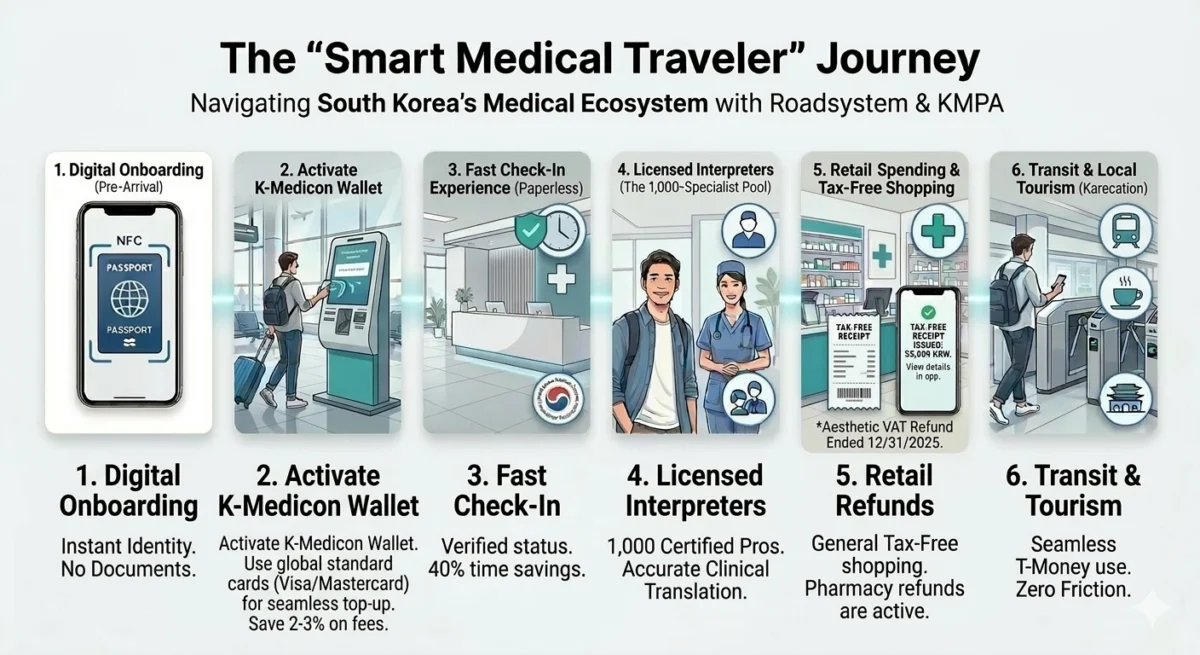
Landing at Incheon International Airport in 2026 offers international travelers a vastly streamlined entry into South Korea’s medical and wellness landscape. Passengers no longer need to navigate the historical bureaucratic friction that once defined international medical travel—such as hauling physical passports to every clinical consultation, facing card declines at specialized pharmacies, or struggling through complex language barriers during critical healthcare discussions. Instead, a traveler’s smartphone immediately transitions into a multi-functional digital instrument: acting seamlessly as a medical identity, a secure financial wallet, and an instant key to tax-free retail shopping.
This transformation became official on March 10, 2026, when fintech innovator Roadsystem and the Korea Medical Tourism Promotion Association (KMPA) executed a landmark strategic alliance. This high-profile partnership establishes a new digital tourism infrastructure, effectively merging advanced healthcare services with frictionless consumer tourism. By dismantling decades-old administrative hurdles, South Korea is setting a progressive benchmark for global medical hubs, redefining how international patients experience clinical care abroad.
Dismantling the Traditional Broker System and Ensuring Price Transparency
For years, the multi-billion-dollar South Korean medical tourism industry operated under a fragmented intermediary model. Independent brokers and third-party agencies served as the primary communication and logistics link between foreign patients and top-tier hospitals, particularly in major hubs like Seoul’s Gangnam district. While these brokers facilitated initial connections, the ecosystem suffered from systemic issues, including a glaring lack of price transparency, high hidden commissions, and inconsistent quality control. Patients frequently found themselves vulnerable to inflated costs and uneven administrative support.
Recognizing the urgent need for modernization, the Roadsystem and KMPA alliance was engineered to eliminate these predatory middlemen. By shifting the foundation of trust from human brokers to an immutable digital rail, the initiative ensures absolute transparency.
"We will build a new digital tourism infrastructure model that connects medical services with tourism consumption," stated Yang-ho Jang, Chief Executive Officer of Roadsystem, during the formal signing ceremony.
This structural overhaul ensures that prospective patients interact directly with verified medical institutions, safeguarding their financial investments and elevating the overall standard of care.
The Technological Core: TripPASS and Mobile eKYC Integration
At the center of this digital paradigm shift is the TripPASS platform, a regulatory-compliant identity solution engineered by Roadsystem. Rather than serving as a standard payment utility, TripPASS utilizes patented mobile-passport electronic Know Your Customer (eKYC) technology. International visitors can securely verify their legal identity using only their smartphones, effectively replacing physical passports during clinic registrations and hospital admissions.
This robust digital security layer complies strictly with South Korea’s stringent Personal Information Protection Act (PIPA). Healthcare data privacy remains a paramount concern when integrating medical records with financial infrastructure. By employing government-standard eKYC encryption, the platform ensures that sensitive patient metrics are safely isolated, preventing unauthorized access while facilitating instant administrative clearance at participating clinics.
The removal of physical document requirements lays the structural groundwork for "Karecation"—a rapidly expanding travel model that blends high-end medical procedures with leisure tourism. Patients can transition smoothly from postoperative recovery to cultural exploration without carrying sensitive paperwork across provincial borders.
The K-Medicon Card: Solving the Last-Mile Payment Puzzle
A critical innovation emerging from the Roadsystem-KMPA collaboration is the deployment of the K-Medicon Card. Functioning as a prepaid financial instrument operating on the TripPASS network, the card handles a comprehensive array of consumer expenses, including hospital bills, retail shopping, public transit, and dining.
Historically, international patients faced persistent financial hurdles when attempting to settle bills at smaller neighborhood pharmacies or specialized aesthetic clinics. Foreign credit cards frequently triggered steep cross-border transaction fees or were flatly rejected by domestic payment gateways that required local resident registration numbers. The K-Medicon Card bypasses these barriers by operating directly on local payment rails, granting foreign visitors the same transactional efficiency as native South Korean citizens.
Furthermore, the card integrates an automated, immediate mobile tax-refund system. Foreign patients making medical and retail purchases at participating pharmacies can receive Value-Added Tax (VAT) refunds directly through their mobile devices at the point of sale. This technological integration entirely removes the necessity of waiting in protracted, multi-hour queues at airport tax-refund kiosks prior to departure.
Scaling Human Support: The Expansion of Medical Interpreter-Coordinators
While advanced financial technology and digital identity verification streamline logistics, healthcare delivery remains an inherently human enterprise requiring deep empathy, clarity, and trust. Recognizing that digital applications cannot entirely replace human communication during complex surgical consultations, the Seoul Metropolitan Government and KMPA have initiated a massive workforce expansion.
To support the influx of digitally enabled medical tourists, authorities are scaling the pool of certified medical interpreter-coordinators tenfold. The strategic objective is to deploy 1,000 certified, highly trained bilingual professionals across major medical facilities by the conclusion of 2026.
These specialists undergo rigorous training programs that extend far beyond conversational translation. They function as comprehensive medical guides, accompanying patients from initial digital consultation bookings through clinical procedures and post-operative recovery protocols. By ensuring patients fully comprehend complex surgical risks, pharmacological instructions, and rehabilitation schedules, the initiative mitigates clinical malpractice risks and enhances patient satisfaction.
Chronology of Reform and Strategic Implementation
The convergence of fintech and healthcare tourism in South Korea did not happen overnight; it represents the culmination of a multi-year national strategy to capture a larger share of the global wellness economy.
- 2023–2024 (Post-Pandemic Rebound): Following the global relaxation of travel restrictions, South Korea experienced an unprecedented surge in medical tourism, shifting from traditional cosmetic surgery to comprehensive wellness, dermatology, and preventative health screenings.
- Mid-2025: Regulatory frameworks surrounding mobile passports and eKYC authentication matured, allowing fintech firms to legally integrate identity verification systems with national health databases under controlled sandbox environments.
- March 10, 2026: Roadsystem and the Korea Medical Tourism Promotion Association formally execute their strategic alliance, introducing the unified K-Medicon Card and TripPASS integration.
- Throughout 2026: KMPA rolls out comprehensive training initiatives for medical administration staff across Gangnam and surrounding districts to ensure seamless backend adoption of the K-Medicon payment and verification apparatus.
- Late 2026 Target: Deployment of 1,000 certified medical interpreter-coordinators across Seoul to support the rising volume of international healthcare visitors.
Addressing Real-World Challenges and Last-Mile Adoption
Despite the technological sophistication of the K-Medicon initiative, scaling the ecosystem across South Korea presents distinct operational obstacles. The most prominent hurdle is achieving "last-mile adoption." While premier medical centers in Seoul’s Gangnam and Mapo districts possess the digital infrastructure to immediately integrate the K-Medicon backend, smaller provincial clinics and independent community pharmacies require significant technical upgrades.
To combat this fragmentation, KMPA’s 2026 roadmap prioritizes intensive on-site training sessions and software deployment assistance for medical staff. Technicians are actively working with independent pharmacies to ensure their point-of-sale terminals are fully compatible with the TripPASS rail, guaranteeing that patients experience zero friction regardless of where they fill their prescriptions.
Additionally, data sovereignty and cybersecurity remain critical focal points. Given the cross-border nature of international patients, maintaining strict adherence to PIPA while enabling future interoperability with foreign health insurance databases requires continuous system auditing and encryption enhancements.
Global Implications and Future Outlook
The partnership between Roadsystem and the Korea Medical Tourism Promotion Association establishes a compelling blueprint for other global medical tourism destinations, including Bangkok, Dubai, and Singapore. By successfully resolving the dual complexities of secure digital identity verification and localized financial settlement, South Korea has constructed a robust "trust layer" for both healthcare providers and international consumers.
Hospitals benefit from guaranteed, instantaneous payments, dramatically reduced administrative overhead, and minimized paper processing. Concurrently, patients enjoy the peace of mind afforded by a government-backed, highly secure regulatory framework.
As the digital ecosystem continues to mature over the coming years, industry analysts anticipate further integration with international health insurance providers, paving the way for direct-billing capabilities for global policies. Through this seamless marriage of financial technology and clinical excellence, South Korea has firmly established that it is no longer merely a destination for isolated medical procedures, but the pioneer of a fully integrated, world-class healthcare travel experience.
