

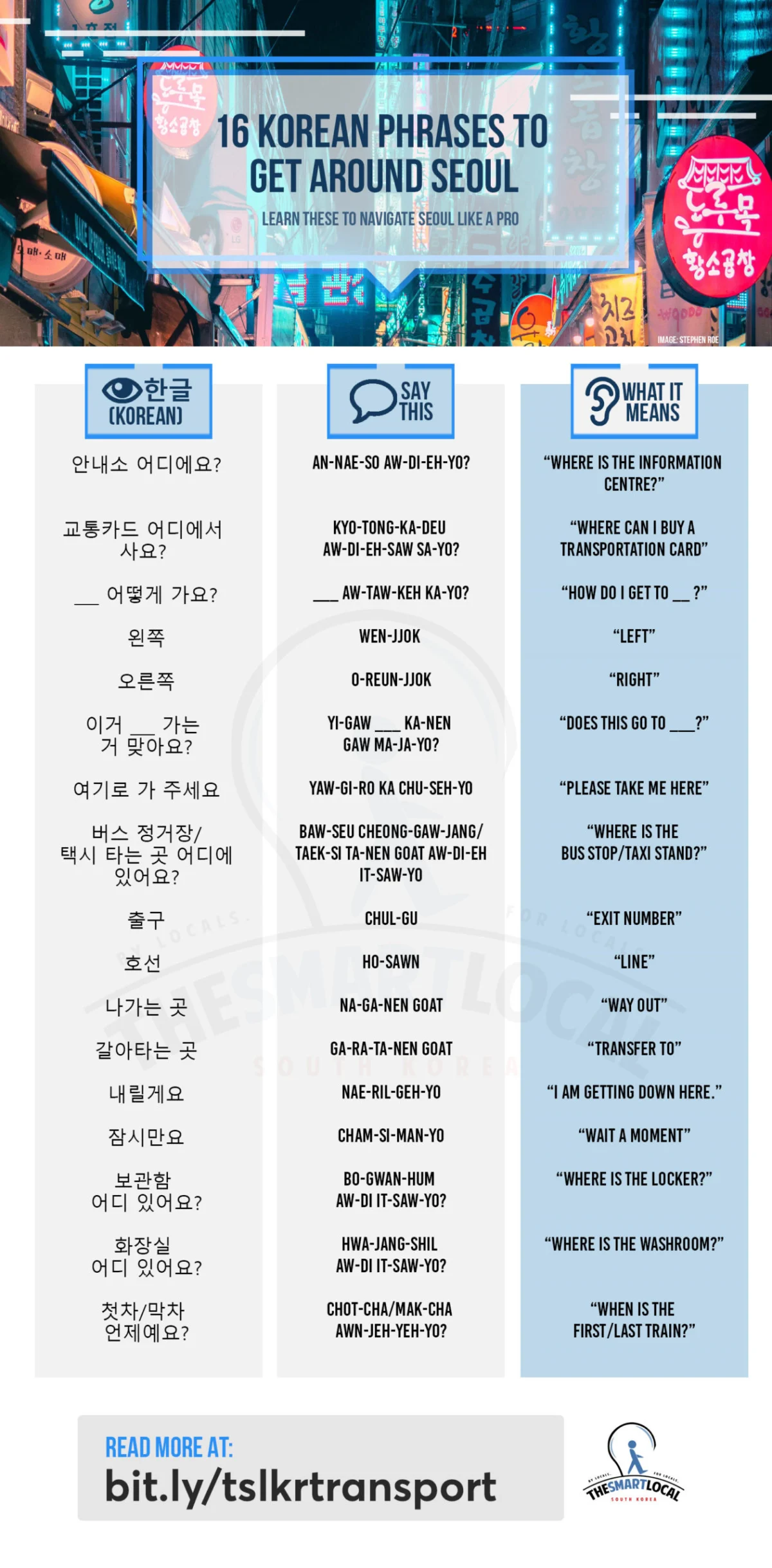
Seoul’s public transportation system is widely regarded as one of the most efficient, clean, and comprehensive networks in the world. Serving over 10 million residents and millions of annual international visitors, the metropolitan transit infrastructure—comprising an expansive subway system, a complex web of bus routes, and high-speed rail links—is the backbone of the South Korean capital’s mobility. However, for the first-time traveler, the sheer scale of the network, combined with the linguistic barrier of Hangeul, can transform a simple commute into a logistical challenge.

As the South Korean tourism sector continues to rebound, reaching pre-pandemic levels of international arrivals, government authorities and transit operators have ramped up efforts to improve accessibility. Despite the integration of English signage and digital maps, linguistic competency remains a primary friction point for tourists. Mastering a foundational set of Korean transit phrases is no longer just a cultural exercise; it has become a practical necessity for navigating the city’s intricate tunnels and transit hubs.

The Evolution of Seoul’s Transit Accessibility
The history of Seoul’s public transport is a story of rapid modernization. The Seoul Metropolitan Subway, which first opened its doors in 1974 with a single line, has expanded into a massive labyrinth of 23 lines covering over 1,000 kilometers of track. Historically, the transit system was designed purely for local commuters. It was not until the 1988 Seoul Olympics that the city began a significant push toward bilingual signage.

Today, the Korea Transport Institute (KOTI) notes that while 95% of major subway stations offer English-language information, the "last-mile" navigation—finding specific exits, locating bus stops in less-developed districts, or managing station transfers during peak hours—continues to frustrate non-Korean speakers. Data from the Seoul Metropolitan Government indicates that during the 2023 fiscal year, over 2.5 billion passenger trips were recorded, highlighting the critical need for clear, multilingual communication.

Navigating the Language Barrier: Essential Communication
When navigating the city, the ability to engage with transit staff or fellow commuters can mean the difference between a seamless journey and a missed connection. Language experts and local tourism boards suggest that while English is widely taught in Korean schools, many citizens may feel hesitant to initiate conversations in a foreign language. Consequently, learning key phrases in Korean acts as a "social lubricant" that encourages locals to offer assistance.

1. Inquiries at Information Centers
The "Information Center" (Annaeso) serves as the primary point of contact for international travelers. Asking "Annaeso eodieyo?" (Where is the information center?) is the most effective way to secure a physical map or receive specific instructions. Station staff are professionally trained to provide assistance, and they often possess the most current information regarding service disruptions or construction projects that may not yet be updated on digital platforms.

2. Mastering the T-Money Infrastructure
The T-Money card is the standard for fare payment in Seoul. It functions as a universal "smart" ticket for subways, buses, and even taxis. Travelers often struggle to find vending machines at Incheon International Airport due to the distance between the arrival hall and the subway platform. Asking "Gyotongkadeu eodieseo sayo?" (Where can I buy a transportation card?) at an information booth can save travelers valuable time, preventing the stress of navigating transit gates without a valid fare method.

3. Directional Queries and Destination Navigation
While digital navigation tools like Naver Maps and KakaoMap are superior to Google Maps in the Korean region, physical navigation remains essential. The phrase "[Destination] eotteoke gayo?" (How do I get to [Destination]?) allows for a direct query. When asking, it is recommended that travelers carry a card or printout of their destination in Hangeul, as this reduces the potential for misinterpretation of English pronunciations.

Tactical Communication for Bus and Subway Travel
Seoul’s bus system is famously fast but can be intimidating due to the speed of traffic and the brevity of stops. Unlike subway systems where platforms are fixed, bus stops can be inconspicuous, marked only by a small sign. If a traveler is unsure of a route, confirming with the driver—"Igeo [Destination] ganeun geo majayo?" (Does this go to [Destination]?)—is a standard safety measure.

Furthermore, the etiquette of the "bus culture" requires passengers to signal their intention to alight well in advance. In crowded conditions, the stop button may be physically inaccessible. In such cases, shouting "Naerilgeyo!" (I am getting off here!) is not considered rude; rather, it is a necessary communication to ensure the driver keeps the doors open long enough for a safe exit.

Deciphering the Labyrinth: Subway Signage
For the uninitiated, the subway signage at major interchanges like Seoul Station or Gangnam Station can appear overwhelming. These hubs act as convergence points for the KTX, ITX, and multiple subway lines.

- Chulgu (Exit Number): Essential for finding the specific street exit.
- Hoseon (Line): Crucial for identifying the correct platform.
- Naganeun got (Way Out): Directs passengers toward the street level.
- Garataneun got (Transfer to): Indicates the route toward a different subway line.
Understanding these four terms significantly lowers the cognitive load of navigating stations that span several subterranean levels.

Broader Impact and Economic Implications
The economic impact of a user-friendly transit system is profound. According to a 2022 report by the Korea Tourism Organization, tourists who feel confident in navigating local public transport are 30% more likely to visit attractions outside of the traditional central districts (such as Myeong-dong or Gwanghwamun). By encouraging travel to peripheral areas, the city effectively distributes the economic benefits of tourism to local small businesses and traditional markets.

Furthermore, from a policy perspective, the Seoul Metropolitan Government has emphasized that "Smart City" initiatives, which include digital kiosks and AI-powered transit assistants, will continue to supplement—not replace—human interaction. The emphasis remains on the "human touch," where local knowledge remains the most reliable source of information during unforeseen circumstances, such as sudden weather-related delays or holiday service adjustments.

Expert Advice for the Modern Traveler
Travel logistics experts emphasize that preparation is the primary antidote to "travel anxiety." Beyond learning the phrases, travelers are encouraged to keep a physical copy of their itinerary, including the address of their accommodation in Korean, as a contingency for device failure.

Ultimately, the goal of learning these phrases is to empower the visitor. While the pronunciation may not always be perfect, the attempt to communicate in the local language is consistently met with respect and helpfulness by the South Korean public. By bridging the gap between the visitor and the infrastructure, these 16 key phrases transform the experience of the Seoul subway and bus system from a daunting obstacle into a gateway for authentic urban exploration. As Seoul continues to evolve as a global tourism hub, the ability to navigate its veins—the public transport network—will remain a vital skill for every traveler.
