

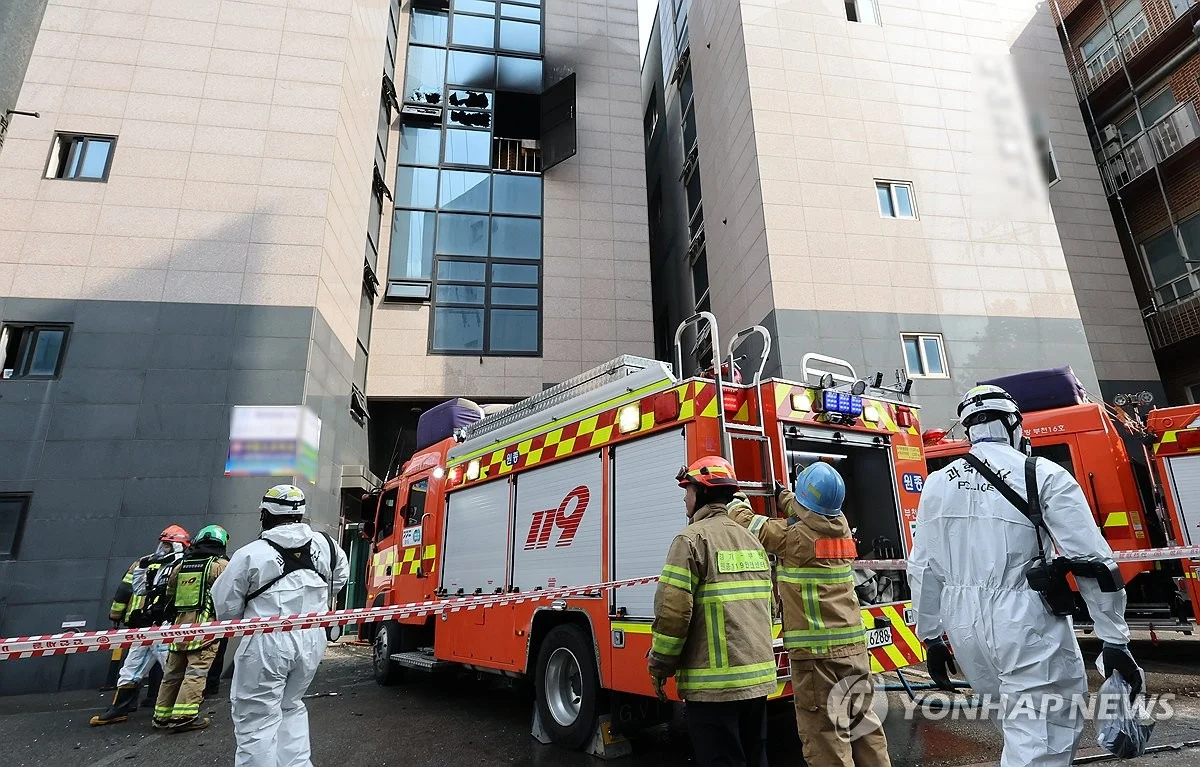
A major industrial fire erupted on the morning of Friday, October 16, at a four-story metalworking facility in Bucheon, a bustling industrial hub located just west of Seoul. The incident, which prompted a massive emergency mobilization, resulted in a critical medical emergency for one firefighter and left seven other individuals, including additional first responders and factory staff, injured. The blaze, which tore through the structure for over two hours, has once again brought to the forefront the persistent safety challenges faced by aging industrial zones in the Seoul Metropolitan Area.
The fire was first reported at 8:38 a.m. local time. By the time emergency crews arrived, smoke was already billowing from the upper levels of the facility, which contained a significant volume of volatile metalworking fluids and flammable materials. The intensity of the inferno required a coordinated response from multiple fire stations in the Gyeonggi Province region, deploying dozens of trucks and aerial ladders to prevent the fire from spreading to adjacent industrial properties.
Chronology of the Emergency Response
The rapid escalation of the fire necessitated an immediate and high-stakes rescue operation. According to fire department logs, the following timeline reconstructs the events as they unfolded:
- 08:38 a.m.: The first distress call was received by the Bucheon Fire Station, reporting smoke emanating from the metalworking factory.
- 08:45 a.m.: Initial fire units arrived on the scene and began establishing a perimeter. Firefighters were immediately deployed inside the structure to locate potential occupants.
- 09:15 a.m.: The fire reached a high-intensity phase, with heat levels inside the factory rising significantly due to the presence of flammable chemical solvents and metal shavings.
- 09:40 a.m.: During the interior suppression efforts, one firefighter collapsed due to suspected heat exhaustion leading to cardiac arrest. A mayday call was issued, and a specialized medical team was dispatched to extract him.
- 10:30 a.m.: Fire authorities managed to contain the primary blaze, preventing it from breaching the roof and spreading to nearby warehouses.
- 11:06 a.m.: The fire was officially declared fully extinguished. Investigators and cooling-down crews commenced the site safety sweep.
The firefighter who suffered cardiac arrest was stabilized on-site by paramedics before being transported to a regional trauma center in critical condition. As of Friday afternoon, he remains under intensive care. Two other firefighters were treated for severe injuries sustained during the rescue effort, while four more were treated for heat exhaustion and smoke inhalation. Two factory officials, who were reportedly attempting to initiate internal fire suppression systems before the arrival of the fire department, were also treated for minor injuries.
The Hazards of Metalworking Facilities
Metalworking factories in the Bucheon area, many of which were built during the rapid industrialization period of the 1980s and 1990s, often pose significant fire safety risks. These facilities frequently utilize flammable coolant oils, high-pressure hydraulic systems, and fine metallic dust, which, if ignited, can create "flash fire" conditions.
According to industrial safety data from the Korea Occupational Safety and Health Agency (KOSHA), fires in metal-processing plants are particularly difficult to suppress because standard water-based extinguishing methods can sometimes exacerbate reactions with certain metallic dusts. While authorities have not yet confirmed the exact ignition point, preliminary reports indicate that the storage of highly flammable materials on the lower levels likely contributed to the rapid spread of the fire.
Local safety inspectors have noted that older industrial districts in the Gyeonggi region often struggle with "compartmentalization" issues—where fire-rated walls are either missing or insufficient—allowing smoke and flames to move vertically through ventilation shafts and utility conduits.
Presidential and Official Responses
The severity of the incident triggered an immediate response from the highest levels of government. President Lee Jae Myung, upon receiving briefings from the Ministry of the Interior and Safety, directed all relevant agencies to prioritize the recovery of the injured personnel.
"The government must ensure that every possible medical resource is made available to the injured firefighters," the President stated through his spokesperson, Kang Yu-jung. He further instructed local officials to conduct an immediate and exhaustive safety audit of all similar manufacturing facilities in the Bucheon district to prevent a recurrence of such a disaster.
The President emphasized the need for a "zero-tolerance" approach to fire safety violations, particularly regarding the improper storage of hazardous chemicals. He explicitly urged local governments to review whether the facility had complied with the latest fire safety codes, which were updated following a series of tragic industrial fires over the past five years.
Implications and Future Oversight
The Bucheon fire serves as a sobering reminder of the ongoing struggle to modernize safety protocols in South Korea’s aging industrial base. Experts argue that while technological advancements in firefighting equipment have improved, the human element—specifically the physical toll on first responders—remains a critical point of failure.
"When we look at the statistics of industrial fires, we often focus on property damage and building codes," says Dr. Kim Min-soo, an industrial safety consultant based in Seoul. "However, the primary concern must be the vulnerability of our fire crews. Buildings that house volatile materials require automated fire suppression systems that can activate before a human even enters the building. If those systems are absent or fail, we are asking firefighters to risk their lives in conditions that are essentially death traps."
In the coming weeks, a joint investigation team comprising the Bucheon Police Department, the National Forensic Service, and the local fire marshal’s office will perform a forensic analysis of the site. The investigation will focus on three core areas:
- Ignition Source: Determining whether the fire was caused by an electrical short, a mechanical failure of a lathe or milling machine, or human error.
- Safety Compliance: Verifying if the factory had performed its mandatory annual fire safety inspection and whether the facility’s fire extinguishers and sprinklers were functional.
- Hazardous Material Protocols: Assessing whether the volume of flammable material stored at the facility exceeded legal safety thresholds.
As the community in Bucheon reels from the incident, the focus remains on the recovery of the first responders who placed themselves in harm’s way. The event is expected to accelerate legislative discussions regarding the enforcement of stricter fire safety penalties for small and medium-sized enterprises (SMEs) that fail to upgrade their safety infrastructure.
For the residents of Bucheon, the day was marked by the persistent wail of sirens and the thick, acrid smell of burnt plastic and industrial lubricant. As investigators continue to sift through the charred remains of the factory, the broader implications of this fire will undoubtedly influence future industrial policy. The incident is a stark illustration of the tension between economic productivity and the essential requirement for safe working environments in a modern, industrialized society. The government’s pledge to conduct a thorough investigation is viewed as a necessary first step, but labor unions and safety advocates are already calling for more proactive measures, including increased funding for local fire departments and stricter, more frequent inspections of high-risk industrial zones.
