

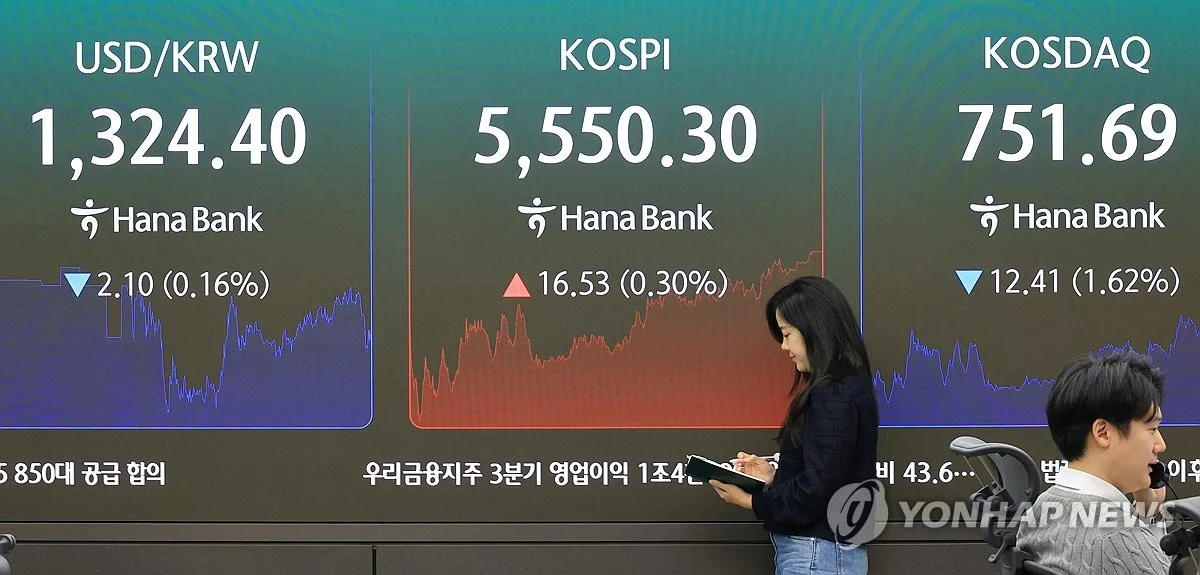
South Korean equities commenced Monday’s trading session on a defensive footing, with the benchmark Korea Composite Stock Price Index (KOSPI) retreating 51.25 points, or 0.92 percent, to settle at 5,499.05 shortly after the opening bell. The downward trajectory reflects a broader climate of investor apprehension as the market prepares for a high-stakes week defined by domestic semiconductor earnings, looming U.S. monetary policy decisions, and persistent volatility in global energy markets. This cautious start follows a turbulent week that saw the KOSPI index shed 2.08 percent, punctuated by aggressive foreign capital outflows and intensified scrutiny of the semiconductor sector’s growth trajectory.
The Convergence of Macroeconomic Headwinds
The current market sentiment is being dictated by a trifecta of pressures: the cooling enthusiasm for high-growth tech stocks, the anticipation of Federal Reserve policy shifts, and the precarious state of Middle Eastern geopolitics. Friday’s session on Wall Street set the tone for Monday’s opening in Seoul, as major U.S. indices retreated under the weight of surging crude oil prices and investor skepticism regarding the immediate profitability of the massive capital expenditures currently being poured into artificial intelligence (AI) infrastructure.
While the KOSPI had managed a modest 0.3 percent gain on Friday, the momentum proved insufficient to offset the week’s significant losses. Foreign institutional investors, who have historically been the primary drivers of South Korean market liquidity, have demonstrated a marked trend toward risk aversion, exacerbating the volatility in blue-chip semiconductor shares. The focus now shifts to the local giants—SK hynix and Samsung Electronics—whose upcoming financial disclosures are viewed as bellwethers for the global AI hardware cycle.
Chronology of Market Turbulence
The current market dip is not an isolated event but rather the latest chapter in a volatile October. To understand the gravity of the current situation, one must look at the recent sequence of events:
- October 20-22: Market participants began pricing in a more hawkish stance from the U.S. Federal Reserve, with yields on U.S. Treasury bonds climbing as expectations for interest rate cuts diminished.
- October 23: Financial data reflected growing anxiety in Seoul, with the Hana Bank dealing room reporting increased selling pressure on tech-heavy indices as investors moved to lock in profits ahead of the quarterly earnings cycle.
- October 24: Regional markets reacted to renewed geopolitical tensions in the Middle East, specifically following comments from U.S. leadership regarding potential military actions against Iran.
- October 25: Wall Street closed lower, confirming a trend of "sell-the-rally" behavior that has defined the tech sector throughout the latter half of the month.
- October 26: The KOSPI opened at 5,499.05, signaling a continued correction as domestic traders aligned their positions with the global sell-off.
The Semiconductor Bellwethers: SK hynix and Samsung Electronics
The eyes of the global investment community are firmly fixed on South Korea this week. SK hynix is scheduled to release its third-quarter earnings on Wednesday, followed by Samsung Electronics on Thursday. These reports are considered essential data points for determining the sustainability of the AI-driven semiconductor boom.
For months, the "AI trade" has been the primary engine of the KOSPI. However, recent reports from global tech firms have suggested a potential "bottleneck" or a cooling in demand for high-bandwidth memory (HBM) chips, which are critical for the training of Large Language Models (LLMs). Investors are looking for concrete evidence in the earnings reports that memory prices remain resilient and that capital investment in AI is yielding the anticipated operational efficiencies.
Analysts at major financial institutions in Seoul have suggested that if these reports fall short of consensus estimates, the index could face further downside pressure. Conversely, positive surprises regarding margins and future guidance could provide the necessary catalyst for a market rebound.
Energy Markets and Geopolitical Risk Factors
The global energy market remains a significant variable. While oil prices showed a slight retreat from the six-month highs seen late last week, the underlying risk premium remains elevated. President Donald Trump’s recent signals regarding a willingness to resume strikes on Iran have introduced a layer of unpredictability into the global supply chain.
South Korea, as an energy-import-dependent economy, is particularly sensitive to fluctuations in crude oil prices. Higher energy costs not only impact the bottom line for domestic manufacturers but also feed into inflationary pressures, potentially complicating the Bank of Korea’s monetary policy path. The correlation between the KOSPI’s performance and energy price volatility has been a recurring theme throughout the fourth quarter, serving as a reminder of the country’s vulnerability to external geopolitical shocks.
Implications for Monetary Policy and Foreign Capital
The looming U.S. Federal Reserve decision is perhaps the most significant macro factor on the horizon. With inflation data showing stickiness in several key sectors of the U.S. economy, the market is bracing for a "higher-for-longer" interest rate environment. For the South Korean market, this presents a dual challenge: it increases the cost of borrowing for domestic firms and incentivizes foreign investors to move capital back into U.S.-denominated assets, thereby placing downward pressure on the Korean won and, by extension, the KOSPI.
Market strategists note that the recent wave of foreign selling is indicative of a broader portfolio rebalancing. As volatility increases, institutional investors are moving toward defensive sectors, away from the high-beta semiconductor and technology stocks that have historically led the Korean market. This shift creates a structural challenge for the KOSPI, as it requires a broader base of domestic retail and institutional buying to stabilize the index.
Economic Analysis: The Path Forward
The fundamental outlook for the South Korean economy remains tethered to global trade dynamics. While the semiconductor sector faces short-term volatility, the long-term demand for high-performance computing components is widely viewed as robust. The current correction, while painful for short-term traders, may be interpreted by some long-term investors as a necessary cooling period that brings valuations back to more sustainable levels.
However, the immediate risk remains the potential for a "liquidity crunch" if the upcoming earnings season fails to provide a clear narrative for growth. The interplay between U.S. fiscal policy, Middle Eastern geopolitical stability, and the tech sector’s output will determine whether the KOSPI can reclaim the 5,500-point threshold or if it is headed for a deeper consolidation phase.
In the coming days, market participants will likely remain on the sidelines until the earnings reports are fully digested. The lack of conviction currently being observed in the trading volume suggests that institutional players are waiting for a clearer signal before committing to large-scale entries. As the market enters the latter half of the week, the focus will transition from the semiconductor earnings to the implications of the Federal Reserve’s guidance on the cost of capital, which will ultimately dictate the risk appetite for the remainder of the year.
The situation in Seoul serves as a microcosmic view of the challenges facing export-oriented economies in the current global climate. With the convergence of high-stakes corporate reporting and a shifting global monetary landscape, the KOSPI is currently navigating one of its most critical periods of the fiscal year. Investors are advised to maintain a focus on cash flow stability and to monitor the geopolitical headlines, as the intersection of these factors will remain the primary driver of market direction in the short-to-medium term.
