

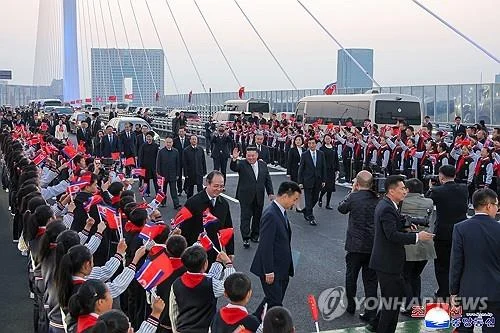
North Korean leader Kim Jong-un concluded a high-profile diplomatic visit to the Chinese border city of Dandong on Saturday, an excursion that served to underscore the enduring, strategic partnership between Pyongyang and Beijing. The state-run Korean Central News Agency (KCNA) confirmed on Sunday that the North Korean leader traveled to the Chinese frontier to pay homage to the sacrifices made by Chinese forces during the 1950-1953 Korean War. This visit, which marked Kim’s first excursion to China since September 2025, comes at a pivotal juncture in regional geopolitics as Pyongyang balances its intensified military cooperation with Moscow against its foundational reliance on Chinese economic and diplomatic support.
The delegation accompanying Kim included a cadre of senior North Korean officials, highlighting the significance of the meeting. Among those present were Jo Yong-won, a member of the powerful Presidium of the Workers’ Party of Korea; Foreign Minister Choe Son-hui; and Kim Yo-jong, the leader’s sister and a key architect of the country’s foreign policy outreach. Upon his arrival, Kim was received by Wang Huning, the fourth-highest-ranking official in the Chinese Communist Party and Chairman of the National Committee of the Chinese People’s Political Consultative Conference. The presence of Chinese Foreign Minister Wang Yi further underscored the gravity of the discussions, which occurred just ahead of the 76th anniversary of China’s entry into the Korean War.
A Diplomatic Bridge: Symbolic and Economic Significance
The logistics of the visit were as symbolic as the rhetoric employed by the leadership. Kim returned to North Korea by traversing the newly inaugurated New Amnok River Bridge—a massive infrastructure project connecting the North Korean city of Sinuiju to Dandong. While construction on the bridge concluded in 2014, the span remained dormant for over a decade due to fluctuating political tensions and economic sanctions. Its recent opening serves as a physical manifestation of the revitalized logistical and economic cooperation between the two neighbors. Standing at the midpoint of the bridge, Kim remarked on the structure’s historic mission to link the two nations, signaling a desire for deeper integration of their respective economies.
During the visit, Kim participated in a series of engagements, including a tribute at a war memorial dedicated to the Chinese People’s Volunteer Army and a visit to a regional bus manufacturing facility in Dandong. These events served to reinforce the narrative of "militant fraternity," a phrase frequently utilized by the North Korean state apparatus to characterize the relationship. Wang Huning, representing President Xi Jinping, conveyed a message emphasizing that the preservation of this friendship remains a cornerstone of China’s regional policy.

Chronology of Kim’s Diplomatic Outreach to China
The relationship between Kim Jong-un and his Chinese counterparts has experienced several distinct phases over the past decade. A brief timeline of significant engagements illustrates the rhythm of this bilateral history:
- 2011: Kim Jong-un assumes power following the death of his father, Kim Jong-il.
- March 2018: Kim makes his first international trip as leader to Beijing, marking the start of a period of rapid diplomatic re-engagement.
- May/June 2018: Subsequent summits in Dalian and Beijing follow as denuclearization talks with the United States gain momentum.
- January 2019: Kim visits Beijing ahead of his second summit with then-U.S. President Donald Trump in Hanoi.
- June 2019: President Xi Jinping makes a historic state visit to Pyongyang, the first by a Chinese leader in 14 years.
- September 2025: Kim travels to Beijing to attend the 80th anniversary of the end of World War II, engaging in extensive bilateral talks with Xi.
- June 2026: President Xi and Kim hold a summit in Pyongyang to map out long-term cooperation in political and economic sectors.
- October 2026: Kim visits Dandong to commemorate the anniversary of China’s entry into the Korean War.
Geopolitical Context: Navigating the Russia-China Axis
Analysts observe that this visit is a carefully calibrated maneuver by Pyongyang. Over the last two years, North Korea has significantly deepened its military ties with Russia, a relationship solidified by the ongoing conflict in Ukraine and the provision of munitions and technology transfers between Moscow and Pyongyang. However, this pivot toward Russia has raised questions regarding the stability of North Korea’s "special relationship" with Beijing.
China remains North Korea’s primary economic lifeline, accounting for the vast majority of its trade and food security. By visiting Dandong, Kim is effectively signaling to Beijing that, despite his blossoming alliance with Moscow, Pyongyang remains committed to the strategic alignment with the Chinese Communist Party. For Beijing, maintaining a stable, albeit sometimes unpredictable, North Korea serves as a critical buffer against the influence of the United States and its regional allies, South Korea and Japan.
The timing of the visit is particularly sensitive given the upcoming Asia-Pacific Economic Cooperation (APEC) summit in China next month. With former U.S. President Donald Trump expected to attend, the regional security landscape is in flux. Trump’s past expressed interest in reopening a dialogue with Pyongyang creates a complex dynamic; Beijing likely views its proximity to Kim as a necessary tool to ensure its voice is heard in any future U.S.-North Korea negotiations.
Strategic Implications and Future Outlook
The visit to the bus factory and the focus on cross-border infrastructure suggest that the talks between Kim and Wang Huning likely covered more than just historical commemoration. Economic cooperation, particularly regarding the relaxation of trade bottlenecks, remains a priority for the North Korean regime as it struggles to overcome the legacy of prolonged sanctions and post-pandemic economic contraction.

While official reports from both the KCNA and Chinese state media remain focused on "traditional friendship," observers in Seoul and Washington are scrutinizing the visit for signs of a shift in regional security posture. The lack of explicit detail regarding discussions on denuclearization or the Korean Peninsula’s security architecture does not necessarily imply their absence from the agenda. Given the heightened tensions involving regional missile testing and military exercises, both Beijing and Pyongyang have a mutual interest in managing regional stability to prevent a conflict that would disrupt their domestic agendas.
Furthermore, the participation of key figures such as Foreign Minister Choe Son-hui suggests that the meetings involved high-level discussions on diplomatic strategy. As the international community watches for the next developments in the U.S.-China-North Korea triangle, the Dandong visit serves as a reminder that the "blood-forged" ties between Beijing and Pyongyang continue to serve as the bedrock of North Korean survival.
Ultimately, Kim Jong-un’s return to the border is a statement of continuity. By emphasizing his country’s historical and ideological ties to China, the North Korean leader is attempting to insulate his regime from the uncertainties of a shifting global order. Whether this visit leads to a concrete increase in Chinese economic aid or a more coordinated approach to dealing with the West remains to be seen, but the optics of the weekend in Dandong have effectively reinforced the North’s position as a central, if contentious, actor in the regional security calculus of East Asia. As the winter season approaches, the opening of the New Amnok River Bridge stands as a literal and metaphorical symbol of a renewed attempt to facilitate the flow of goods, people, and political influence between the two nations, securing North Korea’s strategic depth in a volatile international environment.
