

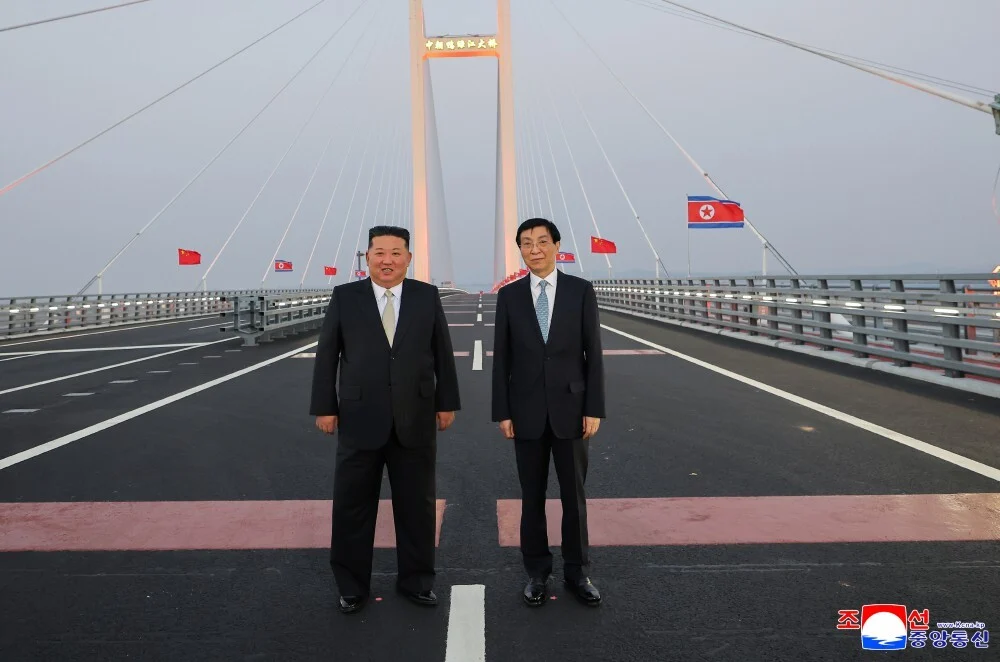
North Korean leader Kim Jong Un made a high-profile visit to the Chinese border city of Dandong, meeting with senior Beijing official Wang Huning in a carefully orchestrated display of bilateral solidarity. The high-level engagement took place to mark the 76th anniversary of China’s entry into the Korean War, an event officially commemorated in Beijing as the "War to Resist U.S. Aggression and Aid Korea."
The timing of the summit-level interactions is particularly sensitive. It occurs just weeks before a scheduled diplomatic visit by U.S. President Donald Trump to Beijing, signaling a unified strategic and geopolitical front by North Korea and China. By staging this display of alliance directly on the international border, Pyongyang and Beijing appear to be sending a clear message to Washington regarding regional security architecture, economic cooperation, and enduring geopolitical alignments in Northeast Asia.
Commemoration and High-Level Itinerary
According to reports published by the Korean Central News Agency (KCNA) and corroborated by Chinese state media outlets, Kim Jong Un’s itinerary in Liaoning Province was rich in historical symbolism and strategic signaling. The North Korean leader was accompanied by Wang Huning, the third-highest ranking official in the Chinese Communist Party and chairman of the National Committee of the Chinese People’s Political Consultative Conference (CPPCC).
During his time in Dandong, Kim visited the Memorial Hall of the War to Resist U.S. Aggression and Aid Korea, a museum dedicated to honoring Chinese soldiers who fought alongside North Korean forces against United Nations commands during the Korean War (1950–1953). Standing before historical exhibits, Kim lauded the historic blood ties forged between the two nations, emphasizing that the sacrifices made decades ago continue to serve as the bedrock of contemporary bilateral relations.
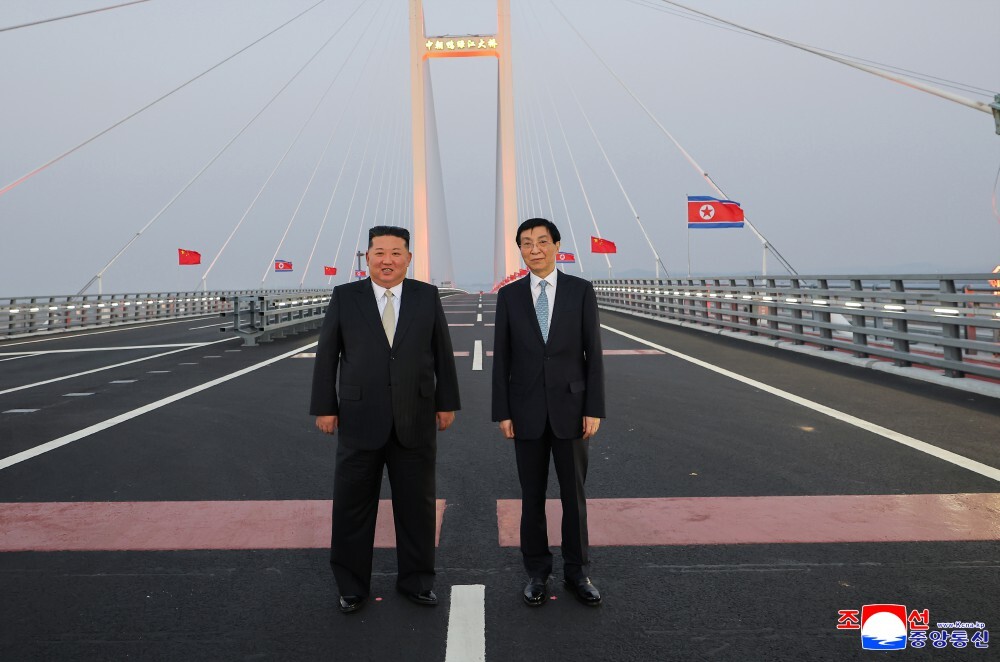
In addition to historic memorials, the itinerary featured heavy industrial and economic cooperation sites. Kim toured the Huanghai Bus factory, where he expressed profound admiration for China’s rapid modernization and technological advancements. According to KCNA, Kim stated that North Korea was deeply "inspired" by China’s socioeconomic success, pointing to Dandong as a thriving model of urban and industrial development. The leaders also visited the New Yalu River Bridge, a massive infrastructural project linking the two countries that symbolizes potential cross-border trade expansion once regional and international conditions permit.
Historical Background of the Alliance
The foundational narrative of the China-North Korea relationship remains deeply rooted in the shared combat experiences of the Korean War. In October 1950, as United Nations forces led by the United States advanced toward the Yalu River, the Chinese People’s Volunteer Army (PVA) crossed the border to rescue the retreating North Korean military, altering the trajectory of the conflict.
For decades, both capitals have routinely invoked this history—frequently referred to as a friendship "forged in blood"—to weather international isolation, economic sanctions, and geopolitical shifts. The anniversary of China’s entry into the war has traditionally served as a diplomatic touchstone. However, joint appearances by top-tier leaders directly on the border on this specific anniversary are relatively rare, underscoring a concerted effort to elevate bilateral optics amid contemporary global tensions.
In recent years, Sino-North Korean ties have experienced a notable resurgence. Following a period of relative cooling in the mid-2010s—driven by Pyongyang’s accelerated nuclear and ballistic missile testing—relations warmed significantly around 2018. Since then, regular high-level exchanges, economic delegations, and rhetorical coordination have reaffirmed the strategic utility of the alliance for both Beijing and Pyongyang, particularly as competition between the United States, China, and North Korea has intensified.
Chronology of Recent Bilateral Engagements
The Dandong meeting does not occur in a vacuum; it is the latest milestone in a steady drumbeat of high-level diplomatic exchanges between Pyongyang and Beijing:
- September 2024: High-ranking Chinese delegations visit Pyongyang to mark North Korea’s National Day, emphasizing mutual support against external pressures.
- October 2025: Bilateral consultations take place at the ministerial level to discuss expanded trade corridors and economic cooperation in border provinces.
- Early 2026: Intelligence and military cooperation agreements are reportedly updated, alongside increases in cross-border freight train operations connecting Dandong and Sinuiju.
- October 24, 2026: Kim Jong Un crosses into Dandong, Liaoning Province, meeting with Wang Huning to tour historical sites and industrial plants.
- October 25–26, 2026: KCNA and Chinese state media simultaneously release extensive coverage of the visit, emphasizing shared resistance to "U.S. aggression."
Geopolitical Implications and Strategic Signaling
International relations analysts and security experts view the Dandong summit as a deliberate pre-emptive diplomatic move ahead of U.S. President Donald Trump’s upcoming visit to China. By projecting an unbreakable political and ideological bond with North Korea, Beijing is signaling to Washington that its strategic perimeter in Northeast Asia remains robust and unyielding.
For Beijing, maintaining a stable, allied North Korea acts as an essential strategic buffer against U.S. military presence in South Korea and the broader Indo-Pacific region. While China occasionally experiences friction with Pyongyang over its nuclear weapons program—preferring regional stability over escalation—Beijing consistently prioritizes preventing the collapse of the North Korean regime, which it views as a catastrophic security outcome.
For Pyongyang, the visit provides vital domestic and international political capital. Domestically, associating Kim Jong Un with China’s economic prowess reinforces state narratives of progress and resilience despite heavy international sanctions. Internationally, it demonstrates that North Korea is far from isolated, anchoring its foreign policy firmly within a rising anti-Western coalition that includes Beijing and, increasingly, Moscow.
Furthermore, the emphasis on "U.S. aggression" directly aligns with broader efforts by China, Russia, and North Korea to challenge the U.S.-led international order. As Washington seeks to manage complex security dilemmas on the Korean Peninsula alongside broader strategic competition with Beijing, the Dandong meeting serves as a stark reminder of the deeply entrenched alliances shaping modern geopolitics.
Regional Reactions and Future Outlook
Neighboring capitals are closely monitoring the fallout from the Kim-Wang meeting. In Seoul, South Korea’s unification and foreign ministries are evaluating the long-term implications of strengthened Sino-North Korean economic and security coordination, particularly regarding the enforcement of United Nations Security Council resolutions. Increased trade and infrastructural integration through border hubs like Dandong could potentially undermine the efficacy of unilateral and multilateral sanctions designed to curb Pyongyang’s nuclear ambitions.
Meanwhile, Washington faces a delicate diplomatic balancing act. As the White House prepares for upcoming high-level summits with Chinese leadership, the overt display of Beijing-Pyongyang solidarity underscores the limits of U.S. leverage over North Korea through Chinese channels. Observers suggest that the upcoming U.S. presidential visit to China will likely feature intensive behind-the-scenes discussions regarding regional stability, denuclearization, and the management of flashpoints in East Asia.
As the geopolitical landscape continues to evolve, the historic bridge at Dandong stands as a physical and metaphorical checkpoint where past conflicts meet contemporary great-power competition. The joint messaging delivered by Kim Jong Un and Wang Huning ensures that the Korean Peninsula will remain a central arena in the broader contest for influence between Washington, Beijing, and Pyongyang for the foreseeable future.
