

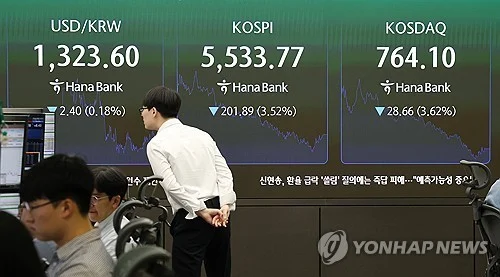
South Korean markets opened under significant downward pressure on Friday, October 23, 2026, as the benchmark Korea Composite Stock Price Index (KOSPI) tumbled by 130.6 points, or 2.36 percent, to reach 5,403.17 within minutes of the opening bell. The sharp decline reflects a global wave of risk aversion spurred by a double-edged sword of cooling enthusiasm for artificial intelligence (AI) stocks and heightening energy security concerns stemming from renewed hostilities in the Middle East.
The sudden volatility highlights the sensitivity of the South Korean exchange—a hub for global semiconductor manufacturing—to the performance of major U.S. technology firms. As investors digest the implications of a broader correction in the technology sector, the market is bracing for a period of heightened uncertainty.
The U.S. Tech Sell-off and Its Global Ripple Effect
The catalyst for the Friday morning rout in Seoul was a tumultuous trading session on Wall Street. On Thursday, the U.S. markets witnessed a divergence that left tech-heavy indices reeling. While the Dow Jones Industrial Average managed to eke out a marginal gain of 0.02 percent, the S&P 500 slipped 1.21 percent, and the Nasdaq Composite suffered a significant 2.6 percent contraction.
The epicenter of this volatility was the semiconductor sector, which has been the primary engine of global market growth over the past several quarters. Micron Technology led the decline among major chipmakers, plummeting 6.26 percent as analysts expressed concerns regarding inventory levels and slowing demand in the memory sector. Nvidia, the leading architect of AI processing hardware, saw its shares tumble 4.4 percent, while Intel recorded a sharper drop of 8.04 percent.
For South Korean investors, these figures are particularly sobering. The local market is heavily weighted toward technology giants like Samsung Electronics and SK Hynix, both of which serve as key nodes in the global semiconductor supply chain. When U.S. chip firms face a valuation correction, the sentiment is almost immediately transmitted to the KOSPI, reflecting the deep integration between Seoul’s industrial output and Silicon Valley’s demand cycles.
Geopolitical Instability and the Energy Price Spike
Compounding the pressure on the KOSPI is the resurgence of geopolitical tensions in the Middle East. Reports emerging late Thursday indicated that Yemen’s Iran-aligned Houthi rebels had launched a series of strikes targeting key oil facilities in Saudi Arabia.
The attack has stoked fears regarding potential supply chain disruptions, prompting an immediate climb in global oil prices. For an import-dependent economy like South Korea, rising energy costs act as a drag on corporate margins and consumer sentiment. Higher energy prices typically translate into inflationary pressure, which may complicate the central bank’s ability to maintain a growth-supportive monetary policy.
The energy market’s reaction serves as a reminder of the fragility of current global supply chains. With oil prices trending upward, investors are increasingly concerned about the potential for "stagflationary" pressures—a scenario where rising costs collide with a cooling technological sector, leaving central banks with few levers to pull.
Timeline of Market Developments
The current market environment has been shaped by a sequence of events over the last 72 hours:
- October 21, 2026: Markets showed signs of exhaustion following several weeks of gains. Analysts began noting a "valuation fatigue" in high-growth AI stocks, as investors started looking for more consistent earnings reports.
- October 22, 2026 (Early Morning): Economic data releases in the United States hinted at a possible softening in the industrial sector, leading to early weakness in semiconductor stocks.
- October 22, 2026 (Afternoon/Evening): News broke of the Houthi rebel strikes on Saudi Arabian energy infrastructure. Oil prices surged in after-hours trading, and the futures markets for major indices began to signal a negative opening for the following day.
- October 23, 2026 (Opening Bell): The KOSPI opened sharply lower, tracking the losses from the Nasdaq and reacting to the overnight increase in crude oil benchmarks.
Institutional Analysis and Market Implications
Market strategists at major brokerage houses in Seoul are advising caution as the market processes these developments. "The current sell-off is not merely a technical correction; it is a fundamental reassessment of the AI-led growth narrative," noted one senior analyst. "When companies like Nvidia and Micron see double-digit drops in such a short window, it forces institutional investors to rebalance their portfolios toward defensive assets, which inevitably leads to the type of sharp index drops we are witnessing today."
The implications for South Korea are twofold. First, the export-oriented nature of the economy means that any sustained slowdown in global AI investment will have a direct, measurable impact on the nation’s trade balance. Second, the energy price spike acts as a "hidden tax" on domestic manufacturing, further squeezing the profit margins of firms already dealing with cooling demand.
There is also a broader question regarding the resilience of the AI investment thesis. For months, capital expenditure by major tech firms has been the primary driver of the equity market rally. Should these firms choose to pull back on infrastructure spending—citing either a lack of immediate profitability or macroeconomic uncertainty—the entire sector could face a period of consolidation.
Responses and Future Outlook
While no formal government intervention has been announced, market observers expect the Financial Services Commission (FSC) of South Korea to monitor the volatility closely. In previous periods of extreme market turbulence, the FSC has been known to implement measures to stabilize trading, such as temporary restrictions on short-selling or coordinating with national pension funds to provide liquidity.
"The immediate focus for the market will be how quickly the geopolitical situation in the Middle East is contained," says a strategist at a major Seoul-based investment bank. "If the energy supply is not significantly compromised, we might see the tech sell-off stabilize once valuations return to more reasonable levels. However, if energy prices remain elevated, the KOSPI will struggle to regain its footing in the short term."
Investors are now looking toward the upcoming earnings season. The results released by domestic semiconductor leaders in the coming weeks will be critical in determining whether the local market can decouple from the negative sentiment emanating from the United States. Should the domestic chip giants report robust demand despite the global tech slowdown, it could provide the necessary floor for the KOSPI to recover.
In the meantime, the atmosphere in the dealing rooms of Seoul remains tense. As the trading day progresses, market participants are keeping a close watch on foreign investor flows. Historically, foreign selling has been the primary driver of KOSPI declines during periods of global uncertainty. If foreign capital begins to exit the market in search of safer havens, the index could face further testing of its support levels.
For the individual investor, the current environment underscores the risks of a market that has become hyper-concentrated in a handful of high-growth sectors. The events of October 23 serve as a stark reminder of the interconnectedness of modern finance, where a localized conflict in the Middle East and a change in investor sentiment in Silicon Valley can combine to erase billions of dollars in market capitalization in a matter of hours on the other side of the globe.
As the markets settle into the day’s session, the focus remains firmly on the interplay between macroeconomic indicators, corporate earnings, and the unpredictable nature of geopolitical risk. Whether this is a temporary shakeout or the beginning of a more prolonged downturn remains the central debate among market participants. For now, the index remains under siege, waiting for a catalyst—either from economic policy or corporate performance—to restore confidence in the trajectory of the South Korean economy.
