

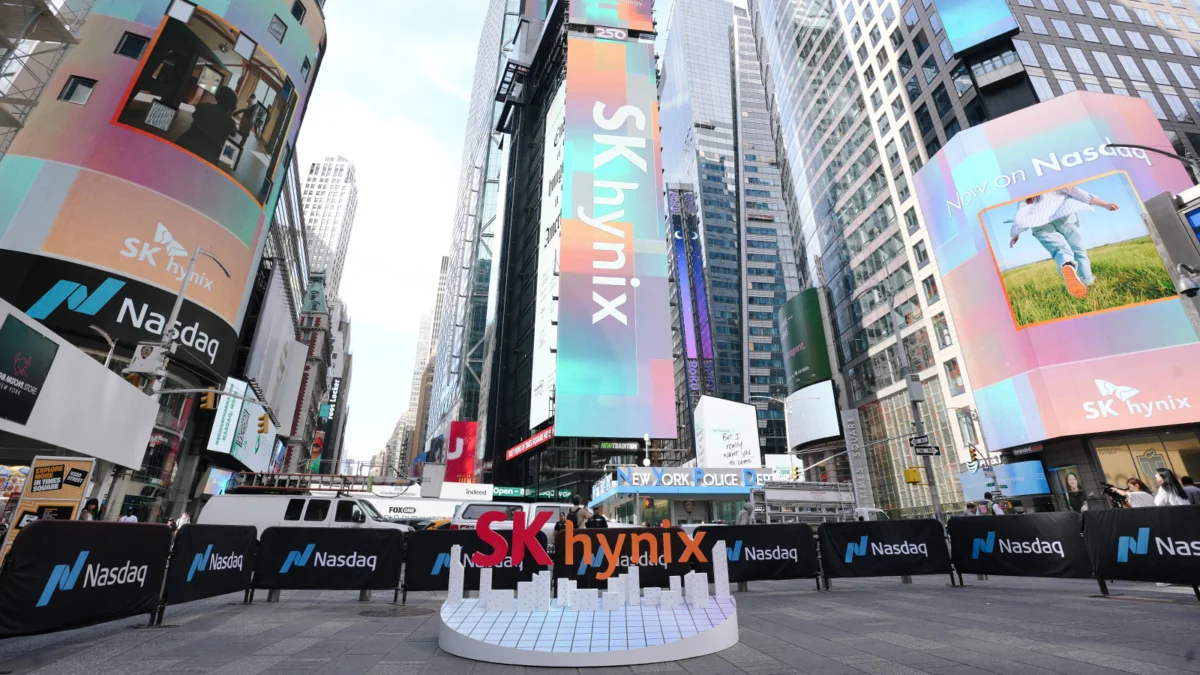
The global artificial intelligence hardware boom has officially reached a historic financial milestone on Wall Street, anchored by an unprecedented cross-border market entry from South Korea’s memory manufacturing powerhouse. SK Hynix, a cornerstone of the modern semiconductor supply chain, successfully raised a staggering $26.5 billion (approximately KRW 40 trillion) through its landmark U.S. market debut, rewriting the history books for international initial public offerings and underscoring the relentless investor appetite for critical AI infrastructure.
The transaction eclipsed Alibaba’s legendary $25 billion U.S. initial public offering in 2014, making SK Hynix’s entry the largest-ever U.S. debut by a non-American corporation. The scale of the offering reflects not only the massive capital requirements of the contemporary semiconductor industry but also the extraordinary market valuation being commanded by companies directly tied to the exponential expansion of generative artificial intelligence and high-performance computing architectures.
Structure of the Blockbuster Offering
To facilitate broad participation from U.S. institutional and retail investors, SK Hynix structured the offering meticulously. The company sold 177.9 million American Depositary Receipts (ADRs) at a precise price of $149 per share. The ADR program was engineered so that individual U.S. shares represent a fraction—specifically roughly one-tenth—of the value and pricing of a full share traded domestically on the Korea Stock Exchange.
Despite pricing the U.S. ADRs at a 2.7% premium relative to its three-day average trading price back in Seoul, investor demand for the asset proved to be astronomical. According to financial filings and market reports, the offering was more than seven times oversubscribed. This immense enthusiasm carried directly over to the trading floor. When the stock opened on the Nasdaq under the temporary ticker symbol SKHYV, it immediately surged 14% above its initial offering price, maintaining an upward trajectory through early trading sessions and signaling robust confidence from Western markets. Regular trading under the permanent ticker symbol SKHY is scheduled to commence following the settlement period.
Overcoming the "Korea Discount"
The overwhelming success of SK Hynix’s U.S. debut carries profound symbolic and economic weight, particularly regarding the long-standing phenomenon known among economists as the "Korea Discount." For decades, major South Korean conglomerates and publicly traded corporations have historically traded at persistent valuations and multiples discount compared to their global peers in the United States, Europe, and Japan.
Financial analysts have frequently attributed this valuation gap to structural impediments, including complex and opaque corporate governance frameworks (often managed through family-controlled chaebol structures), historically low shareholder returns and dividend payouts, regulatory unpredictability, and the persistent geopolitical shadow cast by North Korea.
However, SK Hynix’s record-breaking U.S. offering proves that structural market discounts can be entirely neutralized by undeniable technological indispensability. The company has decoupled itself from traditional regional valuation constraints because it occupies a non-negotiable choke point in the AI supply chain. As a primary manufacturer of high-bandwidth memory (HBM)—the critical, high-speed memory architecture required by advanced AI graphics processing units (GPUs) designed by industry leaders like Nvidia—SK Hynix commands pricing power, strategic relevance, and growth projections that eclipse traditional macroeconomic risk factors.
Capital Allocation and Strategic Infrastructure
Where the newly acquired capital will flow reveals the strategic roadmap of a company racing to keep pace with a generational technological pivot. According to regulatory filings submitted to financial authorities, SK Hynix plans to channel the $26.5 billion influx directly into three core expansion pillars designed to alleviate global bottlenecks in memory chip production:
- Advanced Fabrication Plants: Funding the rapid construction and outfitting of a major new semiconductor fabrication facility (fab) currently rising in South Korea, designed specifically to address the acute worldwide shortage of high-capacity memory caused by the sudden surge in AI infrastructure deployment.
- Advanced Packaging Facilities: Investing in specialized domestic packaging infrastructure. As chips grow more complex and rely on multi-die architectures like HBM, advanced packaging has become just as critical as the lithography process itself in determining chip performance and energy efficiency.
- Extreme Ultraviolet (EUV) Technology: Acquiring state-of-the-art Extreme Ultraviolet lithography scanners, the ultra-precise, multi-million-dollar machines essential for printing the microscopic circuitry of next-generation memory semiconductors.
Washington’s Push for Domestic Semiconductor Autonomy
Even as Wall Street celebrated SK Hynix’s triumph, geopolitical dynamics and national security considerations continued to shape the broader semiconductor landscape. In a high-profile appearance at a Micron Technology event, U.S. Commerce Secretary Howard Lutnick delivered a pointed message addressing the geographic concentration of the world’s most advanced memory chip manufacturing.
Lutnick confirmed that the United States government is actively engaged in direct, high-stakes negotiations with both SK Hynix and its chief domestic rival, Samsung Electronics—the world’s other major memory giants—to encourage substantial capital expenditure and factory construction on American soil. The underlying objective of the Biden-Trump administration’s ongoing industrial policy is to diminish reliance on East Asian supply chains for critical microelectronics, ensuring that the United States retains domestic manufacturing capabilities for the hardware powering the next economic revolution.
Domestic competitors are moving swiftly to align with these federal priorities. Micron, one of SK Hynix’s primary global competitors, has fully embraced the American manufacturing push, announcing an expansive $250 billion commitment to build new state-of-the-art U.S. manufacturing facilities. Company executives estimate that this massive domestic investment will generate upward of 90,000 direct and indirect jobs, anchoring leading-edge semiconductor production firmly within American borders.
The timing of Secretary Lutnick’s push highlights a delicate balancing act for South Korean chipmakers. Just weeks prior to the U.S. market debut, both SK Hynix and Samsung committed over $550 billion in combined domestic capital expenditure within South Korea to safeguard their technological leadership and ease the global crunch affectionately dubbed "RAMageddon" by industry insiders. Balancing gargantuan domestic infrastructure investments with demands from Washington for localized U.S. production represents the primary strategic challenge for South Korea’s chip titans as they navigate an increasingly splintered and geoeconomically sensitive global marketplace.
Market Implications and Analyst Outlook
The dual narrative of SK Hynix’s historic $26.5 billion U.S. debut and the concurrent political pressure for localized manufacturing paints a vivid picture of a semiconductor industry operating at maximum velocity.
For investors, the event validates the thesis that physical hardware infrastructure remains the most reliable vehicle for capturing value in the AI boom. While software developers and cloud hyperscalers capture headlines, the underlying chips—and the specialized memory required to feed them—remain the physical bedrock upon which the entire artificial intelligence edifice is constructed.
As SK Hynix transitions into its active trading life on the Nasdaq under its permanent ticker, market observers will be closely watching whether this successful cross-border listing paves the way for other Asian technology giants to bypass local valuation caps by tapping directly into the deep, liquidity-rich pools of U.S. capital markets. For now, SK Hynix stands alone at the summit of international market debuts, symbolizing the immense economic stakes of the global artificial intelligence race.
