

South Korea’s public transportation system is widely recognized as one of the most efficient, affordable, and technologically advanced networks in the world, playing a critical role in the country’s rapid urbanization and tourism success. As international travel to South Korea continues to climb following the lifting of pandemic-era border restrictions, the Ministry of Land, Infrastructure and Transport (MOLIT) has reported a significant resurgence in public transit ridership. For visitors, mastering this intricate grid of subways, buses, and express trains is the key to unlocking a seamless travel experience. Understanding the nuances of local navigation—from digital infrastructure to social etiquette—is essential for the estimated 15 to 20 million annual visitors projected to visit the peninsula.

The Digital Backbone of Korean Transit
The integration of technology into Korean infrastructure has fundamentally altered how commuters and tourists move across the country. Unlike many Western nations where Google Maps remains the gold standard, South Korea’s unique digital landscape requires travelers to utilize localized applications for accurate navigation. This is due to security-related restrictions on high-precision map data provided by foreign entities.

The "must-download" toolkit for any traveler includes Naver Map, Kakao T, and a dedicated subway application such as Subway Korea. Naver Map serves as the primary navigation tool, offering real-time updates on subway and bus routes, walking directions, and even street-view imagery that is far more accurate than international alternatives. Kakao T, the dominant ride-hailing service, acts as the local equivalent to Uber or Grab, allowing users to hail taxis, manage payments, and track vehicles with precision. These applications are designed with multi-language support, including English, Japanese, and Chinese, effectively bridging the language barrier for international tourists.

The Evolution and Functionality of the T-Money System
Central to the success of South Korea’s transit efficiency is the T-money card. Introduced in the early 2000s, this stored-value smart card system serves as the universal payment method for almost all public transport. The system’s success lies in its interoperability; a single card allows for seamless transfers between buses and subways without the need to purchase separate tickets for each leg of a journey.

Data indicates that the T-money system handles billions of transactions annually, with a high adoption rate among both locals and tourists. The card can be purchased at major convenience store chains—such as CU, GS25, and 7-Eleven—and at transit hubs. A notable feature for tourists is the ability to personalize these cards at kiosks found in major transit centers, such as Seoul Station or Hongik University Station, where users can print custom designs. It is critical for travelers to note that while South Korea is a largely cashless society, the recharging of T-money cards remains a cash-only process at kiosks. Furthermore, financial experts advise that users should avoid using 50,000 KRW notes for small top-ups, as the machines have limitations regarding change disbursement, often favoring 10,000 KRW notes.

Strategic Planning: The Subway and Bus Network
The Seoul Metropolitan Subway is a marvel of engineering, encompassing over 20 lines that connect the capital with the surrounding Gyeonggi Province and Incheon. The network is characterized by its color-coded lines, English-language signage, and clear audio announcements, making it accessible to those who do not speak Korean.

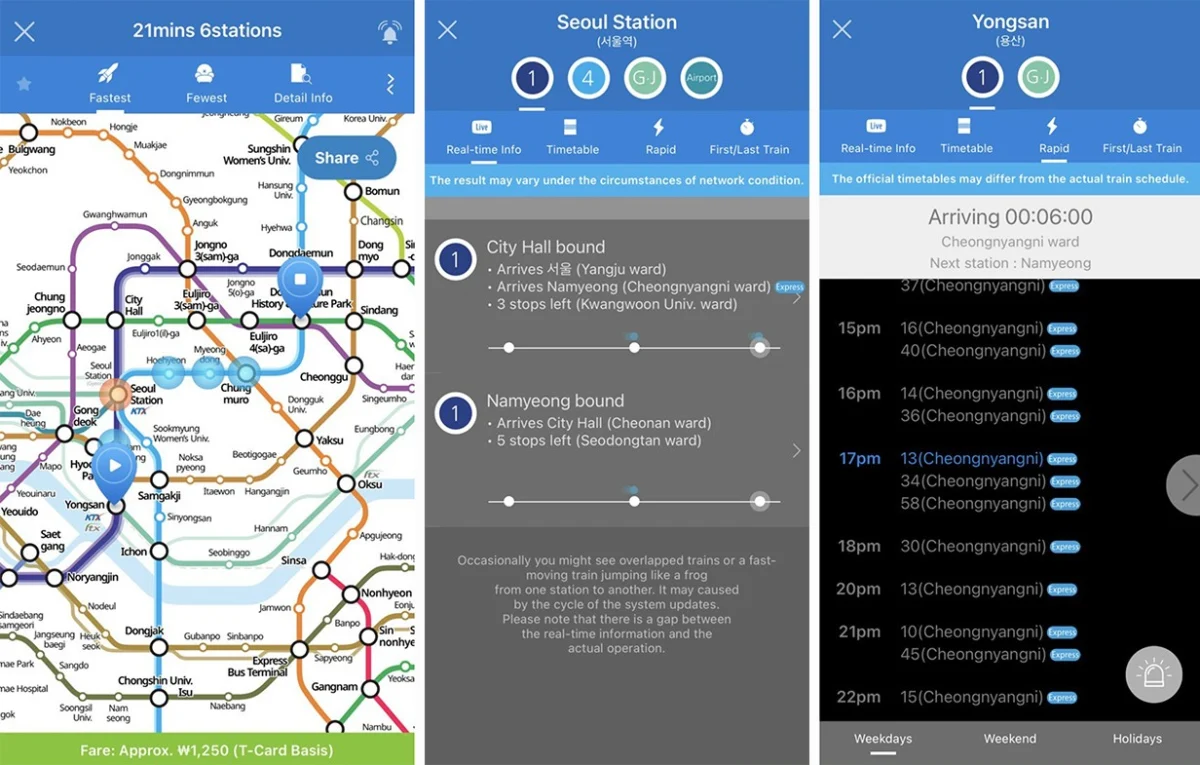
For travelers looking to optimize their time, the Subway Korea app is an indispensable resource. It provides real-time train status, platform information, and schedules for rapid trains. These rapid services are essential for long-distance travel within the city, as they bypass smaller stations to save significant time. However, passengers must exercise caution to ensure they board the correct train, as express and local services often share the same platform.

Buses in Seoul operate on a color-coded system that indicates their service areas:

- Blue buses traverse long distances between the outskirts and the city center.
- Green buses handle shorter routes, often connecting transit hubs to residential areas.
- Yellow buses circulate through downtown districts, specifically targeting tourist and business hubs.
- Red buses serve as long-haul express routes for commuters traveling from the metropolitan suburbs into the city.
Adherence to Transit Etiquette and Regulations
Public transit in South Korea is governed by a strict set of social norms and official regulations. Understanding these is not merely about etiquette; it is about compliance with local laws. For instance, the Seoul Metropolitan Government has enforced a strict ban on open food and beverage containers on buses since 2018. Drivers are legally empowered to deny boarding to passengers carrying "to-go" cups of coffee or unsealed food items.

Reserved seating is another area where social norms are deeply entrenched. Every subway car and public bus features seats specifically designated for the elderly, disabled, and pregnant women. These seats are clearly marked with distinct signage and, in the case of seats for pregnant women, are often distinguished by a bright pink color and, occasionally, plush toy mascots to discourage non-priority passengers from occupying them. Violating these social cues is generally frowned upon by the local population, who place a high value on public courtesy.

Technological Connectivity and Infrastructure
South Korea’s commitment to digital connectivity extends into the public transport sector. Nearly all buses and subway stations provide high-speed, free public Wi-Fi. This initiative, part of the government’s broader "Digital New Deal," ensures that travelers can access navigation apps and real-time transit information without relying on expensive mobile data roaming. This connectivity is particularly beneficial for budget-conscious travelers and those on extended itineraries.

Regional Variations: Jeju Island and Beyond
While the mainland boasts a sophisticated rail and subway network, travelers must adjust their expectations when visiting Jeju Island. As a volcanic island with a different geographical layout, Jeju lacks a railway or subway system. Transportation there relies exclusively on public buses, rental cars, and taxis. The island features an extensive bus network, including specialized tourist shuttle buses and electric buses, which are becoming the primary mode of travel for eco-conscious tourists.

Financial Analysis of Transport Costs
From an economic perspective, the use of a T-money card is not only a matter of convenience but also a cost-saving measure. The transit authority offers discounted fares and free transfers between buses and subways when using a registered smart card, compared to the higher costs associated with single-journey paper tickets or cash payments. For families or groups, the ability to pay for multiple passengers with a single card—by informing the driver of the number of passengers—streamlines the boarding process and reduces the time spent at bus stops.

Implications for Future Tourism
The resilience and adaptability of South Korea’s public transportation system are critical pillars of its national tourism strategy. As the country aims to attract a more diverse range of international travelers, the focus has shifted toward enhancing the "user experience" of these systems. Future developments, such as the expansion of high-speed KTX lines and the implementation of AI-driven traffic management, are expected to further solidify South Korea’s reputation as a world leader in urban mobility.

For the modern traveler, the system is no longer just a way to get from point A to point B; it is a sophisticated, digital-first environment that demands preparation and respect for local conventions. By leveraging the right applications, utilizing the T-money card efficiently, and observing local transit etiquette, visitors can navigate South Korea with the same ease and confidence as a seasoned local commuter. As the nation continues to modernize its infrastructure, the integration of technology and public policy will ensure that South Korea remains a top-tier destination for global travelers for years to come.
