

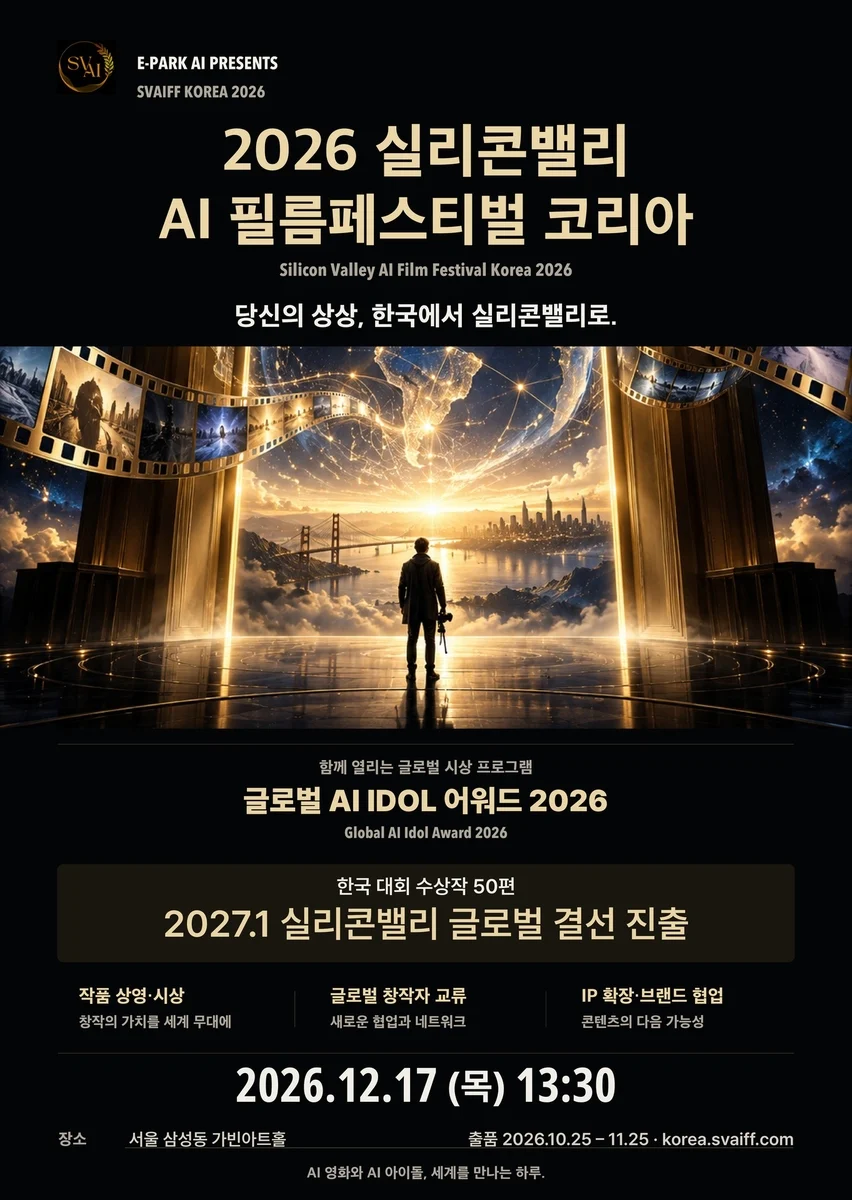
Seoul will serve as a pivotal nexus for the burgeoning world of machine-generated cinema this December, as organizers officially launch the Silicon Valley AI Film Festival Korea. This event, a localized precursor to the global finals in California, marks a significant milestone in the integration of generative artificial intelligence into the professional creative arts. By hosting a competition that spans 12 distinct categories—ranging from narrative storytelling and animation to documentary and commercial advertising—the festival aims to identify the most compelling voices currently utilizing tools like Sora, Runway, and Kling to bridge the gap between prompt engineering and high-end cinematography.
The competition, scheduled for mid-December, serves as a gateway for domestic talent to gain international recognition. Winners in each category will secure a direct invitation to the Silicon Valley AI Film Festival’s final round, which is slated to take place in January in the heart of the global technology sector. There, they will face off against finalists selected from a prestigious network of nine other international hubs, including Los Angeles, London, Beijing, Paris, Tokyo, Berlin, Mumbai, Toronto, and Singapore.
The Evolution of the AI-Driven Creative Economy
The rise of generative AI in film production has evolved from a niche experiment to a disruptive force within the entertainment industry. For decades, the barrier to entry for high-quality filmmaking remained prohibitively expensive, requiring massive investments in equipment, labor, and time. Today, the landscape is shifting. According to a recent industry report by Goldman Sachs, the generative AI market is projected to reach $150 billion by 2026, with the media and entertainment sectors identified as primary drivers of this growth.
The Silicon Valley AI Film Festival Korea emerges at a time when the Korean film industry—already a global powerhouse following the success of projects like Parasite and Squid Game—is aggressively exploring new production workflows. By hosting this event, organizers are positioning Seoul as a laboratory for the intersection of traditional artistic heritage and cutting-edge algorithmic storytelling.
Chronology of the Event and Selection Process
The road to the January final in Silicon Valley is structured to ensure a rigorous selection process that emphasizes both technical proficiency and narrative depth.
- October 27: Official announcement of the Seoul event details, including the 12 competitive categories.
- November 1–30: Submission window for filmmakers to upload their AI-assisted projects.
- December 1–10: Evaluation by a panel of experts comprised of film directors, AI researchers, and digital media scholars.
- December 17: Awards ceremony in Seoul, where winners will be announced and finalized for their travel to the United States.
- January (Upcoming): The global final in Silicon Valley, featuring the international cohort of winners.
The organizers have emphasized that the evaluation criteria will focus on "originality, technical execution of AI tools, and the coherence of the narrative." This is a crucial distinction, as the festival seeks to dispel the myth that AI film is merely a "random" output of prompts. Instead, it seeks to highlight the "human-in-the-loop" philosophy, where the AI serves as a collaborator rather than a replacement for the visionary filmmaker.
Strategic Significance for Global Media
Industry analysts suggest that the decision to include cities like Seoul and Beijing in the global circuit reflects the shifting geography of AI innovation. While Silicon Valley remains the headquarters of model development, the application of these models—particularly in visual storytelling—is increasingly being driven by markets with strong gaming, animation, and digital infrastructure histories.
"We are witnessing the democratization of high-end visual effects," says Dr. Elena Vance, an analyst specializing in digital media transformation. "Events like this in Seoul are not just about showing off fancy software; they are about establishing a new language of cinema. When you look at the 12 categories—animation, music video, documentary—you see a roadmap of how AI will eventually permeate every layer of television, film, and digital advertising."
The inclusion of documentary as a category is particularly noteworthy. While critics often raise concerns regarding "deepfakes" and misinformation, the organizers of the festival maintain that AI can be used ethically to reconstruct historical events or visualize abstract concepts that were previously impossible to film. The festival’s ethical guidelines require all submissions to clearly label the AI tools utilized, promoting a culture of transparency that is currently lacking in the broader tech ecosystem.
Official Responses and Industry Sentiment
While the organizers of the Silicon Valley AI Film Festival Korea have kept the names of the jury members under strict confidentiality until the final judging phase, industry insiders note that the event has garnered significant interest from major production houses and streaming platforms.
"The interest from the local creative community has been overwhelming," stated a spokesperson for the event organizers. "We aren’t just looking for people who can write a good prompt. We are looking for filmmakers who understand the emotional weight of a scene and know how to use AI to amplify that weight. The talent we are seeing in South Korea right now is uniquely positioned to lead this shift."
There is, however, a measured level of caution within the wider industry. Creative guilds in both South Korea and the United States have been vocal about the need for intellectual property protections regarding the data sets used to train these models. The festival has addressed this by encouraging participants to utilize ethically sourced AI models, a stance that aligns with the growing movement for "Human-Centric AI."
Implications for the Future of Filmmaking
The long-term impact of this festival will likely be measured by the professional opportunities it creates for participants. By providing a direct pipeline to the venture capital and production networks in Silicon Valley, the competition functions as an incubator. Many of the participants are expected to be independent creators, small-scale studios, and digital artists who might otherwise lack the capital to pitch their concepts to major distributors.
Furthermore, the data collected during the Seoul event will provide valuable insights into the current state of generative video. As the industry moves toward 4K-resolution real-time generation, the films produced today will be viewed as the "silent film era" of the AI generation—a foundational period characterized by rapid experimentation and the defining of new technical standards.
As the December 17 awards ceremony approaches, the focus in Seoul remains on fostering a collaborative environment. The festival is expected to host a series of forums alongside the screenings, where attendees can discuss the ethical implications of the technology, the future of labor in the film industry, and the necessity of maintaining human creative control in an automated age.
Conclusion
The Silicon Valley AI Film Festival Korea is more than just a competition; it is a signal of the changing tides in global media production. By bridging the gap between the creative talent of Seoul and the technical infrastructure of Silicon Valley, the event provides a platform for the next generation of visual storytellers. Whether these tools will eventually complement traditional film production or fundamentally replace it remains a subject of intense debate, but one thing is certain: the conversation has moved from the theoretical to the practical. With 12 categories and a global spotlight, the winners in Seoul will be at the forefront of a technological revolution that promises to redefine what it means to create a film in the 21st century. As the December deadline approaches, the global film community turns its eyes to Seoul, waiting to see what the future of cinema looks like through the lens of artificial intelligence.
