

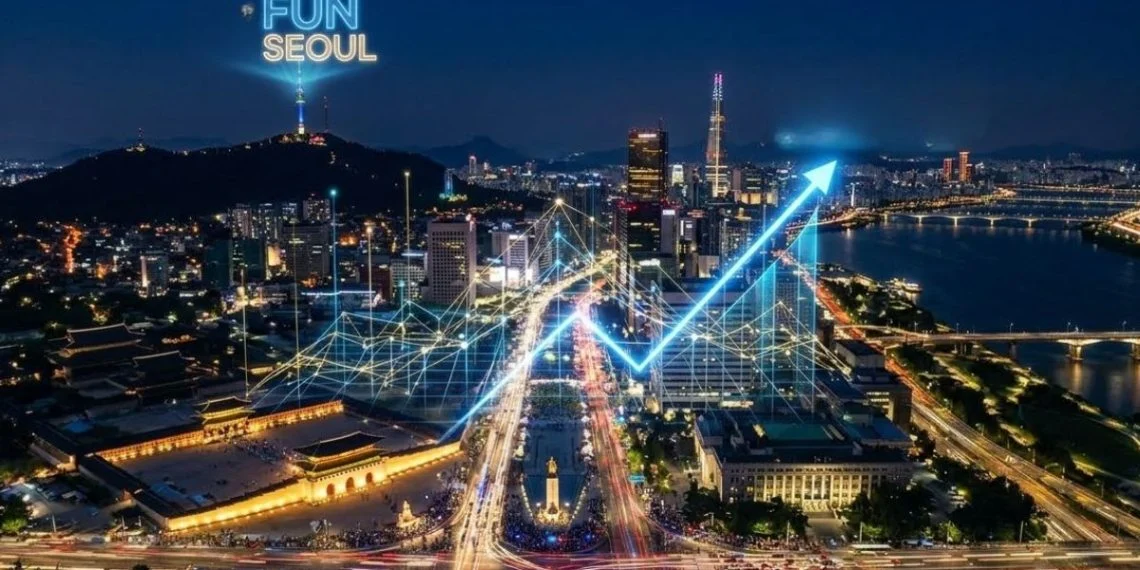
Seoul is undergoing a radical urban and economic transformation. The Seoul Metropolitan Government (SMG) has officially launched the "365 Day Festival City" initiative alongside a new municipal tourism banner, "Fun Seoul." This strategic pivot abandons the fragmented, seasonal festival calendar of the past—such as the discrete spring "Seoul Festa" and winter "Seoul Lantern Festival"—in favor of a continuous, year-round cultural ecosystem. Designed to eliminate the traditional peaks and valleys of South Korea’s tourism industry, the multi-billion-won strategy aims to hit an ambitious economic and visitation milestone known as the "30-30-30 target": attracting 30 million foreign visitors, generating 30 trillion Korean Won (approximately $22.5 billion USD) in annual tourism revenue, and securing a top-five global city ranking by the end of 2026.
For years, critics and urban planners pointed out the volatility of Seoul’s tourism metrics. Visitor numbers would surge predictably during the spring cherry blossom season and major K-pop award ceremonies, only to plummet during the humid monsoon weeks of summer or the biting cold of late winter. The "Fun Seoul" rebranding and its accompanying "Festival Belt" strategy are designed to stabilize the velocity of commerce across all 25 districts of the capital. By replacing confusing Korean-English hybrid terms with a unified global identity, the city aims to transition its cultural output from a sporadic tourist attraction into a permanent, reliable utility for economic growth.
The Chronology of Seoul’s Tourism Evolution
The rollout of the "365 Day Festival City" is the culmination of years of escalating investments in South Korea’s creative economy, propelled globally by the explosive rise of the country’s soft power.
Phase one of this structural shift began taking shape in late 2024 and 2025, as municipal authorities recognized that traditional downtown squares—most notably Gwanghwamun Square and Seoul Plaza—were reaching maximum logistical capacity. Chronic traffic gridlock and pedestrian safety concerns during major gatherings highlighted the need for spatial decentralization.
The turning point arrived this week with the official dissolution of the "Seoul Festa" moniker. In its place, the SMG established a synchronized four-season calendar integrating over 200 performing arts programs and four major signature hubs.
The first major blueprint for this new spatial strategy is the upcoming Seoul Spring Festival, which launches on April 10. Breaking from past precedent, the city has quadrupled the duration of the spring event from a fleeting seven days in 2025 to a sprawling 26 days in 2026. Rather than concentrating crowds in historical downtown corridors, the festival’s epicenter is shifting definitively to the Han River parks, specifically targeting Yeouido, Ttukseom, and Banpo.
Financial Architecture and Data-Driven Investments
The ambition of the "Fun Seoul" campaign is backed by unprecedented fiscal commitments from both the national government and the municipal administration. National budget allocations for 2026 feature a record-breaking culture budget of 7.86 trillion KRW, with 1.62 trillion KRW dedicated strictly to advancing K-content.
At the municipal level, the SMG has earmarked an initial 9.7 billion KRW ($7.2 million USD) explicitly as a "Festival Accelerator" fund to support the 2026 seasonal cycle. Economists and city planners project a massive return on investment, estimating an economic ripple effect of 500 billion KRW ($334 million USD) generated solely by this year’s restructured festival calendar.
Rather than viewing cultural events as standalone entertainment expenses, the SMG is treating the festival calendar as a hard infrastructure asset. Officials describe these events as a physical storefront for the digital K-content that consumers around the world stream daily on platforms like Netflix and YouTube. By physically manifesting the digital worlds of K-pop, K-dramas, and Korean cinema, Seoul is creating an experiential ecosystem designed to convert online global fandom into tangible foot traffic.
The Han River Axis Shift and Slow Tourism
A cornerstone of the "365 Day Festival City" framework is the logistical pivot toward the Han River. By relocating the primary festival zones to the riverbanks, the city has unlocked a scalable venue capable of accommodating the projected 60 million total attendees—both domestic and international—expected throughout the 2026 festival calendar.
To maximize visitor retention and economic capture, the city is introducing the "7 Spots, 7 Emotions" experience, a curated cultural trail along the riverbanks connected by a newly minted Han River Bus One-Day Pass. This initiative aims to combat "mass transit tourism," where visitors breeze through a single landmark and immediately depart. Instead, the one-day pass and multi-dock infrastructure encourage "slow tourism," inviting travelers to spend prolonged hours moving between riverside hubs, enjoying drone light displays at the Dongdaemun Design Plaza (DDP), and patronizing local commerce.
Longer stays directly correlate with higher per-capita spending. When a tourist extends their itinerary by even 48 hours to attend a signature showcase, their expenditures naturally bleed out from basic street food and public transportation into high-margin sectors, including luxury retail, high-end gastronomy, and medical wellness tourism. To streamline this transition, the city has deployed 1,000 newly certified medical interpreting coordinators directly to festival hubs, seamlessly funneling cultural tourists toward South Korea’s world-class medical facilities.
High-Stakes Stress Tests: Safety and Regulatory Hurdles
While the long-term economic projections are exceptionally bullish, municipal authorities face immediate, high-stakes operational challenges. The ultimate stress test for the 365-day festival plan arrives with a massive, high-profile concert event in central Seoul, testing the city’s readiness to handle unprecedented crowds safely.
To manage an estimated 260,000 attendees in a historically dense urban core, the city elevated its crisis alert level to "Caution" and deployed over 6,000 security and safety personnel. The financial and operational burdens of crowd management have escalated significantly, with municipal security costs rising by roughly 25% year-over-year. This increase is driven by the integration of cutting-edge, AI-based crowd-sensing technologies and subsidized "empty train" public transit operations designed to prevent bottlenecks on the subway lines.
For urban policy-makers, these events serve as a masterclass in risk management. Proving that Seoul can host world-scale pop culture gatherings safely within its political and historical heartland is viewed as a prerequisite for maintaining international confidence in the city’s infrastructure.
Macro-Economic Transformation and the Urban Value Chain
Beyond tourism metrics and foot traffic, the transition to a permanent festival city represents a fundamental restructuring of Seoul’s urban economy. The diversification of the tax base away from traditional business districts like Gangnam and Jongno is already underway.
Real estate experts note that the shift of the festival axis toward the Han River is triggering a spatial revaluation of areas like Ttukseom and Banpo. Once viewed primarily as local recreational retreats, these riverfront neighborhoods are rapidly evolving into international commercial hubs. Private investment is flowing heavily into floating infrastructure, including riverside restaurants, pop-up galleries, and modular performance stages.
Furthermore, the initiative acts as an invaluable living laboratory for domestic startups. Small and medium enterprises specializing in augmented reality (AR), virtual reality (VR), agricultural technology (AgTech), and financial technology (Fintech) are being given municipal backing to deploy pop-up solutions within live, high-traffic festival environments. This grants local innovators a real-world product-market fit testing ground that can be leveraged for global export.
Outlook: Seoul as a Living Cultural Utility
As Seoul pushes forward with its "Fun Seoul" campaign, the city is fundamentally redefining the relationship between urban governance and cultural production. By treating culture as a public utility rather than an occasional luxury, municipal leaders are signaling that South Korea’s capital is permanently open for creative business.
The financial data and strategic frameworks deployed for 2026 suggest that Seoul is well-positioned to achieve its ambitious goals. If the city can successfully navigate its ongoing safety and crowd-control hurdles, the ultimate reward will extend far beyond the targeted 30 trillion KRW in tourism revenue. It will result in a permanent, structural elevation of Seoul’s global soft power, cementing its status not just as a place to visit, but as a city that the world wants to experience 365 days a year.
