

Navigating the culinary landscape of South Korea often presents a unique set of challenges for international travelers, particularly those unfamiliar with the linguistic nuances of the Korean service industry. As South Korea continues to see a rise in tourism—with the Korea Tourism Organization reporting over 17 million international visitors annually in peak years—the demand for effective cross-cultural communication in dining establishments has never been higher. While many modern restaurants in urban centers like Seoul and Busan offer English-language menus, traditional eateries and smaller neighborhood establishments frequently rely on local terminology to facilitate the ordering process. Mastering a foundational lexicon of Korean service phrases not only enhances the dining experience but also serves as a gesture of cultural respect that can significantly influence the quality of service received.

The significance of these linguistic interactions extends beyond mere convenience; it is rooted in the social architecture of Korean dining culture. In South Korea, the relationship between service staff and patrons is often mediated by specific honorifics and functional vocabulary that denote mutual respect. Failure to utilize these terms can sometimes lead to confusion, particularly when dietary restrictions or spice preferences are involved. With a significant portion of Korean cuisine utilizing gochujang (fermented red chili paste) and other potent capsaicin sources, the ability to communicate specific requests—such as minimizing spice levels—is a practical necessity for many visitors.

The Evolution of Korean Service Culture
Historically, the Korean restaurant sector was characterized by high-touch, personalized service. This tradition persists today, even as the industry adopts digital advancements like table-side tablets and automated ordering kiosks. Despite these technological shifts, the reliance on verbal communication for secondary requests—such as water refills or extra portions of banchan (side dishes)—remains constant.

Data from the Korea Food Service Industry Association indicates that while the front-of-house operations in high-end establishments are becoming increasingly multilingual, the vast majority of local, small-to-medium-sized restaurants (SMBs) operate primarily in Korean. For the international traveler, this creates a "communication gap" that can be bridged by learning phrases that address the three primary stages of the dining experience: inquiry, ordering, and request for maintenance.

Core Vocabulary for Restaurant Navigation
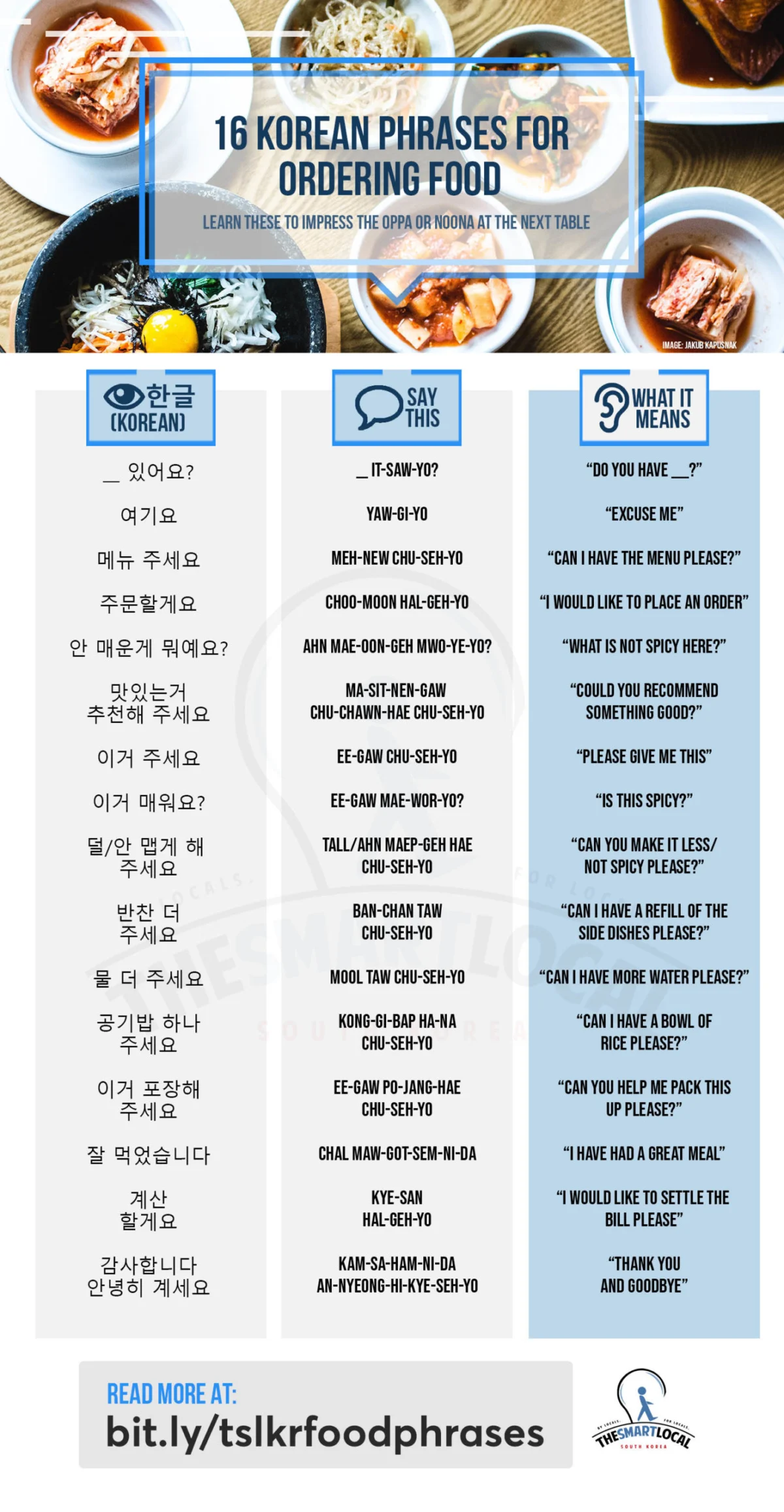
To successfully navigate a typical Korean dining environment, travelers should prioritize the following 15 phrases, categorized by their functional application in a real-world setting.

1. Inquiries and Availability
- "Do you have ?" ( isseoyo?): This is the most versatile phrase in a diner’s toolkit. It functions as a polite inquiry regarding menu availability. Whether confirming the presence of a specific dish or asking about the status of a table, the construction remains consistent.
- "Is this spicy?" (Igeo maewoyo?): Given the ubiquity of chili-based ingredients, this inquiry is essential. It allows patrons to preemptively assess the heat profile of a dish, which is critical for those with sensitivities.
- "What is not spicy here?" (An maeunge mwoyeyo?): For individuals who prefer mild flavors, this phrase allows staff to suggest non-traditional or naturally non-spicy options, such as bulgogi or certain soups, without forcing the staff to guess the patron’s preferences.
2. The Ordering Process
- "Can I have the menu please?" (Menyu juseyo): While many restaurants provide physical menus, some traditional establishments display offerings on wall placards. Using this phrase initiates the interaction professionally.
- "I would like to place an order" (Jumunhalgeyo): This is the standard opening for initiating the ordering sequence. It signals to the waitstaff that the patron has made a selection and is ready to proceed.
- "Please give me this" (Igeo juseyo): Often used in conjunction with pointing at a menu or a picture, this is the most direct way to specify an item. It minimizes the risk of mispronunciation of complex dish names.
- "Could you recommend something good?" (Masinneungeo chucheonhae juseyo): This phrase is highly effective for patrons who are overwhelmed by the breadth of a menu. It leverages the staff’s expertise and often leads to the discovery of local specialties that may not be immediately obvious to foreigners.
3. Customization and Requests
- "Can you make it less spicy?" (Deol maepge hae juseyo): For dishes that are inherently spicy, this request allows the kitchen to adjust the volume of red pepper paste or powder used during preparation.
- "Can I have a refill of the side dishes?" (Banchan deo juseyo): Banchan culture is a hallmark of Korean hospitality, and in most establishments, these side dishes are complimentary and unlimited. This phrase is the standard way to request a replenishment.
- "Can I have more water?" (Mul deo juseyo): As many meals involve high-sodium intake, water consumption is naturally high. This ensures the table’s water supply remains stocked.
- "Can I have a bowl of rice?" (Gonggibap hana juseyo): Rice is the staple of the Korean diet. This phrase is specific enough to ensure a singular bowl is brought to the table, and can be modified by changing the number word for larger groups.
- "Can you help me pack this up?" (Igeo pojanghae juseyo): Food waste reduction is a focus in many Korean cities. Most restaurants provide takeaway containers upon request, though it is standard etiquette to avoid asking for leftovers of banchan.
Establishing Rapport and Closing the Interaction
- "Excuse me" (Yeogiyo): This is the universal call-attention phrase. It is used to flag down staff in a busy environment. It is neutral, polite, and universally understood across all service sectors in Korea.
- "I have had a great meal" (Jal meogeotseumnida): Used while leaving, this phrase acknowledges the quality of the food and the service provided. It is considered high-level etiquette.
- "I would like to settle the bill" (Gyesanhalgeyo): Most payments in Korea occur at a central counter near the exit. This phrase signals the conclusion of the dining experience and the intent to pay.
Economic and Cultural Implications of Language Integration
The adoption of these phrases serves a dual purpose: it eases the operational burden on restaurant staff and creates a more positive public image of international tourists. In the context of the "Hallyu" (Korean Wave) phenomenon, where global interest in Korean culture, media, and cuisine has surged, the interaction between locals and foreigners is often viewed through the lens of cultural exchange.

Industry analysts suggest that when tourists make a sincere effort to speak local phrases, it often leads to a more favorable reception. In some instances, this has been observed to result in "service"—a Korean term referring to complimentary items provided by the establishment to show appreciation for the customer. While not an official policy, the cultural norm of rewarding a polite and appreciative guest with a small token of gratitude (such as an extra drink or a small dish) remains a common, albeit informal, practice in smaller, owner-operated businesses.

Broader Impact on Tourism Strategy
The South Korean government has invested heavily in "Global Korea" initiatives, aiming to make the country more accessible to non-Korean speakers. However, the limitation of this strategy is that it often focuses on tourist hotspots. The broader impact of individual travelers learning these 15 phrases is the democratization of the dining experience. By moving beyond the "tourist menu," visitors can access the authentic, everyday dining culture of the local population.

This, in turn, supports the local economy by distributing tourist spending more evenly across non-tourist-centric neighborhoods. Furthermore, the practice of learning these phrases aligns with the global trend toward "slow travel" and "immersive tourism," where the value of a trip is measured by the quality of local engagement rather than the quantity of sights visited.

Conclusion
Language is more than a tool for transaction; it is the primary bridge for cross-cultural understanding. While the 15 phrases outlined here are not exhaustive, they provide a robust framework for managing the most common interactions in a Korean restaurant. By integrating these phrases into their travel experience, visitors can transition from passive observers to active participants in Korea’s vibrant culinary culture. Whether it is a bustling barbecue joint in Myeong-dong or a quiet, family-run noodle shop in a residential district, the ability to communicate politely will undoubtedly leave a lasting, positive impression on the service staff and enrich the overall quality of the visit. As the travel landscape continues to evolve, the emphasis on respectful, language-conscious engagement remains a cornerstone of successful international exploration.
