

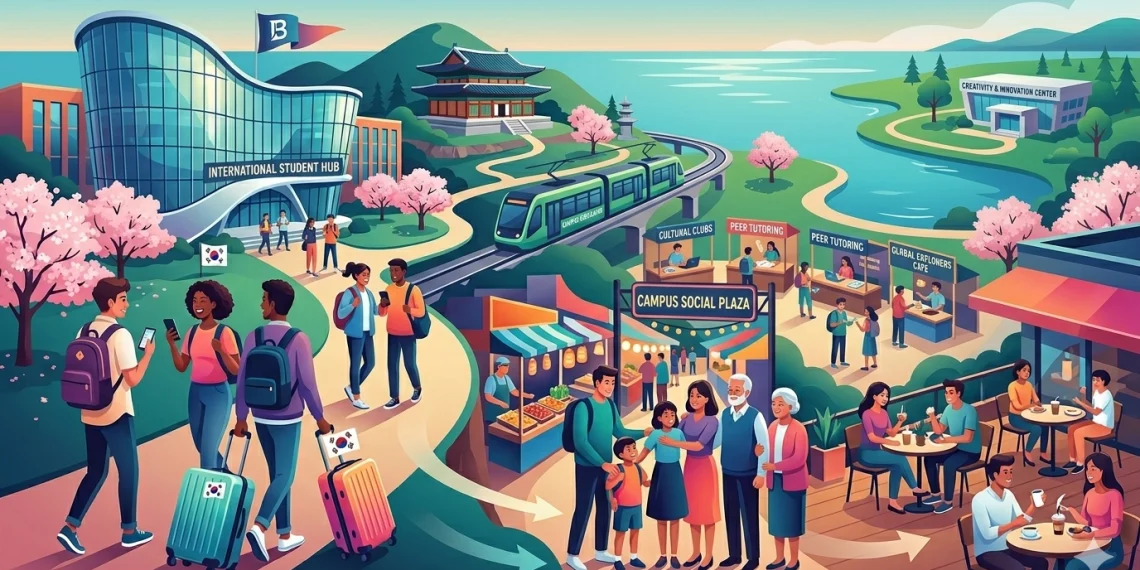
Walk into a local café in Busan or a bustling night market in Gwangju today, and a distinct demographic shift is immediately apparent. The crowds are younger, increasingly international, and noticeably untethered from the traditional gear of short-term tourism: physical guidebooks, oversized tour buses, and rigid itineraries. These individuals are not merely passing through the country for a week-long vacation; they are living there, integrating into local neighborhoods, and quietly transforming South Korea’s economy from the ground up.
In February 2026, South Korea officially crossed a monumental demographic threshold. Data released by the Korea Immigration Service confirmed that the number of international students enrolled in the country reached 314,397. This milestone marks the successful realization—and premature completion—of the government’s ambitious "Study Korea 300K" initiative, achieving its target nearly two years ahead of schedule. While education ministries typically measure the success of such programs through graduation rates and academic rankings, a parallel and arguably more profound transformation is occurring within South Korea’s tourism and regional economic sectors.
The Rise of the "Resident-Tourist" Paradigm
Traditional tourism models have long relied on short-term visitors, whose stays average approximately 7.2 days, according to historical tourism board metrics. While these transient travelers provide seasonal economic boosts, their spending is heavily concentrated in primary urban centers like Seoul, and their economic footprint dissipates the moment their flights depart.
In contrast, the influx of over 314,000 international students has introduced an entirely new economic class: the "Resident-Tourist." These individuals function as permanent, high-spending anchors within the domestic economy. Instead of a fleeting, week-long revenue stream, universities and local businesses gain a reliable, multi-year financial foundation. A typical international student remains in the country for a degree cycle lasting anywhere from two to four years, establishing consistent demand for local housing, public transportation, domestic leisure travel, and neighborhood commerce.
This long-term presence fundamentally alters consumer behavior. Because these students reside in Korea rather than merely visiting, their disposable income is injected directly into regional leisure and service economies. Whether through Hocance (hotel vacations) in coastal cities like Busan or weekend café-hopping excursions in Gwangju, international students sustain domestic tourism infrastructure during traditional off-peak periods when international flight arrivals typically dip.
A Chronology of Policy Shifts and Strategic Expansion
The dramatic acceleration of international enrollment is not accidental; it is the culmination of years of targeted government policy designed to internationalize South Korea’s higher education system while simultaneously mitigating demographic decline in regional provinces.
The origins of this strategy trace back to earlier iterations of the Ministry of Education’s "Study Korea" campaigns, which initially focused on attracting talent from neighboring Asian markets. However, as global interest in Korean culture—collectively known as the Hallyu wave—intensified globally, the government recognized an opportunity to leverage cultural capital for academic migration.
By the mid-2020s, policymakers realized that concentrating international talent solely in the Seoul Metropolitan Area exacerbated regional depopulation crises. Consequently, the strategy pivoted toward decentralization. The introduction and subsequent expansion of specialized legal frameworks, such as the K-STAR Visa and the Global Korea Scholarship (GKS) University Track, began aggressively funneling international applicants into regional institutions.
By early 2026, these policy measures successfully shifted the geographic distribution of students. While the Seoul Metropolitan Area still houses roughly 56% of international enrollees, regional hubs have seen unprecedented surges. Programs like the newly active K-Culture (Hallyu) Training Visa further bridge the gap between cultural enthusiasts and long-term academic residents, transforming casual fans of Korean media into dedicated academic and economic participants.
Concurrently, labor regulations governing international students underwent progressive liberalization. Recognizing both the financial needs of students and the labor shortages plaguing certain domestic service sectors, authorities adjusted work restrictions. Under updated 2026 policies, Master’s and PhD candidates are permitted to work up to 35 hours per week during active semesters, with unlimited working hours permitted on weekends and academic breaks. This policy change has substantially increased the purchasing power of resident students, directly feeding capital back into local service economies.
Quantitative Impact: Supporting Data and Economic Correlations
The economic implications of this demographic shift extend far beyond anecdotal observations of crowded university neighborhoods. Empirical research highlights a direct correlation between the integration of foreign graduates and regional economic productivity.
According to research findings published by the Korea Chamber of Commerce and Industry (KCCI), for every 1% increase in the share of foreign university graduates residing within the economically active population, per capita gross regional domestic product (GRDP) increases by approximately 0.11%. For regional municipalities struggling with shrinking tax bases and aging local populations, international students represent a vital demographic and economic lifeline.
Furthermore, the "Visiting Friends and Relatives" (VFR) tourism effect generates compounding financial returns. International students act as perpetual magnets for inbound tourism from their home countries. Parents, siblings, and friends regularly visit South Korea not merely for graduation ceremonies, but for exploratory trips to evaluate safety, living conditions, and lifestyle infrastructure prior to enrollment.
According to Prabakaran Srinivasan, founder of Studyinkorea.in and a 15-year veteran in international education consultancy, prospective students frequently utilize short-term programs as exploratory trials.
"Students want to explore Korea firsthand in the short term before making their final decision," Srinivasan notes. "This has led them to opt for short courses, which act as a good start to explore the safety and infrastructure confidently."
Once these students commit to full-degree programs, their visiting families consistently patronize local hotels, regional restaurants, and domestic transit networks—funneling tourism dollars into secondary and tertiary cities that traditional international tour packages routinely bypass.
Industry Perspectives and International Appeal
The surge in international enrollment is also being propelled by shifting global perceptions of safety, educational value, and institutional stability. In an era marked by rising geopolitical uncertainties and economic volatility across traditional Western study destinations, South Korea’s reputation as an advanced, high-trust society has emerged as a premier competitive advantage.
For families across diverse regions—including South Asia, Southeast Asia, Central Asia, and parts of the West—the appeal of a Korean education extends beyond institutional prestige. It offers an environment characterized by robust public safety, advanced digital infrastructure, and clear pathways to professional development. While disciplines such as Science, Technology, Engineering, and Mathematics (STEM) remain foundational, there is a burgeoning international interest in Korean business administration, media studies, and hospitality management, where the nation’s exceptional service standards provide global graduates with distinct career advantages.
Industry experts remain optimistic about the trajectory of these programs, provided institutional support continues to evolve. Srinivasan observes that while newer initiatives like the K-Culture Visa are still in their infancy, proactive institutional frameworks could yield even greater participation.
"If the Korean Government takes more initiatives in giving right recognition and awareness," Srinivasan remarks, "then Korea is unstoppable."
Broader Implications and Future Outlook
The crossing of the 300,000-student threshold forces a reevaluation of how South Korea manages its tourism, immigration, and regional development strategies. By blurring the lines between tourism, education, and permanent residency, the country has engineered a sustainable model that circumvents the limitations of short-term visitor economies.
As regional municipalities face ongoing demographic contraction, the integration of hundreds of thousands of young, economically active residents provides an essential buffer against labor shortages and urban-rural economic disparities. These students act as organic, round-the-clock cultural ambassadors, utilizing social media platforms to showcase authentic, off-the-beaten-path destinations in cities like Daegu, Jeonju, and Daejeon—accomplishing marketing reach that traditional government advertising campaigns could rarely match.
Ultimately, South Korea has evolved beyond merely marketing its academic institutions or pop-cultural exports. By cultivating an environment where international youth can live, study, work, and travel seamlessly within regional communities, the nation has pioneered a new blueprint for sustainable tourism. For the 314,000 students currently navigating its transit systems, filling its neighborhood cafés, and anchoring its regional economies, the modern Korean experience offers a definitive economic and cultural proposition: come for the global cultural phenomenon, stay for the long-term return on investment, and build a future within one of the world’s most dynamic modern societies.
