

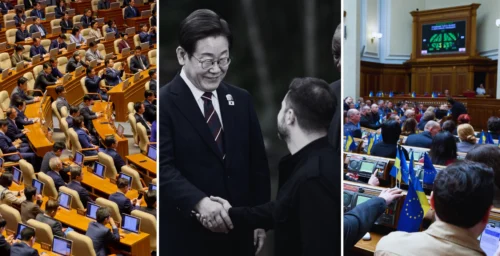
Diplomatic friction between Seoul and Kyiv has escalated following the South Korean government’s decision to recall its ambassador amid a contentious dispute concerning North Korean prisoners of war (POWs). While Ukrainian officials have responded with a measured call for cool heads and continued diplomatic engagement, the maneuver has ignited a fierce political storm inside South Korea. Domestic critics, particularly members of the parliamentary opposition, have sharply rebuked President Lee Jae Myung’s administration, arguing that the sudden recall undermines national interests and exposes glaring inconsistencies in Seoul’s foreign policy handling of both the ongoing war in Ukraine and long-standing inter-Korean hostilities.
The diplomatic fallout highlights the delicate balancing act South Korea must maintain as geopolitical fault lines deepen. With North Korea increasingly aligning its military apparatus with Russia—including reports of troop deployments and material support for Moscow’s war effort—Seoul’s handling of Ukrainian relations has direct implications for its own security posture on the Korean Peninsula.
Roots of the Dispute: The North Korean POW Controversy
The genesis of the diplomatic rift traces back to emerging intelligence and humanitarian disputes over North Korean soldiers captured or defecting on the Ukrainian front lines. Following reports that Pyongyang had dispatched engineering and combat units to support Russian forces, various military and humanitarian channels began tracking North Korean personnel who found themselves caught in the crossfire.
Complications arose over the legal status, ultimate destination, and handling of these captured individuals. Under the South Korean Constitution, all citizens of North Korea are technically considered Republic of Korea (ROK) nationals, granting them a constitutional right to resettle in the South if they express a desire to defect. However, the physical reality of recovering citizens from a distant European war zone involves complex international law, Ukrainian wartime sovereignty, and sensitive intelligence-sharing protocols with Western allies.
Disagreements over jurisdiction, access to the detainees, and the public posturing of both governments rapidly devolved into a diplomatic tit-for-tat. Seoul expressed deep dissatisfaction with how Kyiv handled communications regarding the POWs, viewing certain Ukrainian disclosures as uncoordinated and dismissive of South Korea’s unique constitutional stakes. In response to what it perceived as a breach of diplomatic protocol and a disregard for Seoul’s sensitivities, the ROK Foreign Ministry abruptly announced the recall of its top envoy to Ukraine for consultations.
Kyiv’s Measured Response: Diplomacy Over Emotion
Despite the abrupt withdrawal of the South Korean ambassador, the government in Kyiv has sought to de-escalate the tension, emphasizing the strategic necessity of maintaining a united front among democracies facing authoritarian alignment.
Speaking to local media outlets Interfax-Ukraine and Suspilne, Ukrainian Foreign Ministry spokesperson Heorhii Tykhyi adopted a conciliatory yet firm tone regarding the diplomatic spat.
“We are convinced that diplomacy must prevail over emotions,” Tykhyi stated. “Despite Seoul’s decision to recall its ambassador, Ukraine remains open to resuming constructive dialogue — even if it takes time.”
Ukrainian officials have privately and publicly underscored that Kyiv values its partnership with Seoul, particularly given South Korea’s status as a global economic powerhouse and a major producer of advanced defense technology. While Ukraine has frequently lobbied Seoul to transition from non-lethal humanitarian aid to direct military assistance—such as artillery shells and air defense systems—South Korea has maintained a strict policy against exporting lethal weapons directly to nations actively engaged in active conflicts. Kyiv hopes that despite the current friction, channels of communication will remain open to address both the POW issue and broader security cooperation against the shared challenge of North Korea-Russia military cooperation.
Domestic Backlash in Seoul: A Test for President Lee Jae Myung
While Kyiv has opted for diplomatic restraint, the reaction within South Korea has been intensely polarized. The decision by President Lee Jae Myung’s administration to recall the ambassador has drawn sharp condemnation from conservative opposition lawmakers and foreign policy experts, who argue the move damages Seoul’s international standing and alienates a vital partner in the democratic coalition against Russian aggression.
Critics within the National Assembly have accused the administration of prioritizing short-term political optics or domestic appeasement over long-term strategic alignment. Opponents argue that recalling an ambassador over a procedural dispute regarding POWs sends a confusing signal to international allies, particularly the United States and European Union members who view the war in Ukraine as a critical test of the rules-based international order.
Furthermore, the opposition has targeted President Lee’s broader foreign policy framework, pointing to what they describe as a glaring contradiction in how the administration handles the Democratic People’s Republic of Korea (DPRK). While Seoul has demonstrated extreme caution—and, according to critics, excessive restraint—in managing provocations from Pyongyang directly, its willingness to spark a diplomatic rupture with Kyiv over North Korean soldiers abroad is viewed by detractors as inverted priorities.
“Recalling our envoy to Ukraine plays directly into the hands of Pyongyang and Moscow,” a senior opposition lawmaker noted during a parliamentary committee session. “At a time when North Korea and Russia are forging a dangerous military alliance that directly threatens our security, alienating Ukraine—the very nation on the frontline of fighting our primary security threat’s proxy forces—is profoundly counter to the national interest.”
Broader Implications for ROK Foreign Policy
The unfolding diplomatic crisis underscores the profound complexities facing South Korea as traditional regional diplomacy intersects with global conflict. For decades, Seoul’s foreign policy was primarily anchored around the Korean Peninsula, US-ROK alliance mechanics, and managing relations with neighboring economic giants like China and Japan.
However, the war in Ukraine has irrevocably globalized South Korea’s security environment. With North Korea supplying millions of artillery shells and ballistic missiles to Russia in exchange for advanced satellite and military technology, the security of Kyiv and Seoul have become inextricably linked.
When South Korean intelligence and diplomatic corps engage with Ukraine, they are no longer dealing with a distant European conflict, but rather an active theater where North Korean troops are gaining modern combat experience and testing weaponry. Consequently, diplomatic missteps carry heavy costs.
As the ambassadorial vacuum persists, the ball remains largely in Seoul’s court. Analysts suggest that the Lee administration will need to carefully weigh domestic political pressures against the strategic imperative of repairing ties with Kyiv. Whether South Korea can successfully navigate the domestic backlash and restore normal diplomatic channels will serve as a crucial barometer of the administration’s capacity to conduct coherent, forward-looking foreign policy in an increasingly fragmented geopolitical landscape.
