

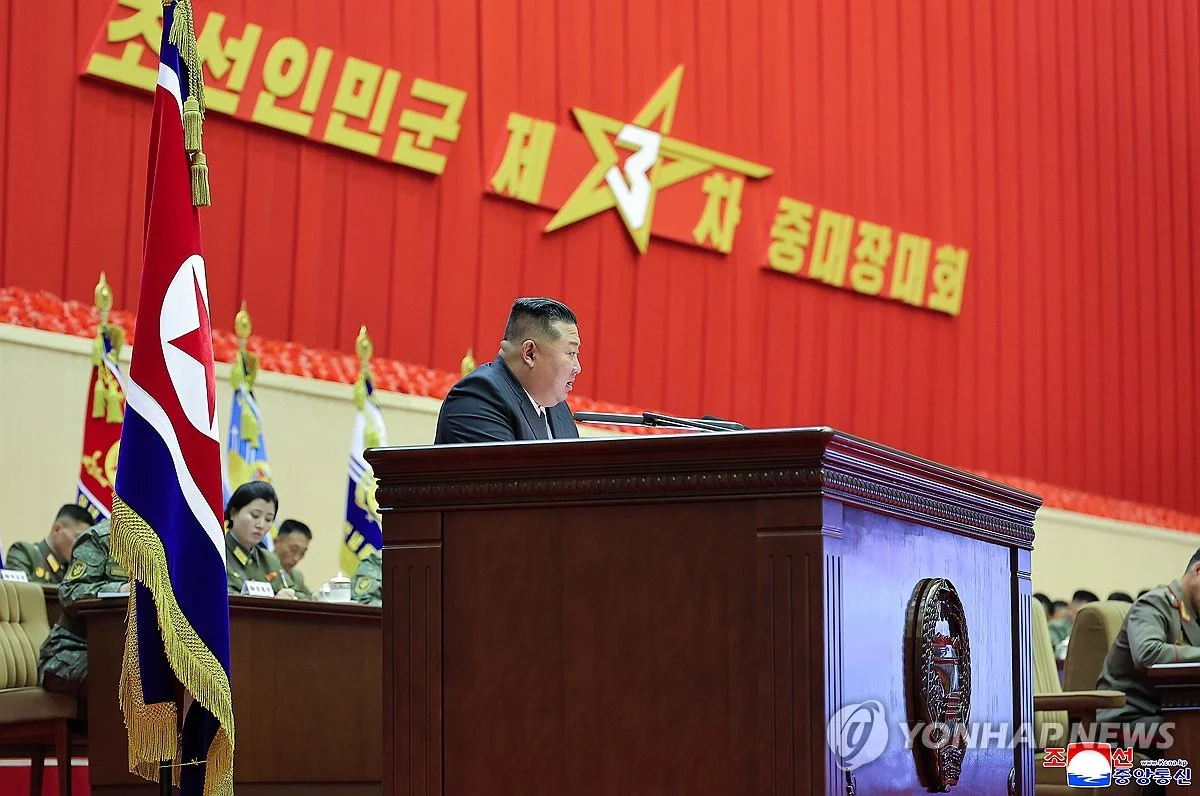
The gathering, which took place in the capital, marks the first large-scale assembly of the regime’s military leadership following the high-stakes Ninth Congress of the Workers’ Party of Korea. By emphasizing the role of the company—the primary tactical unit of the military—Kim is signaling a granular approach to military reform, focusing on the grassroots level to ensure that the regime’s political ideology permeates every tier of the armed forces.
The Strategic Imperative of the Ninth Party Congress
To understand the gravity of Kim’s recent address, one must examine the context of the Ninth Congress of the Workers’ Party of Korea. During that pivotal assembly, the regime outlined a comprehensive roadmap for the next five years, emphasizing the need for rapid technological advancements in defense and a hardening of its stance against external threats. The Congress served as a catalyst for restructuring various administrative and military departments, moving toward a more centralized, high-alert posture.
The recent meeting of company commanders acts as the operational execution of the strategic goals set forth during the Congress. By convening leaders from across the entire KPA, Kim is ensuring that the mandates from the Party Congress are not merely theoretical directives but are integrated into the daily training and organizational culture of the military’s smallest units. This emphasis on the "company level" suggests a shift toward enhancing battlefield autonomy and unit-level effectiveness, potentially in response to advancements in modern, mobile, and network-centric warfare.
Chronology of Recent Military Escalations
The call for the "strongest army" does not occur in a vacuum; it is the latest development in a sequence of events that have defined North Korea’s military trajectory over the last twenty-four months:
- Q3 2025: The regime significantly increases its frequency of short-range ballistic missile tests, citing the need to "neutralize" regional threats.
- Q1 2026: Pyongyang announces the successful testing of new, high-yield tactical weapon systems, accompanied by a shift in rhetoric regarding the "inevitability" of conflict on the peninsula.
- August 2026: The Ninth Congress of the Workers’ Party of Korea concludes, formalizing a new defense doctrine that prioritizes the modernization of the KPA’s conventional and nuclear command structures.
- October 22–23, 2026: The Third Meeting of Company Leaders takes place in Pyongyang, where Kim Jong-un formalizes the mandate to train the "strongest companies" as the cornerstone of the national military revolution.
Ideological Purity and the Role of the KPA
A critical component of Kim’s address was the insistence that the military must act as the "army of the Party." In the North Korean context, this is a call for strict adherence to the Juche (self-reliance) and Songun (military-first) ideologies. Kim instructed commanders to foster a climate where soldiers are ideologically vaccinated against external influences, which the regime views as a primary threat to its internal stability.
By labeling the KPA the "army of ideology and core elements," the regime is reaffirming that military capability is inextricably linked to political loyalty. This dual-track approach—technical military training combined with intense ideological indoctrination—is intended to create a fighting force that is both technologically formidable and immune to dissent. For the company commanders, this means they are not only tactical instructors but also political commissars responsible for the cognitive state of their subordinates.
Statistical Context and Force Posture
The Korean People’s Army remains one of the largest standing militaries in the world, with estimated active-duty personnel exceeding 1.2 million. While the military relies on legacy hardware from the Cold War era, recent trends indicate a pivot toward localized production of high-precision munitions and an expansion of cyber-warfare capabilities.
Data from independent security analysts suggest that while the North’s conventional forces face significant resource constraints, the regime has successfully prioritized the modernization of its rocket forces and strategic deterrents. The focus on company-level training suggests that the regime is aware of the limitations of its aging armored divisions and is looking to compensate by increasing the lethality and agility of its infantry and special operations units. By empowering company leaders, Kim is likely attempting to decentralize tactical decision-making, allowing for more flexible responses to potential kinetic engagements.
Regional Reactions and International Implications
The international community has responded to the rhetoric with heightened vigilance. In Seoul, the Ministry of Unification and the Ministry of National Defense have been closely monitoring the fallout from the meeting. South Korean intelligence reports indicate that the meeting was designed to boost morale within the ranks, which may have been affected by domestic economic challenges and food shortages.
The United States, Japan, and South Korea continue to conduct joint maritime and aerial exercises, which Pyongyang views as provocative rehearsals for an invasion. The declaration of building the "strongest army" is interpreted by these nations as a signal that Pyongyang is not interested in de-escalation in the near term. Analysts suggest that the regime is attempting to leverage its military posture to gain concessions or to maintain internal cohesion during a period of geopolitical isolation.
The "Strongest Army" Doctrine: Analysis of Implications
The implications of Kim’s rhetoric are manifold. First, it signifies that the regime is moving toward a permanent state of high-alert. By framing the modernization of the army as an "accelerated revolution," Kim is signaling that military readiness will take precedence over civilian economic reform for the foreseeable future.
Second, the focus on company-level commanders reveals a strategic concern regarding command and control. In modern conflicts, the ability to operate under decentralized conditions is essential. By drilling the ideology and tactical requirements into the company level, the KPA is attempting to mitigate the risks associated with potential communication disruptions during a conflict.
Third, the move underscores the regime’s belief that its survival is entirely dependent on its military strength. In the eyes of the North Korean leadership, the "strongest army" is the only guarantee against regime change. This creates a feedback loop where every perceived external threat—such as international sanctions or regional military exercises—justifies further military investment, which in turn leads to increased regional tension.
Conclusion: The Future of the Korean Peninsula
As the KPA moves to implement the directives from the Third Meeting of Company Leaders, the international community must prepare for a period of continued friction. The emphasis on ideological indoctrination combined with tactical modernization suggests that North Korea is not seeking a return to diplomatic dialogue, but is instead doubling down on its "military-first" identity.
The role of the company commander, as defined by Kim Jong-un, is now at the heart of the regime’s survival strategy. As these leaders return to their posts, the efficacy of the KPA will likely be measured by their ability to translate these abstract calls for "strength" into tangible, measurable military gains. For the foreseeable future, the Korean Peninsula remains a flashpoint where the pursuit of the "strongest army" by one state is perceived as an existential threat by its neighbors, ensuring that the cycle of military build-up and diplomatic impasse remains the defining feature of the regional security architecture.
The world watches as the KPA attempts to modernize under the weight of strict political control. Whether this "military revolution" leads to genuine tactical improvement or further strains the regime’s limited resources remains a point of intense debate among security experts. What is clear, however, is that Pyongyang’s commitment to building a formidable, ideologically unified military force continues to dictate the pace of developments in Northeast Asia, keeping the region in a state of high-stakes, enduring tension.
