

Navigating the transit corridor between Incheon International Airport and downtown Seoul has become increasingly streamlined, yet choosing the optimal mode of transportation depends heavily on a traveler’s destination, budget, and arrival schedule. Serving as South Korea’s primary international gateway, Incheon International Airport handles tens of millions of passengers annually across its two main terminals. For travelers touching down at either Terminal 1 or Terminal 2, a robust infrastructure of rail systems, airport limousine buses, and metered or specialized taxis offers connectivity to the capital city. Official transit operators have updated their fare structures and operational timetables, providing fixed costs and predictable schedules designed to accommodate both daytime commuters and late-night arrivals.
Main Facts and Service Overview
Traveling from Incheon Airport to central Seoul primarily involves three transit categories: the Airport Railroad Express (AREX), airport limousine buses, and private or international taxis. The AREX rail system is bifurcated into two distinct services: the All-Stop train and the Express train. The All-Stop train caters to commuters and travelers heading to specific neighborhood hubs such as Hongik University or Digital Media City, culminating at Seoul Station. Conversely, the AREX Express operates as a non-stop, direct service specifically connecting Incheon Airport to Seoul Station, prioritizing speed and luggage convenience for tourists and business travelers alike.
For travelers preferring road transport, airport limousine buses offer direct routes to major hotels, commercial districts, and transit nodes across Seoul. These vehicles are equipped for luggage storage and provide a seamless journey, though travel times remain subject to regional highway traffic conditions. Taxis stationed at the arrival halls of both terminals provide door-to-door service, operating on standard meters with implemented night-time surcharges, alongside specialized International Taxis equipped with multi-lingual assistance and fixed flat rates for foreign nationals.
Chronology and Operational Timetables
Understanding the daily operating windows of Incheon Airport’s transit systems is critical for international arrivals, particularly for those landing during late-night or early-morning hours. The daily transit schedule begins in the early pre-dawn hours and winds down systematically past midnight.
The operational timeline for the AREX rail network establishes that the first All-Stop train departs Terminal 2 at 05:08, followed by Terminal 1 at 05:14. Throughout the day, these trains maintain a consistent interval, stopping at key stations including Gimpo Airport and Hongik Univ. As the service day concludes, the final All-Stop train running the full route to Seoul Station departs Terminal 2 at 23:32 and Terminal 1 at 23:38. A subsequent late-night service departs Terminal 2 at 23:50 and Terminal 1 at 23:56, though this specific train terminates early at Digital Media City.
For the non-stop AREX Express service, the initial morning departure leaves Terminal 2 at 05:16 and Terminal 1 at 05:24. The final Express service of the day departs Terminal 2 at 22:40 and Terminal 1 at 22:48. Passengers arriving after these hours must rely on late-night limousine buses, such as the N6002 route departing Terminal 1 toward Hongdae starting at midnight, or transition directly to airport taxi queues.
Supporting Data and Fare Structures
Official pricing data released by transport operators outlines clear financial distinctions between each transit option. Fares vary depending on the chosen terminal of departure, payment method, and passenger age category.
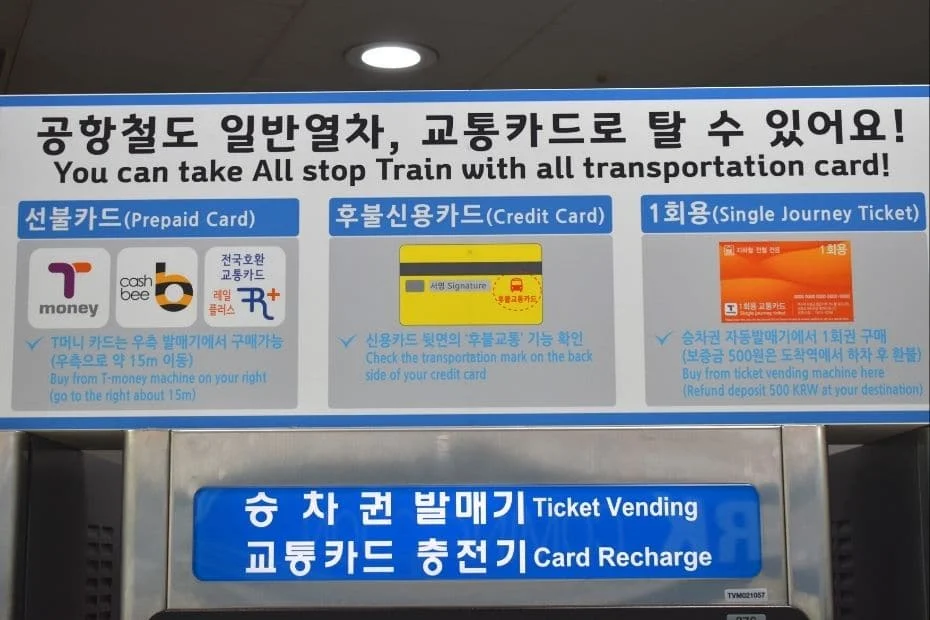
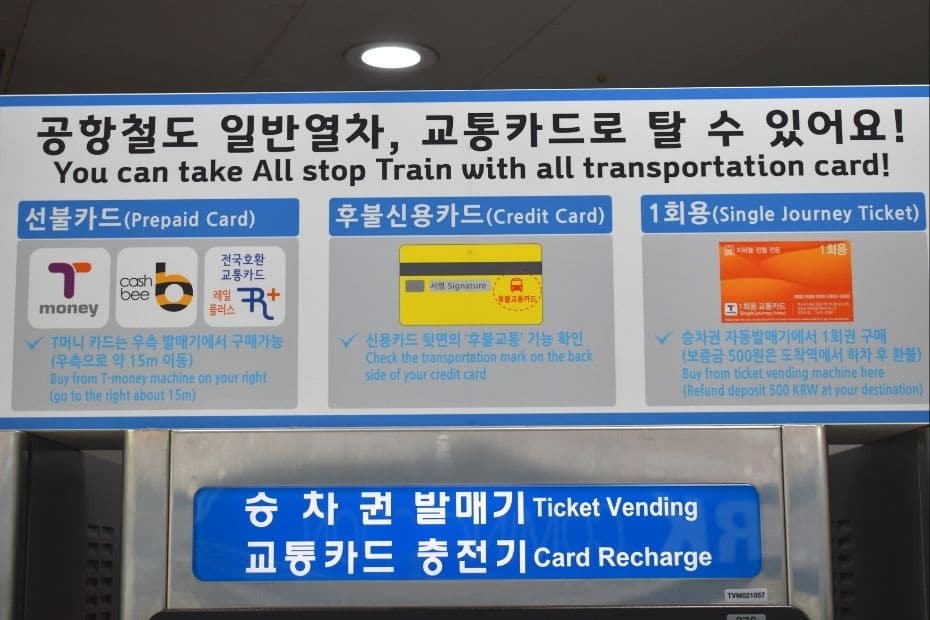
The AREX All-Stop train fare to Seoul Station, when utilizing a rechargeable transport card such as T-money, is priced at ₩4,750 from Terminal 1 and ₩5,350 from Terminal 2. Passengers traveling to intermediate cultural and commercial hubs like Hongik Univ. pay ₩4,650 from Terminal 1 and ₩5,250 from Terminal 2. Purchasing a single-use paper ticket incurs an additional ₩100 surcharge, alongside a refundable ₩500 deposit retrievable upon returning the card at the destination station’s deposit refund devices.

The AREX Express train features a flat adult fare of ₩13,000, while children aged 6 to 12 are charged a reduced rate of ₩9,500. This service guarantees a designated seating assignment and includes access to the express elevators and customer lounges at Seoul Station.
Airport limousine buses operating direct downtown routes charge a standardized adult fare of ₩17,000, with children’s tickets priced at ₩12,000.
Taxi fares begin with a base meter rate of ₩4,800 for standard vehicles originating from Seoul, Gyeonggi, and Incheon jurisdictions. To manage driver supply and demand during off-peak hours, regulatory bodies enforce tiered nighttime surcharges for Seoul and Incheon taxis. A 20% surcharge is applied during the hours of 22:00 to 23:00 and 02:00 to 04:00, which increases to a 40% surcharge during peak late-night hours between 23:00 and 02:00. Specialized International Taxis mitigate fare uncertainty by offering pre-determined flat rates to various zones across Seoul.
Official Guidelines and Passenger Preparation

Transportation authorities and travel advisors emphasize essential pre-transit preparations for international visitors navigating Incheon Airport. Before exiting the terminal arrival halls, passengers are strongly advised to secure local telecommunications access through physical SIM cards or eSIM profiles to enable real-time navigation and ride-hailing applications. Additionally, acquiring and loading a contactless transit card—such as a T-money or WOWPASS card—expedites boarding procedures across the AREX network, municipal subway lines, and urban bus systems without the need for cash transactions or single-use ticket purchases.
Broader Impact and Economic Implications
The efficiency and modernization of Incheon Airport’s ground transportation network play a vital role in South Korea’s broader tourism economy and urban mobility framework. By integrating high-speed rail links with flexible road transport and digital payment ecosystems, the city minimizes passenger congestion and enhances the initial visitor experience. The clear demarcation of tariffs, combined with multilingual support services and transparent meter regulations, safeguards consumer rights and promotes confidence among international arrivals. As Seoul continues to position itself as a premier global hub for business and leisure travel, the continuous optimization of airport transit corridors remains a foundational element of municipal infrastructure development.
