

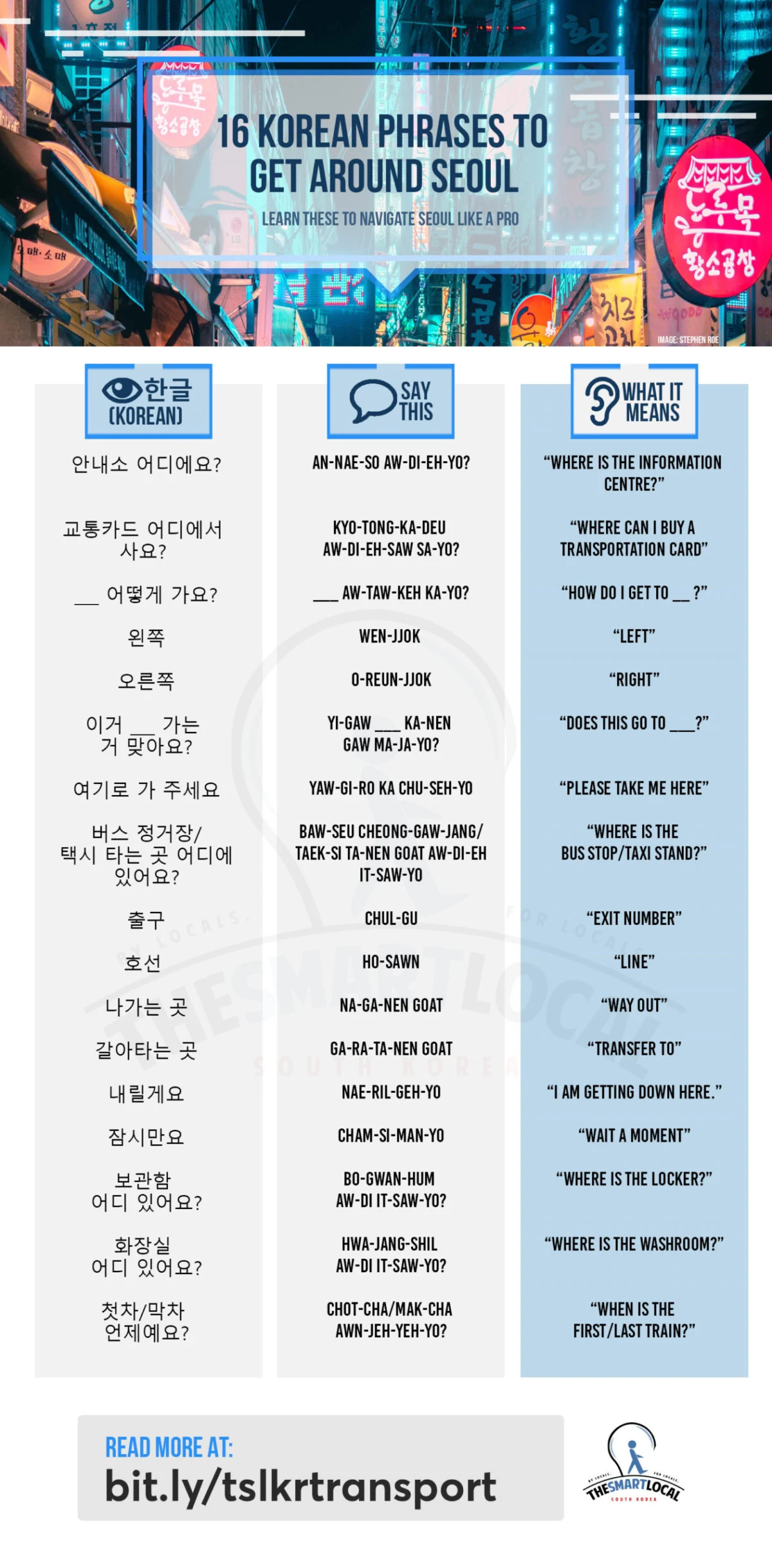
Seoul is home to one of the most efficient, expansive, and technologically advanced public transportation systems in the world. With the Seoul Metropolitan Subway system spanning over 300 kilometers and serving millions of passengers daily, it serves as the circulatory system of the South Korean capital. Despite this world-class infrastructure, the sheer scale of the network—comprising over 20 lines and hundreds of stations—can present a significant navigation challenge for international visitors unfamiliar with the Hangeul script or the nuances of local transit protocols. As South Korea continues to solidify its position as a top-tier global tourism destination, with visitor numbers consistently trending upward in the post-pandemic era, the ability to communicate basic transit requirements has become an essential skill for independent travelers.

The Evolution of Seoul’s Transit Accessibility
The current state of Seoul’s transit network is the result of decades of rapid modernization. The Seoul Subway began operations in 1974 with a single line connecting Seoul Station to Cheongnyangni. Over the following fifty years, the system evolved into a complex web managed by entities such as the Seoul Transportation Corporation and Korail. While the integration of English-language digital signage, mobile apps like Naver Maps and KakaoMap, and the ubiquity of the T-Money smart card system have dramatically lowered the barrier to entry for foreigners, language barriers remain the primary friction point. Historical data from tourism surveys consistently indicates that while physical navigation tools are adequate, the inability to interact with station staff or local commuters during peak hours often leads to anxiety and delays for tourists.

Essential Communication Strategies for Transit Users
Navigating a system of this magnitude requires more than just a map; it requires the ability to solicit assistance. The following phrases serve as a foundational toolkit for any visitor, moving beyond simple tourist interaction into functional, situational communication.

Information Centers and Basic Assistance
The first point of contact for a confused traveler is typically an information center. These facilities are strategically placed at major transit hubs and airport arrival terminals. To solicit help, travelers should use the phrase, "Annaeso eodieyo?" (Where is the information center?). Staff members at these kiosks are trained specifically to provide multilingual support and are generally the best resources for resolving complex routing issues, such as identifying the correct subway line for a cross-city transfer or verifying if a specific bus route is currently operational.

Acquiring and Managing Transit Cards
The T-Money card is the cornerstone of Seoul’s transit experience, functioning as a universal payment method for buses, subways, and even certain taxi services. Obtaining a card is a high priority upon arrival. While vending machines are common, locating them in the sprawling architecture of Incheon International Airport or major rail terminals can be difficult. Asking, "Gyotongkadeu eodieseo sayo?" (Where can I buy a transportation card?) at an information booth is the most efficient way to secure one. These cards can be topped up at any convenience store or station kiosk, and they eliminate the need to purchase individual tickets, which is a major contributor to travel efficiency in the city.

Directional Navigation and Destination Queries
When GPS applications fail or signal is lost in underground tunnels, verbal confirmation becomes necessary. The phrase "[Destination Name] eotteoke gayo?" (How do I get to [Destination Name]?) acts as a universal bridge. By substituting a location—such as Gyeongbokgung Palace, Myeongdong, or the Bukchon Hanok Village—into this sentence, a traveler can gain immediate clarity from local commuters. It is important to note that when directions are provided, understanding the terms "Oenjjok" (Left) and "Oreunjjok" (Right) is crucial for translating those verbal instructions into movement.

Operational Protocol: Ensuring Seamless Travel
Beyond finding one’s way, the operational etiquette of Seoul’s transit system is strict. Understanding when to act—and what to say while acting—is vital for maintaining the flow of the system.

Boarding and Alighting Procedures
Seoul’s buses operate on a high-frequency, high-speed model. In crowded conditions, it is common to be physically distanced from the exit button. In such cases, the phrase "Naerilgeyo" (I am getting off here) serves as a necessary notification to the driver. Similarly, "Jamsimanyo" (Wait a moment) is an effective way to request that a driver pause to allow for safe egress. These phrases are not merely helpful; they are essential for safety in a system where buses move rapidly between stops.

Deciphering Signage and Facilities
For those attempting to navigate without verbal intervention, reading signage is the next line of defense. The most critical signs to recognize include "Chulgu" (Exit), which is typically followed by a number, and "Hoseon" (Line). Knowing that "Naganeun got" means "Way Out" and "Garataneun got" denotes a "Transfer" location can save travelers from walking in circles in complex stations like Seoul Station, which serves as a nexus for the KTX, ITX, and multiple subway lines.

Facility Management
Finally, the ability to locate amenities is a frequent requirement. Whether seeking "Bogwanham" (Locker) for luggage storage or "Hwajangsil" (Washroom), these inquiries are best phrased as "Eodi isseoyo?" (Where is…?). These facilities are well-maintained throughout the city, but they are often tucked away in corridors, making the ability to ask for directions a practical necessity rather than a luxury.

Analytical Implications of Language Preparedness
The impact of these simple linguistic tools extends beyond individual convenience. For the broader Seoul tourism economy, the ease of navigation is directly correlated with the "re-visit rate" of international tourists. When visitors can navigate the city independently, they spend less time in transit hubs and more time at local businesses, cultural sites, and dining establishments. This increases the economic footprint of the average tourist and reduces the burden on city infrastructure by preventing bottlenecks in high-traffic areas.

Furthermore, as South Korea continues to promote its "Smart City" initiatives, the integration of real-time transit data with accessible language tools will likely become even more streamlined. However, even in an era of AI translation and digital mapping, the human element—the ability to look a station official in the eye and ask a question in the local language—remains the most reliable fail-safe.

Conclusion
The Seoul transit system is a marvel of urban planning, designed to move millions of people with precision and speed. While it can appear daunting at first glance, the language required to master it is remarkably accessible. By mastering these sixteen phrases, travelers move from being passive observers to active participants in the city’s rhythm. This shift in capability not only ensures a more efficient trip but also fosters a deeper, more respectful engagement with the culture of Seoul. Whether asking for the nearest subway line or simply expressing gratitude with a polite "Kamsa-ham-ni-da," the effort to communicate in the local tongue is universally recognized and appreciated, turning a potentially stressful commute into a smooth and rewarding experience.
