

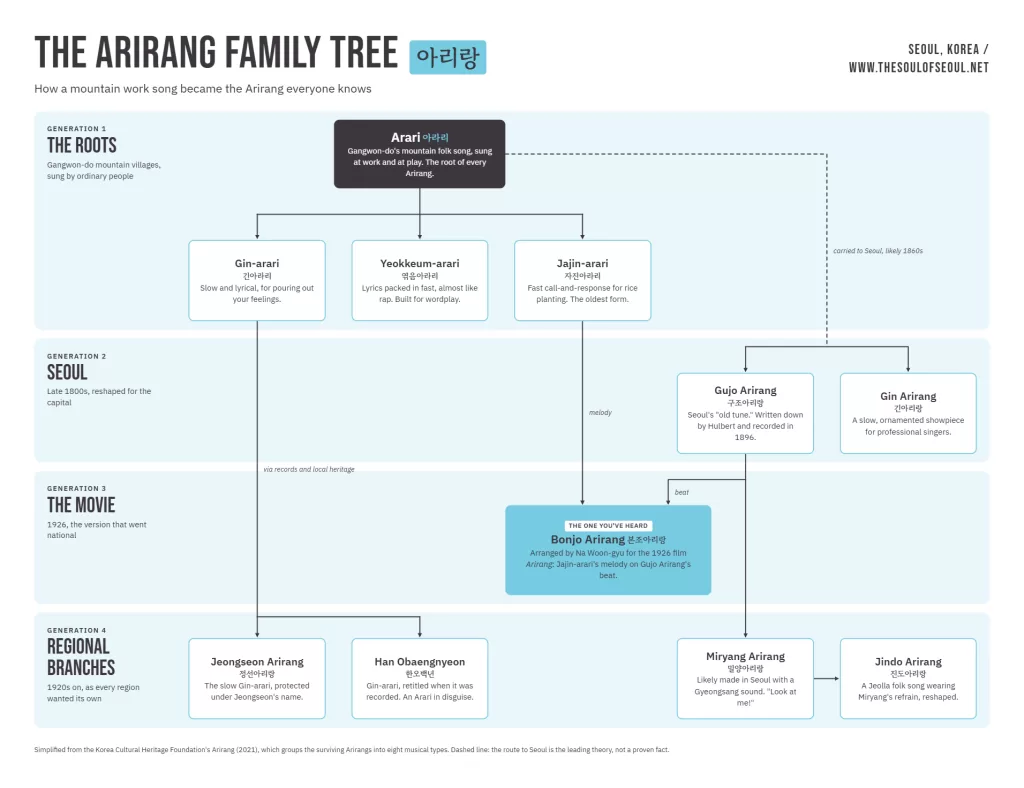
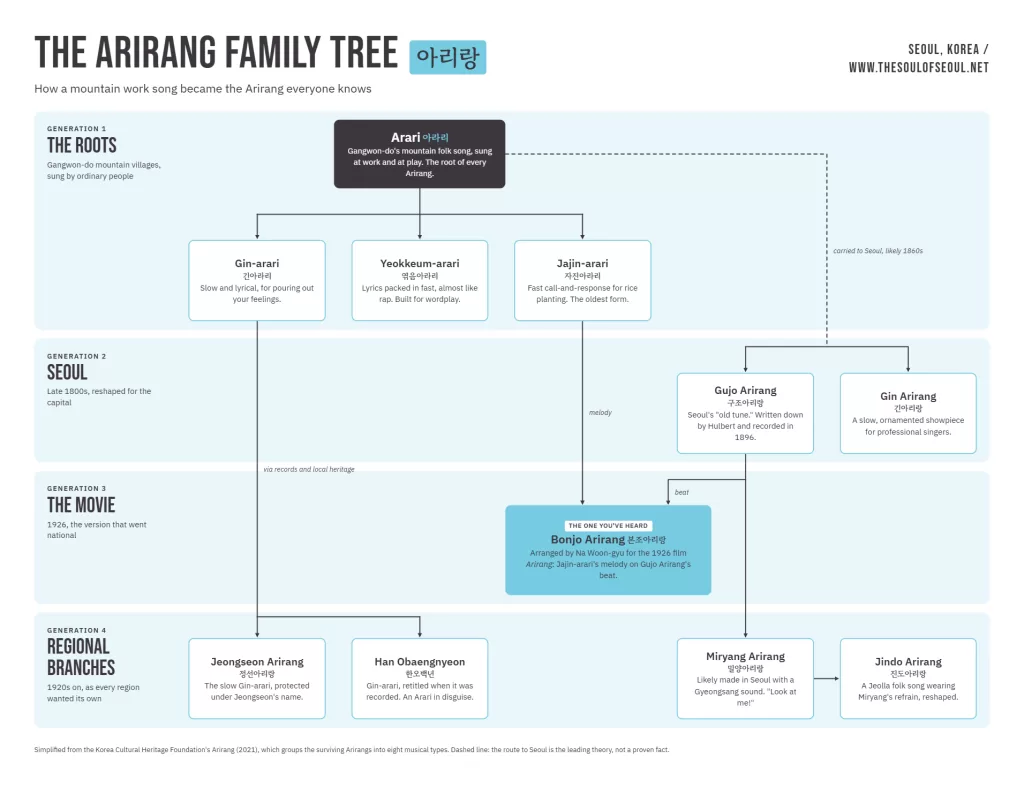
The cultural topography of the Korean Peninsula is anchored by a musical composition so pervasive that it functions as an unofficial national anthem, a historical archive, and a psychological anchor for millions worldwide. Arirang, widely misconstrued by casual observers as a single, immutable tune, is in reality a vast, decentralized family of folk songs encompassing roughly 3,600 variations across 60 distinct regional versions in South Korea, alongside dozens more documented in North Korea and within global diaspora communities. This oral tradition transcends mere melodies; it is a dynamic cultural repository inscribed on UNESCO’s Representative List of the Intangible Cultural Heritage of Humanity, capturing the socio-political trials, triumphs, and daily realities of the Korean people over centuries.
Structural Anatomy and the Myth of a Single Song
To understand Arirang is to understand a tradition defined not by a rigid score, but by a flexible refrain. Musically, a piece qualifies as a member of the Arirang family if it incorporates the characteristic chorus—built around the vocalization of words such as "Arirang," "Arari," or associated vocables—followed by verses that are continually adapted by singers. While melodies, regional dialects, and rhythmic structures shift dramatically from the mountainous terrain of Gangwon-do to the southern island of Jindo, the thematic essence remains tied to motifs of departure, separation, longing, labor, and resilience.

Musicologists generally categorize the surviving repertoire into eight primary musical types, tracing their lineage back to rural work songs. The overarching tradition lacks a single designated master or institutional copyright holder; rather, it belongs collectively to the practitioners who keep it alive. This communal ownership was formally recognized in September 2015 when South Korea designated Arirang as a national intangible heritage asset without assigning a traditional master holder—a legal and cultural precedent designed to honor the folk-derived nature of the art form.

Chronological Evolution: From Mountain Song to Global Phenomenon
The historical trajectory of Arirang spans centuries of oral transmission, political upheaval, and eventual global dissemination. The evolution of the tradition can be tracked through several defining epochs:

- Pre-1800s: The emergence of Arari, the rustic mountain folk song of the Gangwon-do region, sung by agrarian communities along the Taebaek mountain range. Early scholarly records from the late 18th century document similar refrains, laying the groundwork for the modern tradition.
- 1860s–1880s: The migration of the song to Seoul, largely catalyzed by the massive conscription of laborers and transport of timber from Gangwon-do for the reconstruction of Gyeongbokgung Palace. By the 1880s, the tune had captured the attention of the royal court, frequently performed for King Gojong.
- 1896: The first documented Western transcription by American missionary Homer Hulbert in The Korean Repository, followed closely on July 24, 1896, by the earliest known audio recording. Captured on wax cylinders by ethnologist Alice C. Fletcher in Washington, D.C., featuring three Korean students, these recordings reside today in the Library of Congress.
- October 1, 1926: The premiere of filmmaker Na Woon-gyu’s groundbreaking silent film Arirang at the Dansungsa theater in Seoul. Na’s newly arranged theme song, Bonjo Arirang, became an overnight sensation, intertwining the melody inextricably with anti-colonial sentiment during the Japanese occupation.
- Mid-20th Century: The global spread of the melody via the Korean War, leading to international jazz and pop adaptations in the United States, alongside its adoption by Korean independence fighters across Manchuria and the Soviet Far East as a covert medium for communication.
- 1991–2018: A period of diplomatic reconciliation during which the two Koreas utilized Arirang as a shared anthem for joint athletic delegations, culminating in its performance at the 2018 PyeongChang Winter Olympics.
- 2012–2014: International recognition via UNESCO inscription. South Korea successfully inscribed Arirang on the Intangible Cultural Heritage list in December 2012, followed by North Korea’s independent inscription in 2014.
- 2026: The centennial of Na Woon-gyu’s cinematic milestone, marked by nationwide retrospectives, museum exhibitions, and a prominent contemporary cultural resurgence exemplified by the release of the K-pop group BTS’s full-group comeback album, titled Arirang.
Regional Diversity: The Three Great Arirangs
While dozens of local variations exist, musicologists and cultural authorities heavily emphasize the "Three Great Arirangs," each representing distinct geographical and emotional topographies of the peninsula:
- Jeongseon Arirang (Gangwon-do): Serving as the closest living link to the primordial mountain song Arari, Jeongseon’s version is characterized by slow, plaintive, and conversational phrasing. Historically tied to the timber rafters who floated logs down the Namhangang River, the style preserves ancient lyrical structures reflecting separation and existential endurance.
- Miryang Arirang (Gyeongsangnam-do): In stark contrast to the mournful mountain tunes, Miryang Arirang is brisk, upbeat, and rhythmically infectious. Driven by confident, flirtatious lyrics and an energetic tempo, it became a favorite of independence fighters and urban performers alike, frequently accompanied by rapid hand-clapping and dance.
- Jindo Arirang (Jeollanam-do): Originating from the southwestern island of Jindo, this version is intensely ornamented, emotionally rich, and technically demanding. Blending local southern folk melodies with standard Arirang refrains, it showcases the sophisticated vocal control typical of the region’s musical heritage, often blending humor with deep historical grievance.
Sociopolitical Implications and Contemporary Resonance
The enduring viability of Arirang lies in its dual capacity to mirror both collective national trauma and personal, mundane joy. During the Japanese colonial period (1910–1945), the song functioned as a vital instrument of cultural preservation and quiet defiance. Historical accounts document comfort women survivors and forced laborers who, stripped of their native language and identity through decades of displacement, retained their humanity and heritage solely by humming the tune.
In the contemporary era, the legacy of Arirang continues to expand beyond traditional performance spaces. The decision by global music icons BTS to name their post-military service reunion album Arirang underscores the song’s potent utility as a vehicle for modern national identity, continuity, and global outreach. By anchoring a cutting-edge pop production in a foundational century-old cultural motif, the release bridges the gap between historical preservation and 21st-century soft power.
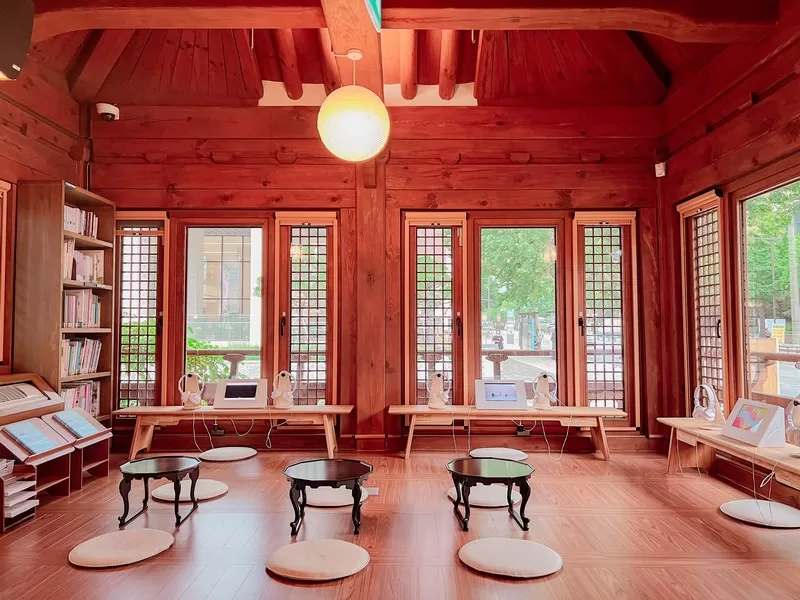
For scholars, preservationists, and travelers wishing to engage directly with the tradition, institutions such as the Seoul Museum of Korean Folk Music—situated opposite Changdeokgung Palace—offer extensive digital archives containing thousands of field recordings gathered from hundreds of rural villages. These resources, alongside regional festivals in Jeongseon, Miryang, and Jindo, ensure that the multifaceted family of Arirang remains an evolving, living testament to the resilience of Korean culture.
