

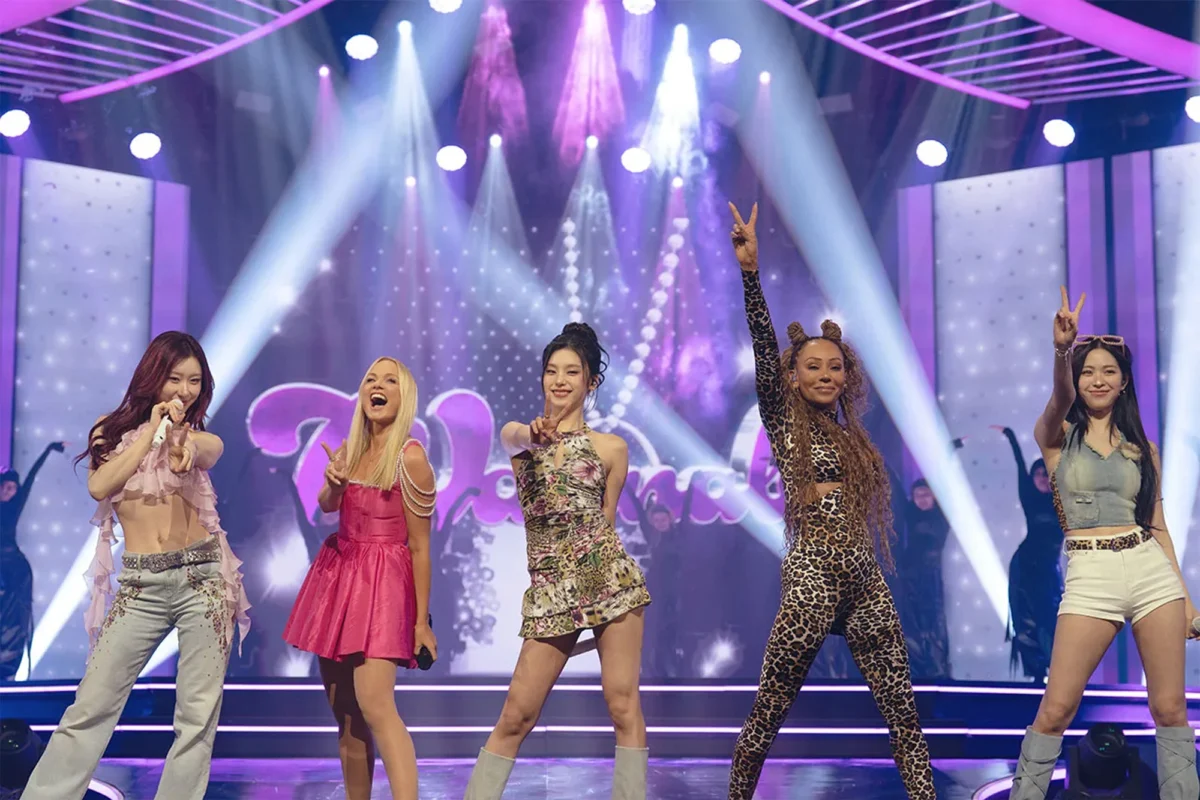
The intersection of Eastern and Western popular culture has reached a formidable new milestone with the release of Apple TV+’s groundbreaking eight-part docuseries, K-popped. Debuting in September 2025, the ambitious television project moves beyond standard industry cross-overs by physically and creatively blending top-tier K-pop groups with legendary, multi-platinum Western music acts. Rather than simply sharing a bill, artists from entirely different eras, musical traditions, and cultural backgrounds are restructured into hybrid units, creating an unprecedented spectacle for global audiences.
Main Facts of the Production
At its core, K-popped is structured as an eight-part musical competition and cultural exchange series. Each episode dismantles the traditional boundaries of collaborative performance by splitting a prominent K-pop group and an iconic Western music artist directly in half. The resulting mixed-ensemble groups are then tasked with staging high-concept, reimagined joint performances of classic hits from their respective discographies.
The roster of talent assembled for the inaugural season represents decades of global chart dominance. Featured K-pop powerhouses such as ITZY and ATEEZ share the screen and the stage with monumental Western legacy acts, including the Spice Girls, Kylie Minogue, TLC, and American rapper Megan Thee Stallion. Spearheaded by Apple TV+’s unscripted content division, the series aims to capture not only the polished final performances on stage, but also the linguistic barriers, creative friction, cultural negotiations, and behind-the-scenes camaraderie that occur during the rehearsal process.
Chronology and Development of the Crossover Phenomenon
The trajectory of Korean popular music into Western mainstream consciousness has been decades in the making, transitioning from a localized East Asian phenomenon to a dominant global export. Throughout the late 2000s and 2010s, groups like Girls’ Generation, BIGBANG, and EXO laid the groundwork for international touring. By the late 2010s and early 2020s, acts such as BTS and BLACKPINK achieved historic milestones, headlining stadiums across North America and Europe, selling out Wembley Stadium, and topping the Billboard charts.
However, these historic achievements primarily manifested as parallel success stories—K-pop acts conquering Western markets independently, or occasionally featuring Western artists on recorded tracks without face-to-face creative integration. The genesis of K-popped represents the next evolutionary step: forced creative synthesis.

Production on the series began quietly in late 2024 under strict security protocols to prevent leaks of the unexpected artist pairings. Apple TV+ formally teased the project in mid-2025, sending shockwaves through fandoms worldwide by revealing the scale of the matchups. The series officially premiered in September 2025 to widespread international streaming traffic, instantly dominating social media discourse and establishing a new benchmark for music-based unscripted television.
Highlight Performances and Musical Highlights
The core appeal of K-popped lies in its high-risk, high-reward performance pairings. Each episode features meticulous arrangements that honor the legacy of the original tracks while infusing the razor-sharp choreography, vocal layering, and high-energy performance styles characteristic of modern K-pop production.
Among the standout collaborations heavily featured in early promotional cycles is the union between fourth-generation powerhouse group ITZY and 1990s British pop phenomenon the Spice Girls. The cross-generational girl groups delivered a heavily publicized rendition of the Spice Girls’ global 1996 anthem Wannabe. In a remarkable twist of pop coincidence, ITZY coincidentally possessed their own distinct musical release bearing the same title, adding a layer of symmetry to the collaboration. The performance seamlessly blended the fierce, synchronized dance moves of contemporary K-pop with the charismatic, empowering pop-ensemble energy that defined the British icons.
Another critically anticipated crossover pairs the intense theatricality of boy band ATEEZ with Australian pop royalty Kylie Minogue. The ensemble tackled Minogue’s hypnotic 2001 dance-pop classic Can’t Get You Out of My Head. The resulting stage production married Minogue’s timeless electronic sophistication with ATEEZ’s aggressive, dynamic performance style, transforming the millennium-era club track into a cinematic stadium experience.
Further expanding the genre boundaries, American rap superstar Megan Thee Stallion teamed up with rising K-pop girl group Billlie. The collaboration breathed fresh life into Megan Thee Stallion’s 2020 viral hip-hop smash Savage. By integrating complex K-pop choreography and localized vocal harmonies into the verses of the fierce American track, the artists produced a cross-cultural statement that underscored hip-hop’s universal appeal.
Official Statements and Industry Reactions
The audacity of the production has drawn significant commentary from participating artists and industry analysts alike. The collaborative friction—and the historical weight of the project—was explicitly highlighted by Megan Thee Stallion in the series’ official promotional teaser.

"This has never been done before. This is some history that we’re making," the three-time Grammy-winning rapper proclaimed, capturing the sentiment of participants who recognized the unprecedented nature of the cross-cultural exchange.
Industry critics and entertainment executives have noted that K-popped serves as a powerful validation of the globalized music market. For decades, Western pop markets operated as a self-contained ecosystem that rarely acknowledged foreign-language music outside of occasional novelty hits. The willingness of foundational Western acts—such as members of the Spice Girls and Kylie Minogue—to deconstruct their signature works alongside K-pop idols signals a fundamental shift in industry power dynamics. Music is no longer viewed as a one-way export from West to East, but as a reciprocal global dialogue.
Furthermore, traditional K-pop media has historically relied on localized formats, such as domestic survival shows (e.g., Produce 101, Queendom) or proprietary YouTube variety content. K-popped breaks this mold by placing K-pop artists into high-budget, Western-produced television frameworks designed for a general, non-fandom streaming audience.
Broader Impact and Implications for the Entertainment Industry
The launch of K-popped on Apple TV+ carries wide-ranging implications for the future of global entertainment production. As streaming platforms increasingly compete for international subscribers, localized content that possesses cross-border appeal has become paramount. By merging the fiercely loyal, highly organized global fandoms of K-pop acts with the nostalgic, multi-generational appeal of Western legacy artists, Apple TV+ has engineered a cross-demographic viewing event.
From a music production standpoint, the series demonstrates the viability of hybrid creative camps. The collaborative tracks developed for the show are expected to influence future studio partnerships, encouraging more fluid, cross-continental writing sessions between Seoul, London, Los Angeles, and Sydney.
As K-popped continues its weekly rollout across global territories, its success will likely pave the way for a new subgenre of music television—one that dismantles cultural and linguistic barriers not through polite acknowledgment, but through the rigorous, vulnerable work of artistic collaboration. For the global music industry, the series proves that when disparate musical worlds collide on screen, the resulting culture shock can yield entirely new dimensions of pop culture history.
