

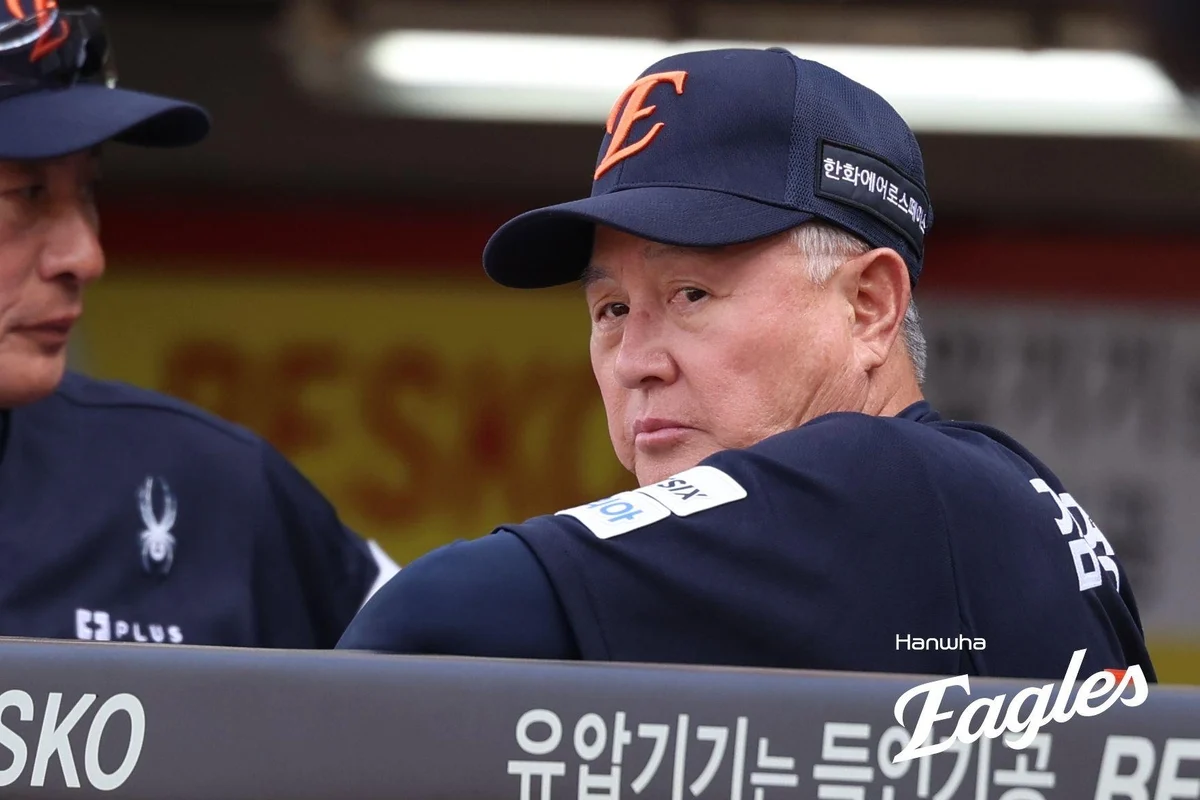
SEOUL — The Hanwha Eagles have officially confirmed that veteran manager Kim Kyung-moon will not return to the helm for the 2027 season. The announcement, delivered on Saturday, October 10, 2026, marks the conclusion of a turbulent tenure that saw the franchise oscillate between the euphoria of a Korean Series appearance and the frustration of a bottom-tier finish. Kim’s three-year contract is set to expire at the conclusion of this season, and both parties have agreed that a change in leadership is necessary to chart a new course for the Daejeon-based club.
The decision was finalized following the Eagles’ final regular-season contest, where the team finished with a dismal 57-82-4 record. Despite high expectations heading into the year, the Eagles remained anchored in ninth place among the league’s ten teams for much of the second half.
A Legacy Defined by Near-Misses and Tactical Acumen
At 67 years old, Kim Kyung-moon remains one of the most polarizing and respected figures in the Korea Baseball Organization (KBO). His career, spanning over two decades, is defined by his reputation as a master strategist who has consistently elevated underperforming rosters. Yet, his resume remains marked by a conspicuous void: the lack of a Korean Series championship.
Kim’s 2026 season was his fifth time finishing as a runner-up in his storied career. While he holds the distinction of being one of only three managers in league history to surpass the 1,000-win milestone—entering his final game with 1,078 victories, 957 losses, and 39 ties—the inability to secure a title has shadowed his tenure at Hanwha.
During his pregame press conference at Daejeon Hanwha Life Ballpark, a somber Kim addressed the local media, expressing regret over the team’s inability to maintain the momentum established during their 2025 campaign. "This will be my last game here," Kim stated. "I am deeply sorry to our fans that we have endured such a difficult season. I feel a heavy burden that I am departing without having left the team in a better position than I found it. However, I am sincerely grateful to the players, the coaching staff, and the front office who worked tirelessly by my side."
The 2025 High Point and the Subsequent Collapse
To understand the suddenness of the Eagles’ decision, one must look at the stark contrast between the 2025 and 2026 seasons. In 2025, the Eagles were arguably the most formidable team in the KBO, posting a 83-57-4 record and securing the second-best standing in the league.
The 2025 success was built on a historic pitching rotation anchored by American imports Cody Ponce and Ryan Weiss. The duo dominated the league, combining for 33 wins and an astounding 459 strikeouts across 359 1/3 innings. Ponce’s performance was nothing short of legendary, as he secured the pitching Triple Crown—leading the KBO in wins, earned run average (ERA), and strikeouts—to earn the league’s Most Valuable Player (MVP) award. Alongside Weiss, who tallied 207 strikeouts, the pair set a KBO record as the first teammates to both cross the 200-strikeout threshold in a single season.
However, the departure of both Ponce and Weiss to Major League Baseball (MLB) following the 2025 season created a vacuum that the Eagles’ front office proved unable to fill. Replacements Owen White and Wilkel Hernandez failed to replicate the production of their predecessors. Hernandez was released in July after a string of lackluster outings, and his replacement, Bruce Zimmermann, struggled to find his rhythm in the starting rotation, eventually being relegated to bullpen duty.
Statistical Regression and Tactical Imbalances
The 2026 season was a tale of two extremes for the Eagles. Offensively, the team was a juggernaut, leading the KBO with 175 home runs and 813 total runs scored. The acquisition of star slugger Kang Baek-ho proved to be a masterstroke, as he delivered a career-high 34 home runs, providing the middle-of-the-order protection the team lacked in previous years.
Despite the offensive firepower, the team’s defensive and pitching statistics were catastrophic. The Eagles posted a 5.27 team ERA, a staggering regression from their league-best 3.55 ERA in 2025. This pitching collapse effectively neutralized the offense’s efforts, leading to a high frequency of "shootout" losses where the team scored in double digits but still failed to secure victory. Analysts note that the lack of depth in the bullpen, combined with the instability of the starting rotation, created a compounding effect that exhausted the team’s relief corps by mid-summer.
The Path Forward for the Hanwha Eagles
The Eagles’ front office issued a brief statement thanking Kim for his service and confirming that the search for a new manager is already underway. While the team has not publicly disclosed a shortlist of candidates, insiders suggest the organization is looking for a leader capable of balancing developmental focus with immediate competitive results.
The implication of this coaching change goes beyond the dugout. With a core group of hitters like Kang Baek-ho entering their prime, the Eagles are under significant pressure to provide a championship-caliber pitching staff. The failure of the 2026 rotation has made the recruitment of high-impact foreign pitchers a top priority for the off-season. Furthermore, the team must address the development of young local arms to ensure that the reliance on foreign starters is not a single point of failure for the franchise.
Chronology of the Kim Kyung-moon Era
- June 2024: Kim Kyung-moon is appointed as the manager of the Hanwha Eagles, tasked with stabilizing a struggling franchise.
- Late 2025: Kim leads the Eagles to their first Korean Series appearance since 2006, ultimately falling to the LG Twins in a competitive five-game series.
- Off-season 2025-2026: Key rotation anchors Cody Ponce and Ryan Weiss depart for MLB, triggering a period of roster uncertainty.
- July 2026: The Eagles release struggling pitcher Wilkel Hernandez, signaling the decline of the team’s pitching depth.
- October 10, 2026: Kim Kyung-moon announces he will not return for the 2027 season, capping a final record of 57-82-4.
Broader Implications for the KBO
The departure of Kim Kyung-moon marks a potential generational shift in KBO leadership. As one of the oldest managers in the league, his exit invites discussions about the future of traditional managerial styles versus the increasing importance of data-driven, analytical decision-making in Korean baseball.
The Hanwha Eagles, a team with one of the most passionate fan bases in the country, are currently at a crossroads. The transition period following the 2026 season will likely define the next five years of the franchise. Whether the team pursues an experienced veteran to stabilize the ship or opts for a younger, modernized manager remains the primary question for the Eagles’ ownership.
For Kim, the future remains uncertain. Having managed at the highest levels of professional baseball and guided the national team, his legacy as a tactical pioneer is cemented, even if the final chapter in Daejeon did not yield the trophy he so desperately sought. As the league enters the off-season, the Hanwha Eagles will begin their search for a manager who can turn their high-scoring offense and rebuilding pitching staff into a cohesive, title-contending unit. The 2026 season will be remembered as a year of immense potential lost to inconsistency, serving as a cautionary tale for the risks of relying on a fragile pitching foundation.
