

As South Korea experiences a significant post-pandemic surge in international tourism, the national infrastructure has been placed under the spotlight. With the country welcoming millions of visitors eager to explore beyond the borders of Seoul, the reliance on a robust, efficient, and user-friendly public transportation network has become paramount. Understanding the intricacies of the local transit ecosystem—which integrates high-speed rail, expansive subway networks, and a sophisticated bus system—is no longer merely a convenience; it is a necessity for the modern traveler. This guide provides a comprehensive analysis of the tools, protocols, and essential information required to navigate the Korean Peninsula effectively.

The Evolution of South Korea’s Transit Infrastructure
The South Korean government has invested heavily in transit infrastructure over the past three decades. Following the rapid urbanization of the late 20th century, the Ministry of Land, Infrastructure, and Transport prioritized the development of the Seoul Metropolitan Subway, which is now one of the most extensive systems in the world. Recent data suggests that the Seoul subway system alone handles over 7 million passengers daily, maintaining a punctuality rate of over 99%.

The shift toward digital integration has been the most significant development in recent years. By transitioning from magnetic stripe tickets to contactless Radio Frequency Identification (RFID) technology—most notably the T-money system—the country has standardized payments across buses, subways, and taxis. This systemic shift has not only streamlined passenger flow but has also provided the government with granular data to optimize route scheduling and fleet management in real-time.

Essential Digital Tools for Seamless Navigation
Navigating a country where Google Maps is restricted due to national security regulations regarding mapping data requires a strategic shift to local applications. International travelers are advised to prioritize the following three digital tools:

-
Naver Map: Serving as the primary alternative to international mapping software, Naver Map provides real-time traffic data, accurate walking directions, and comprehensive transit route options. Unlike international counterparts, it offers detailed street-view imagery and precise navigation for complex subway transfers, which are crucial for maneuvering through the labyrinthine stations of Seoul and Busan.

-
Kakao T (Kakao Taxi): As the dominant ride-hailing platform in Korea, Kakao T has become an essential utility. It allows users to hail, track, and estimate the cost of taxi journeys. It is important to note that while the app supports multiple languages, it generally does not process international credit cards directly for bookings; instead, users should be prepared to pay the driver directly upon completion of the trip using cash or a local credit card.

-
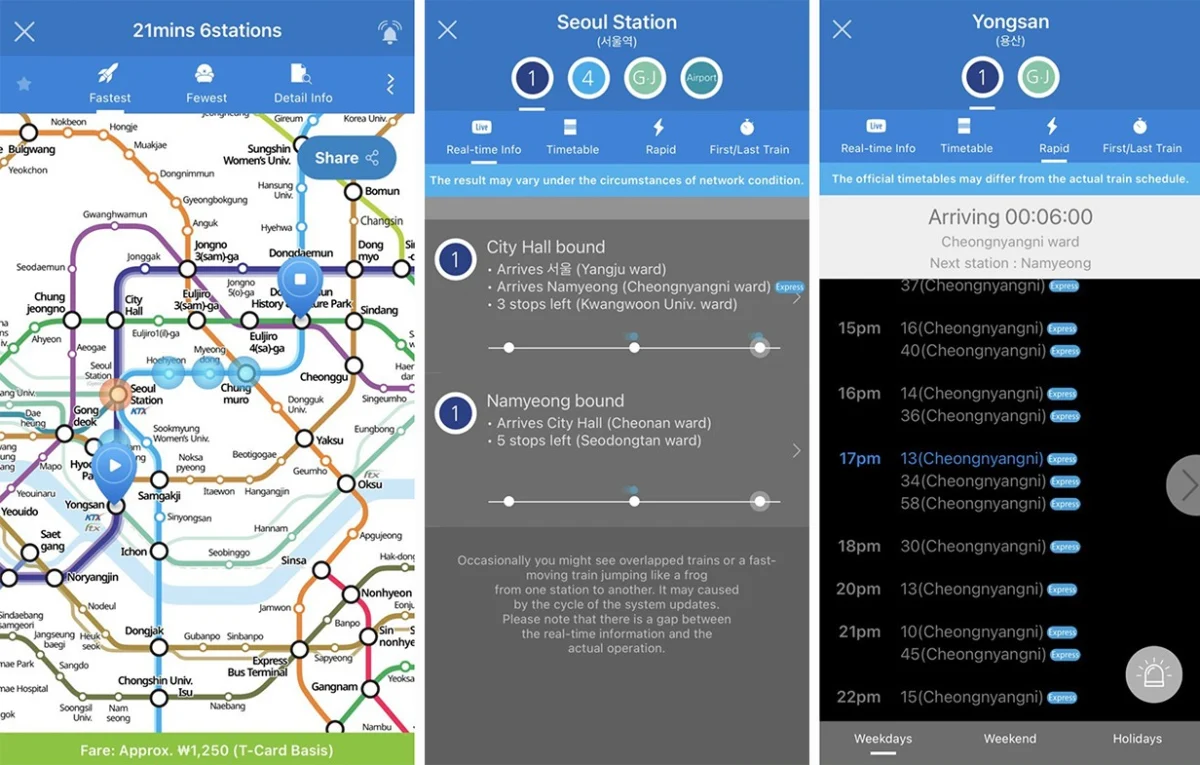
Subway Korea: This specialized application is designed to handle the complexity of the national rail system. It allows users to toggle between major metropolitan hubs including Seoul, Busan, Daegu, Gwangju, and Daejeon. The app’s primary value lies in its ability to calculate the fastest routes, provide real-time status updates on train arrivals, and identify the locations of rapid transit services that skip secondary stations to save travel time.

The T-money System: A Universal Payment Solution
The T-money card represents the backbone of South Korean travel. It is a rechargeable smart card that functions as a prepaid electronic wallet. The card can be purchased at any convenience store—such as CU, GS25, or 7-Eleven—or at dedicated automated kiosks found at major transport hubs like Incheon International Airport.

From a financial perspective, the use of a T-money card is highly recommended. It offers a standardized fare structure, whereas paying with cash often involves higher surcharges and the logistical inconvenience of handling exact change. Furthermore, the card facilitates seamless transfers between buses and subways; passengers who switch between these modes within a 30-minute window are often granted significant discounts on their total fare. It is a vital fact for travelers that T-money card reloads can only be performed using cash at most kiosks and convenience stores. Travelers should also be aware that reloading machines at subway stations may have limitations on high-denomination notes, such as the 50,000 KRW bill, if the transaction amount is low.

Strategic Planning for Long-Distance Transit
For travel between provinces, such as moving from Seoul to Busan or Gyeongju, reliance on the KTX (Korea Train eXpress) or express buses is standard. The KTX is the country’s high-speed rail network, capable of reaching speeds of up to 305 km/h. Due to high demand, especially during weekends and public holidays, booking tickets in advance via the official Korail website or application is strongly advised.

Similarly, the express bus network offers a more budget-friendly, albeit slower, alternative. The terminals are well-organized, and tickets can be secured through automated kiosks. Travelers should be mindful that failing to book during peak seasons may result in wait times exceeding one hour between departures.

Operational Etiquette and Social Protocols
Korean public transportation is governed by a strict set of social norms and regulations that are strictly enforced by both the transit authorities and the local citizenry.

- Reserved Seating: Each subway car and city bus is equipped with seats designated for the elderly, the disabled, and pregnant women. These are typically marked with clear pictograms or, in the case of expectant mothers, a distinct pink color scheme. It is considered a significant breach of etiquette to occupy these seats unless necessary.
- Prohibitions on Consumables: Since 2018, the Seoul Metropolitan Government has enforced a strict ban on bringing open food and beverages onto city buses. This policy was implemented to ensure safety and cleanliness. Drivers are empowered to deny boarding to passengers carrying unsealed coffee cups or food items.
- The "Stop" Bell: On local buses, passengers must signal their intent to alight by pressing a bell, typically located near the exits or on handrails, well in advance of their stop.
Data-Driven Insights and Future Implications
The efficiency of the Korean public transport system is not accidental; it is the result of a deliberate policy to curb private vehicle usage in densely populated urban centers. By providing real-time data to commuters—such as the electronic panels at bus stops that indicate the occupancy level of approaching vehicles (e.g., hon-jap for crowded, yeo-yoo for plenty of seats)—the city has successfully managed to distribute passenger loads more evenly throughout the day.

However, the rapid influx of tourists has brought new challenges. Transit authorities have had to increase the frequency of English-language announcements and improve signage to accommodate non-Korean speakers. For the traveler, this means that while the system is highly accessible, the responsibility to remain informed rests with the individual. Utilizing the aforementioned apps to monitor the specific ID numbers of bus stops—ensuring one does not board a bus traveling in the opposite direction—is a critical skill.

Regional Variations and Unique Transit Features
While Seoul and Busan operate similar, highly advanced systems, regional differences do exist. For instance, Jeju Island presents a unique case; it is the only major Korean tourist destination without a subway or train system. Tourists in Jeju must rely entirely on a network of public buses, rental cars, or taxis. The Jeju City Tour Bus is an effective resource for those looking for a structured way to visit major natural landmarks.

In Busan, the transit authority has experimented with gender-specific subway cabins during peak commuting hours (7:00–9:00 AM and 6:00–8:00 PM). While these are intended to improve comfort and safety, their enforcement is largely self-regulated.

Conclusion: Embracing the Local Experience
Traveling through South Korea via public transit is an exercise in efficiency. By utilizing T-money cards, downloading necessary navigation apps, and adhering to local etiquette, international visitors can move through the country with the same ease as the local population. The integration of high-speed rail, localized bus networks, and digital payment solutions serves as a model for modern urban mobility. As the country continues to expand its transit footprint, the importance of maintaining a well-informed, prepared approach remains the best strategy for any traveler looking to experience the full scope of what South Korea has to offer. Whether navigating the high-speed tracks between Seoul and Busan or catching a local bus through a quiet neighborhood, the system is designed to connect the visitor to the heart of the nation with unparalleled reliability.
