

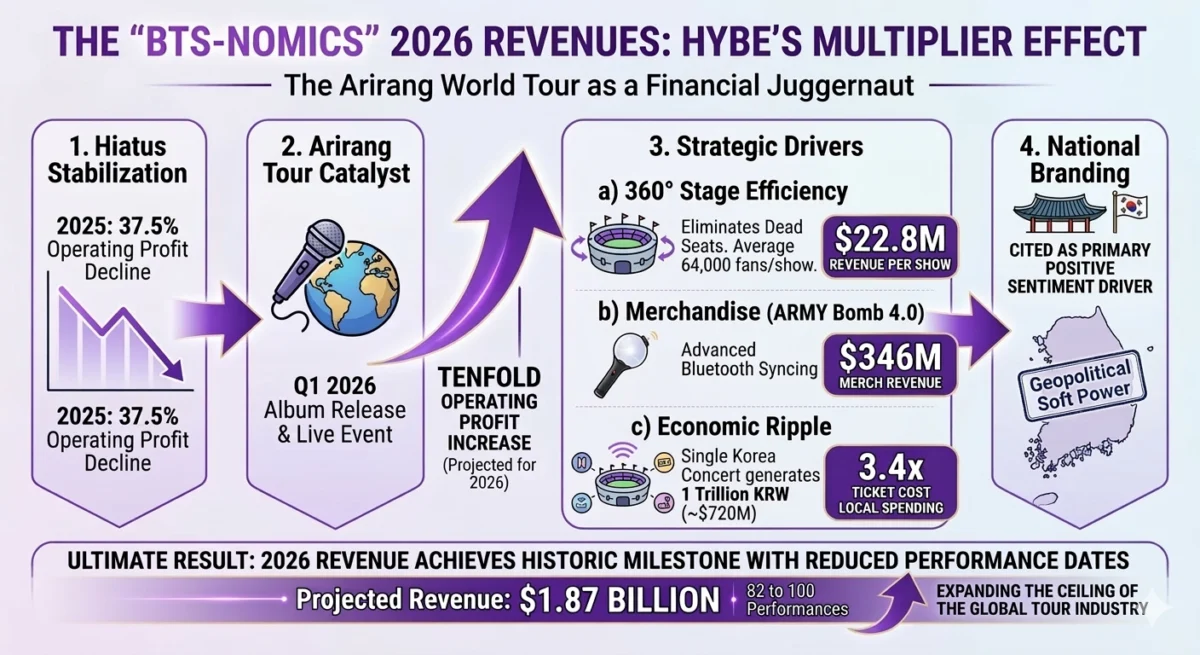
The long-awaited reunion of RM, Jin, SUGA, j-hope, Jimin, V, and Jungkook marks one of the most significant cultural and financial events in the history of the modern entertainment industry. Following a mandatory hiatus to fulfill South Korea’s military service obligations, the seven-member global phenomenon is officially returning to the stage for the BTS "Arirang" World Tour. Financial institutions, tourism boards, and global market analysts are projecting a staggering $1.87 billion in gross revenue, a figure that repositions the boundaries of touring efficiency and cements a new era of economic influence often referred to as "BTS-nomics."
Rather than following the conventional trajectory of legacy reunion tours, the Arirang World Tour is engineered as a macroeconomic stabilizer for HYBE and a massive stimulus for the South Korean national economy. This comprehensive analysis explores the financial architecture of the tour, the innovative stage production driving its efficiency, the sweeping infrastructure upgrades implemented across Seoul and Busan, and the profound geopolitical soft-power implications of the group’s return.
The Financial Architecture and Tour Efficiency: A Comparative Analysis
To understand the magnitude of the Arirang World Tour, financial analysts at IBK Securities and IM Securities have drawn direct comparisons to other historic global tours, most notably Taylor Swift’s Eras Tour. While Swift’s monumental run generated approximately $2.07 billion, it required an exhaustive 149 performances across multiple continents. In contrast, BTS is projected to approach a nearly identical financial threshold with a remarkably condensed schedule of just 82 to 100 shows.
This discrepancy highlights a masterclass in touring efficiency. On a per-show basis, the Arirang tour is projected to gross approximately $20.8 million, representing a roughly 50 percent increase over traditional stadium tour revenues and significantly outpacing the per-show averages of Western counterparts.
The primary catalyst for this financial leap is the strategic implementation of a 360-degree "in-the-round" stage design. Standard stadium setups typically rely on an end-stage configuration, which inherently obstructs or "kills" up to 30 percent of available seating situated behind the primary video screens and production rigs. By adopting a central, 360-degree layout, HYBE has effectively eliminated restricted-view sections, optimizing capacity utilization to accommodate an average of 64,000 attendees per venue.
Furthermore, this setup is complemented by hardware-as-a-service innovations, most notably the integration of the fourth-generation ARMY Bomb 4.0 light stick. Featuring advanced Bluetooth synchronization capabilities, the next-generation merchandise functions as an interactive component of the 360-degree light shows, driving projected merchandise sales to an estimated $346 million. For HYBE, the tour acts as a vital financial correction following a 2025 fiscal period that saw a 37.5 percent decline in operating profit during the group’s hiatus. Corporate forecasts now indicate a potential tenfold increase in operating profit for the upcoming fiscal cycle.
Chronology and Strategic Rollout of the Arirang Era
The launch of the Arirang era is structured as a carefully calibrated, multi-phase global campaign designed to maximize both digital engagement and localized economic impact.
Phase 1: Q1 2026 – The Digital and Domestic Prelude
The campaign officially commences on March 20, 2026, with the global release of the Arirang album, establishing a thematic identity rooted in cultural heritage and modern pop synergy. This is followed immediately on March 21 by a high-visibility live performance at Gwanghwamun Square in Seoul. Broadcast globally via Netflix, the performance serves to reset the group’s cultural dominance and signal their official return to the public sphere.
Phase 2: Q2 2026 – The Stadium Kickoff and Domestic Anchors
The live touring phase begins with a three-night residency in Goyang on April 9, 11, and 12, serving as the commercial and logistical proof-of-concept for the 360-degree stage metrics. This is swiftly followed by the Busan Anniversary shows on June 12 and 13, strategically timed to coincide with the group’s debut anniversary celebrations, locking in long-term intellectual property loyalty and driving localized tourism spikes.
Phase 3: International Expansion
Following the domestic anchors, the tour transitions into a 34-city international run spanning North America, Europe, Latin America, and select Asian markets, bringing the meticulously engineered production model to millions of international fans.
The "Popcorn Effect" and Regional Economic Multipliers
The economic ripple effects of the Arirang World Tour extend far beyond ticket sales and merchandise revenue. According to estimates by the Hyundai Economic Research Institute, a single BTS-related event in South Korea generates upwards of 1 trillion KRW (approximately $720 million) in regional economic impact.
Within 48 hours of the initial tour announcement, travel search metrics reflected unprecedented demand. Tourism inquiries for Seoul surged by 155 percent, while Busan experienced an astronomical 2,375 percent increase in localized search volume. Empirical research indicates that international BTS fans, colloquially known as ARMY, spend an average of 3.4 times the face value of their concert tickets on local hospitality, transport, dining, and retail services. This "multiplier effect" is a phenomenon typically reserved for major geopolitical undertakings such as the Olympic Games.
Infrastructure Modernization and the Hallyu Visa Era
Recognizing the influx of an estimated 5.2 million international travelers expected to visit South Korea throughout the duration of the tour, government and municipal authorities have enacted sweeping infrastructure upgrades to streamline the visitor experience.
The implementation of the K-Culture Training Visa allows fans who enroll in certified Korean cultural and artistic academies to reside in the country for up to two years. For short-term visitors, the K-ETA entry exemption has been formally extended through December 2026 for citizens of 67 designated countries, substantially reducing bureaucratic friction for incoming tourists.
Domestically, transit modernization has kept pace with international demand. Seoul’s Climate Card transit pass has been updated to accept international credit cards, providing travelers with unlimited access to the metropolitan subway and bus networks. This integration facilitates seamless navigation to prominent cultural landmarks and "BTS pilgrimage" sites, such as the historic Cheonggyecheon Arirang Light Walk and legacy agency locations. Furthermore, as of March 2026, major Seoul merchants and public transit Turnstiles have fully integrated Apple Pay, Google Pay, and Samsung Pay for international issuers, eliminating traditional currency exchange and transportation card top-up hurdles.
Geopolitical Soft Power and National Branding
Beyond balance sheets and tourism statistics, the Arirang World Tour functions as a cornerstone of South Korea’s national soft-power strategy. In the 2025 National Image Survey conducted by government-affiliated cultural agencies, BTS was consistently cited as the primary driver of positive international sentiment toward the nation, outperforming traditional diplomatic initiatives in fostering cross-cultural goodwill and global brand equity.
Official responses from industry stakeholders highlight that the tour is not merely an entertainment venture, but a vital instrument of cultural diplomacy. By anchoring the tour’s title to traditional Korean artistic motifs like "Arirang," the group continues to elevate indigenous Korean heritage onto a contemporary global platform, driving interest in Korean language study, culinary arts, and manufacturing exports.
Implications and Future Standards for Global Touring
The BTS Arirang World Tour establishes a definitive new benchmark for the live entertainment industry. By proving that a non-English language act can not only match but exceed the operational efficiency and revenue generation of Western touring giants, BTS has fundamentally rewritten the economics of modern music.
As the tour progresses through its domestic anchors and expands across global markets, it will serve as a permanent case study in post-hiatus institutional recovery, stage design engineering, and the profound economic power of cultural soft power. For South Korea’s tourism and entertainment sectors, the Arirang era represents a transformative chapter that expands the ceiling of what global commercial dominance looks like in the twenty-first century.
