

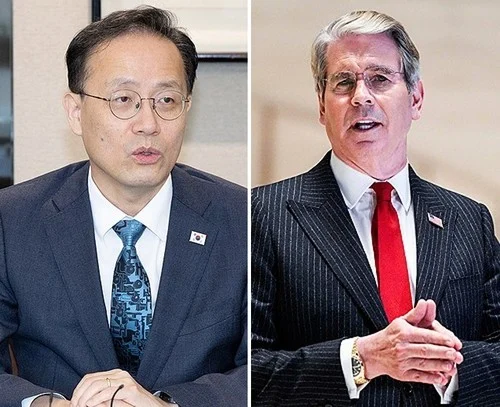
In a high-level diplomatic exchange that underscores the enduring strength of the Washington-Seoul economic partnership, South Korean Finance Minister Lee Hyoung-il and U.S. Treasury Secretary Scott Bessent held their first formal video conference on October 14. The meeting, which served as an introductory engagement following Lee’s appointment to his cabinet post last month, functioned as a critical platform for aligning the two nations on shared economic policy priorities, regional stability, and the management of global financial volatility.
The virtual dialogue, held across the Pacific, provided an opportunity for both officials to signal continuity in bilateral relations at a time when global supply chain restructuring, technological competition, and inflationary pressures continue to shape the international economic landscape. Both the South Korean Ministry of Economy and Finance and the U.S. Department of the Treasury issued statements following the call, highlighting a mutual commitment to maintaining open channels of communication and deepening cooperation on macroeconomic policy.
Contextualizing the Bilateral Economic Framework
The relationship between South Korea and the United States has evolved significantly over the past decade, moving beyond traditional trade agreements to encompass a comprehensive strategic partnership. As one of the United States’ most critical allies in the Indo-Pacific, South Korea serves as a linchpin in Washington’s strategy to secure semiconductor supply chains and advance green energy technology.
For Minister Lee Hyoung-il, this initial engagement with Secretary Bessent is pivotal. As South Korea’s Deputy Prime Minister and Minister of Economy and Finance, Lee is tasked with navigating the country through a complex economic environment characterized by an aging population, slowing domestic growth, and the necessity of maintaining competitiveness in high-tech manufacturing. Secretary Bessent, meanwhile, represents the Treasury Department during a period of transition in U.S. economic policy, where the focus has shifted toward "friend-shoring"—a strategy designed to integrate supply chains with politically aligned nations to mitigate the risks associated with geopolitical dependencies.
The meeting between these two leaders was not merely a diplomatic formality; it was a substantive check-in on the "economic security" architecture that both nations have been building since the inception of the U.S.-Korea Economic and Financial Dialogue.
Chronology of Recent Economic Cooperation
The relationship has been marked by several key milestones over the last twenty-four months, setting the stage for the current alignment:
- September 2026: Lee Hyoung-il is officially appointed as South Korea’s Deputy Prime Minister and Minister of Economy and Finance, taking over the portfolio during a period of fiscal tightening and structural reform efforts.
- Early October 2026: Preparations for the inaugural video conference between Minister Lee and Secretary Bessent are finalized, focusing on agenda items including exchange rate stability and investment screening mechanisms.
- October 14, 2026: The inaugural video conference takes place. Both parties emphasize the need for continued coordination regarding the implementation of the Inflation Reduction Act (IRA) and the CHIPS and Science Act, which have direct impacts on South Korean conglomerates operating in the United States.
- Post-Meeting (October 2026): Both ministries confirm that future working-level groups will be established to monitor developments in emerging technology sectors and monitor potential financial sector risks.
Supporting Data: The Economic Ties That Bind
To understand the weight of this discussion, one must look at the volume of bilateral engagement. According to data from the U.S. Bureau of Economic Analysis and the Korea International Trade Association (KITA), the United States has solidified its position as one of South Korea’s largest export markets.
South Korean foreign direct investment (FDI) into the United States has reached record highs in recent years, driven primarily by massive capital outlays from major firms such as Samsung Electronics, SK Hynix, and Hyundai Motor Group. These investments, centered on battery manufacturing, electric vehicle (EV) production, and semiconductor fabrication plants in states like Georgia, Texas, and Ohio, represent a tangible commitment to the U.S. industrial base.
Conversely, the U.S. remains a vital source of high-end technology, intellectual property, and financial capital for South Korean firms. The total bilateral trade in goods and services between the two nations exceeded $200 billion in the previous fiscal year, a figure that continues to climb as both nations seek to decouple their critical industries from non-market economies.
Official Responses and Diplomatic Messaging
The official statements issued by the two departments were marked by a high degree of cordiality and strategic convergence. The U.S. Treasury Department noted that Secretary Bessent congratulated Minister Lee on his appointment, emphasizing that the U.S.-Republic of Korea economic and financial relationship is "a cornerstone of regional and global prosperity."
From the South Korean perspective, the Ministry of Economy and Finance highlighted that Minister Lee expressed gratitude for the warm reception and outlined his government’s commitment to "close communication and cooperation." The use of the term "shared economic policy priorities" in both press releases suggests that the conversation touched upon sensitive areas such as managing the volatility of the Korean Won against the U.S. Dollar and ensuring that the financial systems of both nations remain resilient against external shocks.
Market analysts suggest that such high-level calls serve to provide "policy signaling" to global investors. By demonstrating that the two finance chiefs are in sync, the governments of South Korea and the U.S. aim to reduce uncertainty for institutional investors who operate across both markets.
Implications and Broader Macroeconomic Impact
The implications of this meeting extend beyond mere diplomatic courtesy. Several key areas are likely to remain at the forefront of the Lee-Bessent agenda in the coming months:
1. Supply Chain Resilience and Investment Security
As the global landscape remains fragmented, the U.S. and South Korea are expected to continue refining their cooperation on investment screening. This includes monitoring sensitive technology transfers and ensuring that the semiconductor ecosystem—the lifeblood of the modern global economy—is shielded from geopolitical interference.
2. Managing Interest Rate and Currency Fluctuations
With the U.S. Federal Reserve’s monetary policy trajectory influencing capital flows globally, South Korea faces constant pressure on its currency. Regular consultations between the Treasury and the Ministry of Economy and Finance are essential for preventing disorderly market conditions. While the two ministers did not release specific details on exchange rate interventions, the fact that they are in direct contact serves as a stabilizing factor.
3. Energy Transition and Industrial Policy
The ongoing transition to green energy presents both challenges and opportunities. South Korean firms are currently at the vanguard of battery production and hydrogen energy. Aligning the regulatory frameworks of the two nations ensures that these companies can continue to scale their operations within the U.S. market without encountering unexpected regulatory hurdles.
Expert Analysis: The Road Ahead
Economic observers in Seoul and Washington have generally reacted positively to the meeting, viewing it as a necessary reinforcement of the alliance’s economic pillar. "The appointment of Minister Lee brings a fresh perspective to the Korean cabinet, and his immediate outreach to Secretary Bessent demonstrates a clear understanding that in today’s world, financial policy is inseparable from national security," says a senior fellow at an international economic policy think tank.
Looking ahead, the success of this partnership will be measured by the ability of both nations to navigate upcoming global challenges, including potential shifts in global trade policy and the ongoing competition for technological dominance. As Lee and Bessent begin their working relationship, the primary focus will likely remain on translating these high-level summits into concrete, actionable policies that protect the economic interests of both nations while fostering a predictable environment for private sector investment.
The meeting concluded with a mutual agreement to continue these dialogues at both the ministerial and working levels, reinforcing the message that while the global economy may be in a state of flux, the strategic alignment between Seoul and Washington remains a fixed, stabilizing force. The engagement serves as a testament to the fact that the U.S.-Korea alliance has successfully matured into a modern partnership, capable of addressing the multifaceted challenges of the 21st-century global economy.
