

Seoul has solidified its status as a global retail powerhouse, drawing millions of international visitors annually to its vibrant commercial districts. From the trendsetting streets of Hongdae to the luxury avenues of Gangnam and the bustling traditional markets of Myeongdong, the city offers an unparalleled shopping experience. However, for many international tourists, the language barrier remains a significant hurdle in maximizing these opportunities. Understanding basic Korean retail etiquette and essential conversational phrases not only facilitates smoother transactions but also fosters positive interactions with local shop owners, or sajangnim.

The Economic Significance of Tourism-Driven Retail
The retail sector is a cornerstone of the South Korean tourism economy. According to data from the Korea Tourism Organization, shopping consistently ranks as the primary activity for international tourists visiting Seoul, accounting for a significant portion of total trip expenditures. In 2019, prior to the global pandemic, international visitors spent billions of dollars on duty-free goods, cosmetics, and fashion apparel. As travel numbers continue to rebound toward pre-pandemic levels, retailers are increasingly emphasizing the importance of hospitality and clear communication to maintain the competitive edge of the "Seoul shopping experience."
For the uninitiated, navigating the complex hierarchy of Korean honorifics can be daunting. However, in a retail environment, the focus remains on functional communication. Simple, polite phrases that yield binary "yes" or "no" responses are often the most effective for foreign visitors.

Essential Communication: Navigating Product Availability
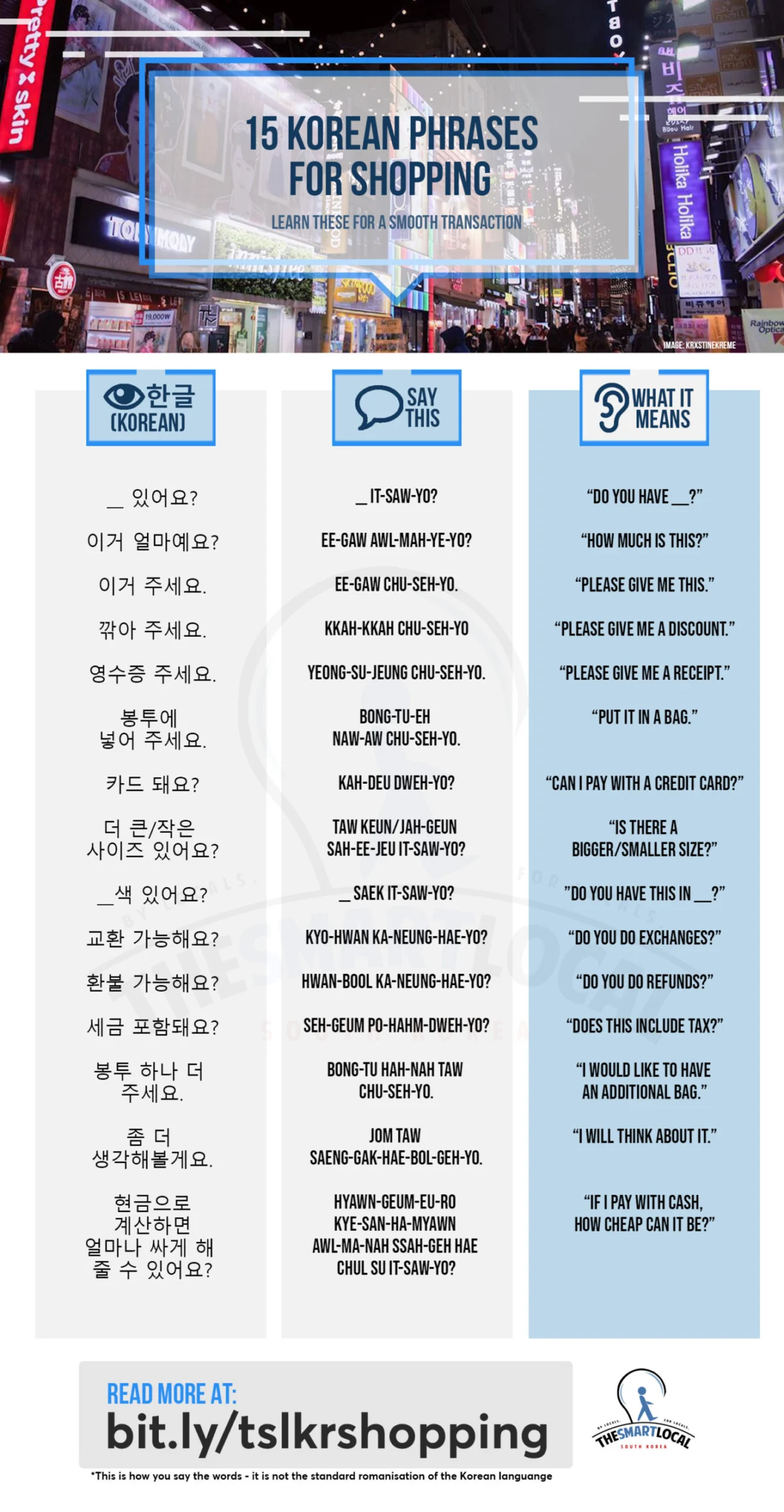
When seeking specific items—ranging from K-beauty skincare products like facial masks and moisturizers to iconic snacks such as Honey Butter Almonds—efficiency is paramount. Asking for items using the phrase “isseoyo?” (Do you have [item]?) allows shoppers to confirm stock without extensive searching.
While many products sold in Korea are marketed using Konglish—a localized hybrid of Korean and English—the pronunciation often deviates from standard English. Being familiar with these variations, such as “awl-gool mah-seu-keu” for face masks or “bo-seup-jeh” for moisturizer, significantly reduces the time spent in each storefront.

The Dynamics of Pricing and Transactional Etiquette
Pricing in Seoul’s diverse retail landscape follows different norms depending on the setting. In modern department stores and chain boutiques, prices are fixed and non-negotiable. However, in traditional markets and smaller, independently owned shops, there is often room for negotiation.
The fundamental phrase “Igeo eolmayeyo?” (How much is this?) serves as the standard inquiry for unmarked goods. Once the price is established, requesting a purchase is done through “Igeo juseyo” (Please give me this). When dealing with local market vendors, the practice of kkah-kkah juseyo (Please give me a discount) is sometimes applicable.

Industry analysts note that while bargaining is not as pervasive in South Korea as in other parts of Asia, it is culturally accepted when purchasing in bulk or when the shop owner is in a receptive mood. Some younger travelers have observed that employing aegyo—a cultural expression of playfulness or charm—or identifying oneself as a student by saying “hak-saeng ee-ye-yo” can occasionally result in small discounts or complimentary items from older vendors, known as ahjumma and ahjussi.
Financial Protocols and Tax Regulations
South Korea is one of the world’s most cashless societies, with credit and debit card penetration reaching near-universal levels. Despite this, smaller, family-run stalls in traditional markets may still operate on a cash-only basis. Asking “Kadeu dwaeyo?” (Can I pay with a credit card?) prevents awkward encounters at the point of sale.

Furthermore, for international tourists, the "Tax-Free" system provides a substantial incentive. Under the current South Korean tax regime, tourists are entitled to a refund on the Value Added Tax (VAT) included in the purchase price of goods. To utilize this, shoppers must request a receipt—“Yeongsujeung juseyo”—which serves as the necessary documentation for claiming tax refunds at the airport or designated kiosks. Retailers displaying the "Tax-Free" logo are equipped to process these refunds, often applying the discount at the time of purchase if the shopper presents their passport.
Logistics: Bags and Returns
In an effort to promote environmental sustainability, South Korea has implemented stringent regulations regarding the use of plastic bags. Many retail establishments now charge for shopping bags or do not provide them at all. Asking “Bongtue neoeo juseyo” (Put it in a bag) or “Bongtu hana deo juseyo” (I would like to have an additional bag) is often necessary for those carrying multiple items.

For consumers concerned about potential defects or buyer’s remorse, understanding the return policy is critical. While policies vary by store, asking “Gyohwan ganeunghaeyo?” (Do you do exchanges?) or “Hwanbul ganeunghaeyo?” (Do you do refunds?) before finalizing a transaction is a prudent step. Most retail outlets have clear policies posted, but in smaller shops, the decision is often at the discretion of the owner.
Reflective Purchasing and Local Integration
As the retail landscape evolves, the relationship between the vendor and the customer remains a focal point of the shopping experience in Seoul. Even when a purchase is not immediately made, it is considered polite to acknowledge the time a staff member has spent assisting the customer. Using the phrase “Jom deo saenggakhaebolgeyo” (I will think about it) is a respectful way to conclude a consultation without making an immediate purchase.

For those looking to secure the best possible value in traditional markets, the comprehensive phrase “Hyeongeumeulo gyesanhamyeon eolmana ssage hae jul su isseoyo?” (If I pay with cash, how cheap can it be?) serves as a direct, albeit bold, method for negotiating prices. This is most effective when purchasing multiple items at a single privately-run stall.
Broader Implications for Global Retail Tourism
The proliferation of these simple, effective linguistic tools underscores a broader trend: the shift toward a more personalized, communicative retail environment. As Seoul continues to attract a diverse global audience, the ability of both retailers and tourists to bridge linguistic gaps will remain a primary driver of the sector’s success.

Ultimately, the goal of these interactions is not perfect linguistic mastery, but rather the fostering of mutual respect and clarity. Local shop owners in Seoul generally welcome the effort made by foreign visitors to speak their language. By integrating these fifteen phrases into their vocabulary, travelers can navigate the city’s complex, high-energy retail districts with confidence, ensuring that their shopping experiences are as rewarding as they are efficient. As international travel continues to integrate with local commerce, these small linguistic bridges will continue to play a vital role in maintaining South Korea’s status as a top-tier destination for global shoppers.
