
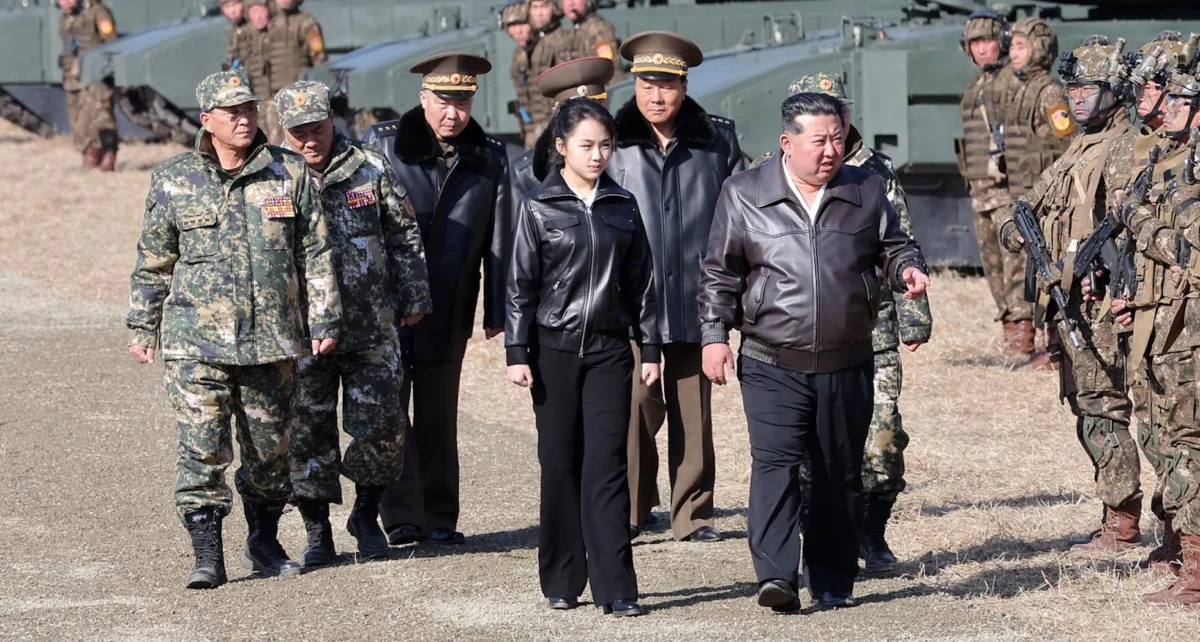
South Korea’s National Intelligence Service (NIS) has formally assessed that it is now appropriate to consider Kim Ju Ae, the young daughter of North Korean leader Kim Jong Un, as the most likely successor to the leadership of the Democratic People’s Republic of Korea (DPRK). This assessment, delivered during a high-level, closed-door briefing to the National Assembly’s Intelligence Committee on Monday, marks a significant shift in the ROK’s official stance on Pyongyang’s succession planning. Lawmakers present at the session reported that the spy agency’s conclusion is based on a comprehensive analysis of the daughter’s public activities, the specific honorifics used by state media, and the protocols observed during recent major political events, including the Ninth Party Congress and the latest session of the Supreme People’s Assembly (SPA).
The intelligence briefing also shed light on North Korea’s evolving foreign policy, revealing that Pyongyang appears to be deliberately distancing itself from Iran. According to the NIS, this strategic recalibration is intended to preserve diplomatic flexibility and keep potential channels for dialogue open with the United States. This move comes at a critical juncture as the international community monitors the fallout from the Ninth Party Congress, which traditionally sets the regime’s long-term economic and military trajectories. The convergence of domestic succession signaling and strategic foreign policy adjustments suggests that Kim Jong Un is attempting to stabilize his internal power base while navigating an increasingly complex global security environment.
The Ascent of the Venerated Child: Evidence of Succession
The NIS assessment that Kim Ju Ae is the heir apparent follows nearly four years of carefully choreographed public appearances. Since her first official debut at a missile launch site in November 2022, her role has transitioned from a mere accompaniment to her father to a central figure in state propaganda. Intelligence officials noted that the frequency and nature of her public engagements have become increasingly "political" and "military-centric." While early appearances focused on her role as a "beloved daughter," state media has transitioned to using terms like "venerated" and "respected," and more recently, the term "Hyangdo" (meaning "guide" or "leader"), a title previously reserved exclusively for top-tier leadership and designated successors in the Kim bloodline.
During the Ninth Party Congress, observers noted that the daughter was positioned in ways that mimicked the early public life of Kim Jong Un when he was being groomed by his father, Kim Jong Il. The NIS highlighted that her presence at military drills—including recent tank maneuvers and paratrooper exercises—is designed to solidify her image among the Korean People’s Army (KPA) as a symbol of the "Paektu Bloodline." This legitimacy is crucial in a society where the military holds significant sway over political stability. The agency pointed out that the North Korean propaganda machine is working to build a cult of personality around her early, likely to avoid the rushed and somewhat unstable transition that Kim Jong Un faced following his father’s sudden death in 2011.
A Chronology of Public Appearances and Political Milestones
The trajectory of the daughter’s public life provides a clear timeline of her elevation within the North Korean hierarchy. Each milestone has served to test domestic and international reactions while normalizing her presence as a future leader.
- November 2022: First public appearance at the launch of the Hwasong-17 intercontinental ballistic missile (ICBM). This established her connection to the regime’s nuclear program.
- February 2023: Participation in the 75th anniversary of the Korean People’s Army, where she was seated at the center of the head table at a military banquet, flanked by high-ranking generals.
- September 2023: Attendance at a paramilitary parade marking the 75th anniversary of the DPRK’s founding, where she sat in the VIP section, a position usually reserved for the highest echelons of the Workers’ Party.
- Late 2024 – Early 2025: Increased visibility at economic sites and localized military drills, showing a broader range of "on-the-spot guidance" activities.
- March 2026: Prominent role at the Ninth Party Congress and military drills alongside Kim Jong Un, where the NIS notes she was treated with a level of deference that suggests a formal, though perhaps unannounced, rank.
This timeline demonstrates a methodical approach to succession. Unlike Kim Jong Un, who was largely kept out of the public eye until shortly before his father’s death, the "venerated daughter" is being integrated into the state’s ideological fabric while Kim Jong Un is still relatively young and active.
Strategic Distancing from Iran and the US Diplomatic Gamble
Perhaps the most surprising element of the NIS briefing was the assessment of North Korea’s relationship with Iran. Historically, Pyongyang and Tehran have maintained a "marriage of convenience," sharing missile technology and resisting Western sanctions. However, the NIS reports that North Korea has begun to scale back its public cooperation and high-level exchanges with the Islamic Republic. This move is interpreted not as a total break in ties, but as a calculated effort to avoid being lumped into a "permanent axis of resistance" that might preclude future negotiations with Washington.

Analysts suggest that Pyongyang is keeping a close watch on the political climate in the United States. By distancing itself from Iran—a nation currently embroiled in heightened tensions with the US and its allies in the Middle East—North Korea may be attempting to signal that its nuclear and military programs are a separate issue, potentially solvable through bilateral diplomacy. This "strategic ambiguity" allows Kim Jong Un to maintain his alliance with Russia—which provides essential food, fuel, and space technology—while avoiding the additional diplomatic baggage of Iran’s regional conflicts.
Supporting Data: Military Escalation and Economic Realities
While the political theater of succession plays out, the NIS also provided data regarding North Korea’s military capabilities and economic state following the Ninth Party Congress. The agency reported that North Korea has intensified its production of tactical nuclear warheads and is continuing to refine its solid-fuel ICBM technology. This military buildup serves a dual purpose: it provides the regime with a "strong state" narrative to support the succession process, and it increases Pyongyang’s leverage in any future diplomatic engagement with the US.
Economically, the NIS noted that while the North remains under heavy international sanctions, its trade with Russia has reached levels not seen since the Cold War. This "Russian lifeline" has mitigated the impact of food shortages and provided the regime with the stability necessary to host grand political events like the Party Congress. The agency estimated that thousands of shipping containers have moved between the two countries, likely containing munitions for Russia’s war in Ukraine in exchange for Russian technical expertise in satellite and submarine technology.
Official Responses and Regional Reactions
The NIS briefing has sparked a flurry of reactions from South Korean lawmakers and international observers. Members of the National Assembly’s Intelligence Committee expressed concerns over the long-term stability of a regime transitioning to a third generation of leadership. Representative Lee Seong-kweun of the ruling People Power Party noted that while the daughter appears to be the chosen successor, the "glass ceiling" in North Korea’s patriarchal society remains a potential hurdle. "We must monitor whether the North Korean elite truly accepts a female leader or if this is a temporary move to secure the bloodline’s grip on power," he stated.
In Washington, the State Department has remained cautious, with officials stating they are "closely monitoring" reports of North Korean succession planning. The US maintains that its policy remains the complete, verifiable, and irreversible denuclearization of the Korean Peninsula, regardless of who sits at the helm in Pyongyang. However, behind the scenes, diplomats are reportedly analyzing the "Iran distancing" theory to see if it presents a genuine opening for a restart of the stalled nuclear talks.
Broader Impact and Implications for Global Security
The formal identification of a successor and the shift in diplomatic strategy have profound implications for global security. If Kim Ju Ae is indeed the future leader, it suggests that the Kim dynasty is planning for a long-term future where nuclear weapons are permanently integrated into the national identity. Her presence at missile launches and military drills sends a clear message: the next generation will be just as committed to the "nuclear sword" as the current one.
Furthermore, the distancing from Iran indicates that North Korea is a rational, albeit aggressive, actor that carefully calculates its geopolitical moves. By attempting to decouple its image from other "pariah states," Pyongyang is positioning itself as a nuclear power that the world must eventually accept and negotiate with on its own terms.
As the international community processes this new intelligence, the focus remains on the internal dynamics of the Workers’ Party. The transition of power in a nuclear-armed state is a period of extreme risk. The NIS concluded its briefing by emphasizing the need for increased surveillance and readiness, noting that while the succession plan seems clear for now, the opaque nature of the North Korean regime means that sudden shifts in power or health crises could lead to regional instability at any moment. The coming months will be critical as analysts look for further confirmation of these trends during North Korea’s national holiday celebrations and potential future weapons tests.
