
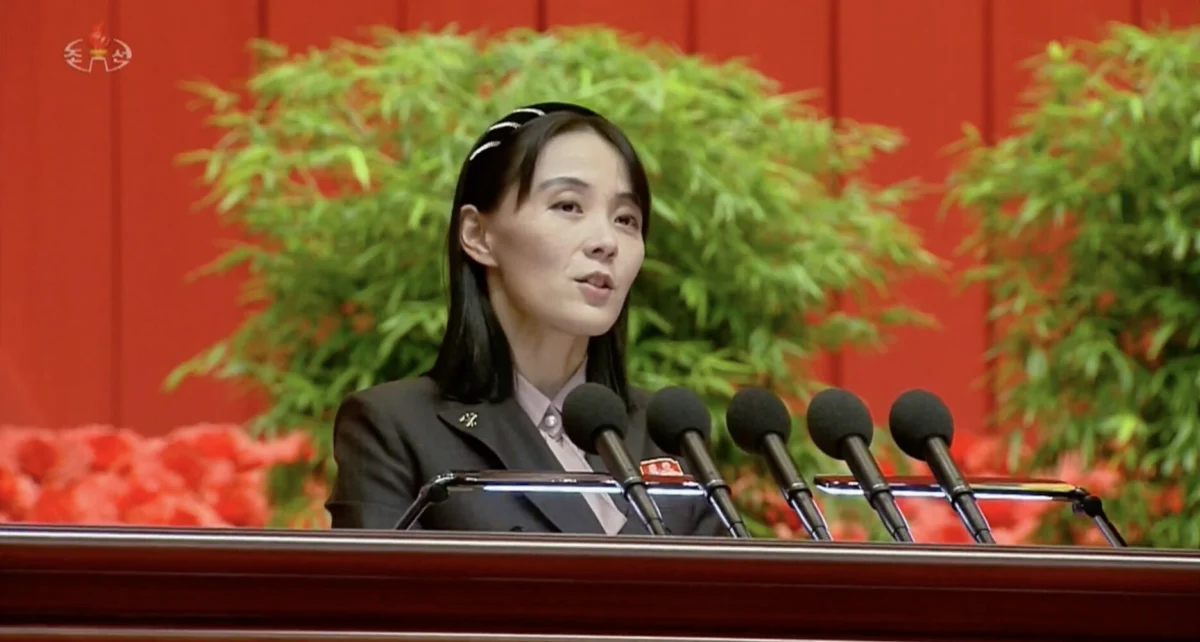
In an unexpected shift in inter-Korean rhetoric, North Korean leader Kim Jong Un has officially welcomed South Korean President Lee Jae Myung’s recent expression of remorse concerning a series of drone flights that violated North Korean airspace. The endorsement, delivered via a late-night statement by the North Korean leader’s powerful sister, Kim Yo Jong, described President Lee as an “honest and bold person.” This diplomatic overture follows a period of heightened tensions on the peninsula and marks a rare moment of verbal de-escalation between Pyongyang and Seoul.
The statement, released late Monday through the state-run Korean Central News Agency (KCNA), specifically addressed President Lee’s public acknowledgement of responsibility regarding civilian-led drone incursions that reportedly occurred on at least four separate occasions between September and January. The South Korean government’s internal investigation into the matter recently implicated certain officials and civilian organizations, leading to the President’s formal expression of regret earlier on Monday morning.
The Context of the Drone Incursions
The controversy centers on a series of unmanned aerial vehicle (UAV) flights that crossed the Military Demarcation Line (MDL) into North Korean territory. According to reports from both Seoul and Pyongyang, these drones were identified as civilian-grade equipment, though their payloads and flight paths suggest a level of sophistication that initially raised alarms within the North’s defense establishment.
The incursions took place during a volatile five-month window starting in September. While the North Korean military initially responded with threats of "physical strikes" and increased anti-aircraft readiness, the South Korean administration under President Lee Jae Myung launched a comprehensive probe to determine the origin of the flights. The investigation concluded that while the drones were operated by civilian groups—primarily those involved in anti-Pyongyang activism—there were lapses in oversight by South Korean military and border officials that allowed the breaches to occur.
President Lee’s decision to express "deep regret" for these incidents is seen as a departure from the more confrontational stances of previous administrations, which often defended such civilian actions as exercises of free speech or denied government involvement entirely. By acknowledging that the incursions were a breach of established protocols and territorial integrity, Lee has signaled a desire to stabilize the border and prevent accidental military escalation.
A Chronology of Escalation and De-escalation
The timeline of the current diplomatic shift reveals a rapid transition from military posturing to tentative dialogue:
- September – October: The first two drone incursions are detected by North Korean radar near the border regions. Pyongyang issues a stern warning, accusing Seoul of “intentional provocation” and violating the 1953 Armistice Agreement.
- November: A third drone is spotted deeper into North Korean territory, reportedly reaching the outskirts of the capital. North Korea’s Ministry of National Defense warns of “unpredictable consequences” if the flights continue.
- January: The fourth and final recorded incursion occurs. In response, North Korea briefly heightens its artillery readiness along the DMZ.
- March: The South Korean government announces a formal investigation into the drone flights, citing the need to maintain regional stability and adhere to international aviation norms.
- Early April: The probe concludes, finding that several civilian organizations utilized modified commercial drones to drop leaflets and digital media, with some tacit awareness from mid-level border security officials.
- Monday Morning: President Lee Jae Myung delivers a televised address expressing regret to the North, emphasizing that the incursions were not state-sanctioned but acknowledging the government’s failure to prevent them.
- Monday Night: Kim Yo Jong releases a statement on behalf of Kim Jong Un, praising Lee’s honesty and characterizing the admission as a bold step toward conflict resolution.
Technical Data and Security Implications
The drones involved in the incursions have been a point of significant technical interest. Analysis suggests the UAVs were multi-rotor and fixed-wing hybrid models, capable of flying at altitudes that evade standard low-level radar. These civilian-operated devices are often equipped with GPS-guided flight controllers, allowing them to follow pre-programmed routes across the heavily fortified border.
From a security perspective, the incursions highlighted vulnerabilities in both North and South Korean airspace management. For North Korea, the presence of drones over sensitive areas was perceived as a direct threat to national sovereignty. For South Korea, the unauthorized use of its airspace by civilian groups posed a risk of drawing the nation into a conflict it did not seek.
The South Korean probe indicated that the drones carried payloads consisting primarily of USB drives containing South Korean cultural content and leaflets criticizing the Northern leadership. While these payloads are non-kinetic, the North Korean military treats them as "psychological warfare tools," often responding with equal or greater force.
Official Responses and Political Analysis
The reaction within South Korea has been divided along partisan lines. Supporters of President Lee Jae Myung argue that his expression of regret was a necessary diplomatic maneuver to prevent a localized skirmish from spiraling into a full-scale war. They point to the "honest and bold" characterization from Pyongyang as evidence that the North is willing to engage if they perceive a level of sincerity from Seoul.

"President Lee has demonstrated that he is willing to prioritize the safety of the Korean people over political optics," said a spokesperson for the ruling party. "By taking responsibility for the oversight, he has effectively neutralized a pretext for North Korean aggression."
Conversely, the political opposition has criticized the move, labeling it as "subservient diplomacy." Critics argue that apologizing for the actions of civilian activists—who are often defectors seeking to send information back to their homeland—undermines South Korean sovereignty and gives Pyongyang a psychological victory.
In North Korea, the tone of Kim Yo Jong’s statement is being scrutinized by analysts worldwide. Kim Yo Jong has historically been the "bad cop" of the regime, often issuing scathing insults toward South Korean leaders. Her use of complimentary language—calling Lee "honest"—is viewed as a calculated signal.
Experts suggest that Kim Jong Un may be looking for a way to pivot toward economic development or internal stabilization, requiring a period of relative calm on the southern border. By praising Lee, the North Korean leadership may be attempting to encourage a specific type of "cooperative" behavior from the South, rewarding transparency while maintaining a firm stance on territorial violations.
Broader Impact on Inter-Korean Relations
The exchange of regret and praise could serve as a foundation for the resumption of high-level talks, which have been largely stalled for several years. Since the breakdown of the Hanoi Summit in 2019 and the subsequent demolition of the Inter-Korean Liaison Office in Kaesong, communication channels have been sporadic at best.
This "drone diplomacy" suggests three potential shifts in the regional landscape:
- Re-establishment of Communication Hotlines: The positive reception of Lee’s statement may lead to the full restoration of military-to-military communication lines, which are essential for preventing accidental clashes in the Yellow Sea or along the DMZ.
- Regulation of Border Activism: President Lee’s administration is expected to move forward with stricter enforcement of laws prohibiting the unauthorized launch of drones and balloons into the North. While controversial, this move would align with his expression of regret and satisfy one of Pyongyang’s long-standing demands.
- Shift in North Korean Policy: Some analysts believe this indicates a slight softening of the "Two-State" hostile policy recently promoted by Kim Jong Un. If the North is willing to acknowledge a South Korean leader as "bold" and "honest," it suggests they still see a path for managed coexistence rather than perpetual confrontation.
International Reaction
The United States and other regional stakeholders have reacted with cautious optimism. A spokesperson for the U.S. State Department noted that Washington "supports all efforts to reduce tensions on the Korean Peninsula through transparent and honest dialogue."
Japan, while wary of North Korean intentions, has expressed hope that the reduction in border tensions will contribute to broader regional stability. China, North Korea’s closest ally, has reportedly welcomed the development, as Beijing has consistently advocated for a "dual-track" approach involving the cessation of provocations from both sides.
Conclusion and Future Outlook
While the exchange of statements does not signify a total resolution of the underlying issues—such as North Korea’s nuclear program or the South’s military alliances—it does provide a much-needed "breathing space" for diplomacy. The characterization of President Lee Jae Myung as an "honest and bold person" by the North Korean leadership is a significant departure from the "traitorous" labels typically applied to South Korean presidents.
As the Lee administration moves to implement the findings of its drone probe, the world will be watching to see if this moment of "honesty" can be translated into lasting peace. For now, the late-night statement from Kim Yo Jong stands as a rare olive branch in a relationship defined by decades of suspicion. Whether this leads to a new era of cooperation or is simply a tactical pause in hostilities remains to be seen, but the shift in tone has undeniably altered the diplomatic calculus on the Korean Peninsula.
