
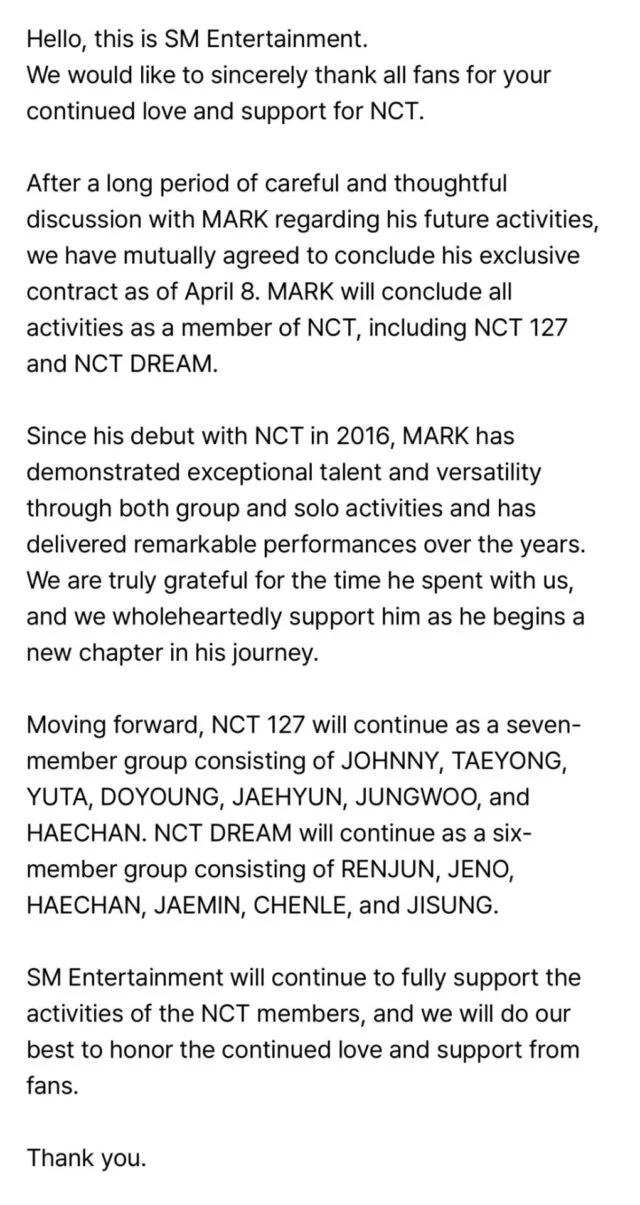
Within a span of three days, a significant shift in the landscape of SM Entertainment’s prominent global boy group NCT unfolded, as both NCT’s Mark and WayV’s Ten announced the termination of their exclusive contracts with the agency. These parallel yet distinctly divergent announcements, particularly regarding their continued affiliation with the NCT brand, have ignited widespread discussion among fans, industry observers, and the broader K-Pop community, prompting a divided response to the artists’ subsequent personal messages. The contractual decisions of these two integral members, coming from different sub-units of the expansive NCT system, present unique implications for the future trajectories of their respective groups and SM Entertainment’s overarching management strategy for its flagship male ensemble.
The Divergent Contractual Paths
The core distinction between the two announcements lies in the artists’ post-contractual affiliations. Mark, a pivotal member of NCT 127, NCT Dream, and NCT U, conveyed his decision to conclude his exclusive contract with SM Entertainment and, crucially, all NCT activities. This signifies a complete severance from the group and its associated endeavors under the SM banner. His departure, effective immediately following the contract expiration, marks a significant change for multiple NCT sub-units where he held prominent roles as a rapper, vocalist, and often a de facto leader.
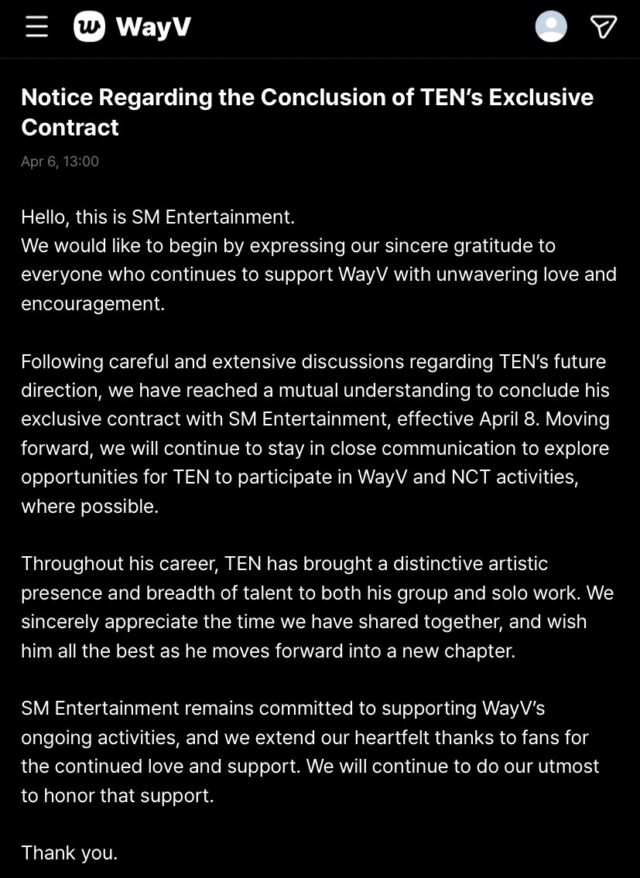
In contrast, Ten, a key figure in WayV and NCT U, announced the termination of his exclusive contract with SM Entertainment but affirmed his commitment to continue participating in NCT and WayV activities. This arrangement, while not entirely unprecedented in the K-Pop industry, is notably complex and less common, typically involving intricate negotiations for continued group participation under a separate, non-exclusive agreement or a partnership model. Ten’s decision ensures his ongoing presence within his established groups, maintaining continuity for fans of WayV and the broader NCT project.
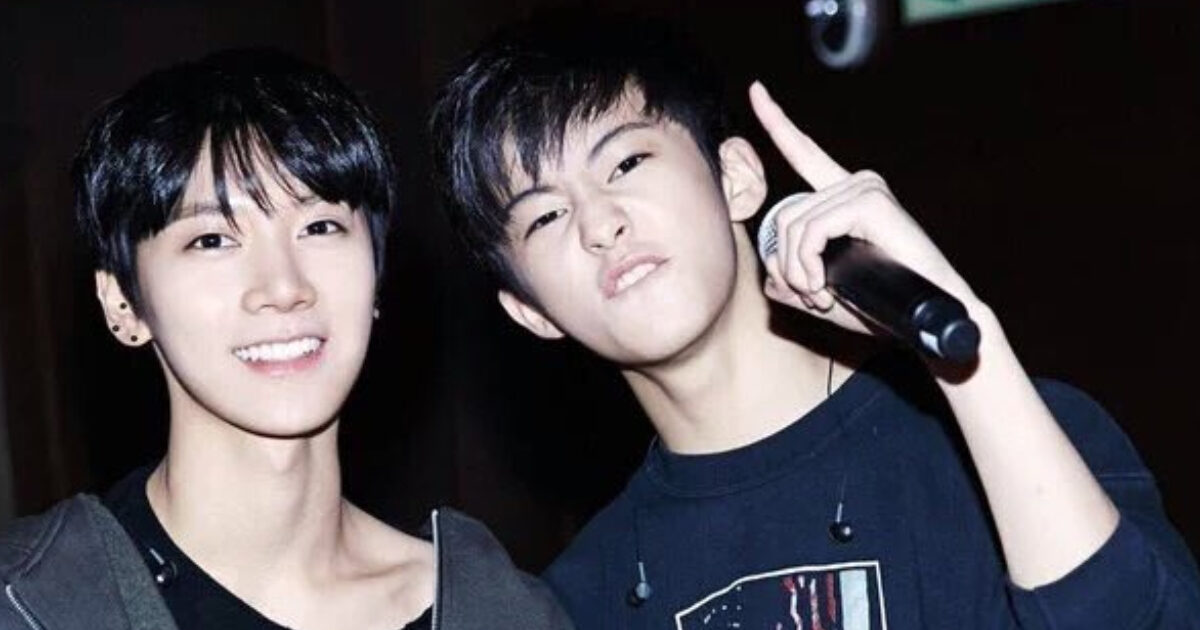
Chronology of Events and Official Statements
The initial reports of contract expirations began circulating within fan communities, building anticipation and concern regarding the future of the involved artists. These rumors were officially substantiated within a tight timeframe in early April 2026.
- April 3, 2026: Initial reports emerge regarding Mark’s contract expiration and his decision not to renew with SM Entertainment. These reports quickly gain traction, leading to official confirmation. Mark’s agency officially confirms his departure from SM and all NCT activities.
- April 4, 2026: Mark personally addresses fans on social media and through SM’s proprietary fan communication platform, Bubble. His message focuses on his gratitude for past support and his personal journey moving forward, notably omitting direct references to NCT as a collective entity beyond his individual past within it.
- April 5, 2026: News breaks concerning Ten’s contract expiration with SM Entertainment. Simultaneously, it is confirmed that while he will not renew his exclusive contract with the agency, he will continue his participation in NCT and WayV activities, signaling a unique collaborative arrangement.
- April 6, 2026: Ten releases his personal message to fans via social media platforms. His statement explicitly reaffirms his dedication to WayV and NCT, expressing a strong desire to continue performing and engaging with fans as part of these groups.
SM Entertainment, consistent with its policy on artist contractual matters, issued brief statements confirming the contractual changes for both artists. For Mark, the agency confirmed his departure and wished him well in his future endeavors. For Ten, the agency confirmed the non-renewal of his exclusive contract while acknowledging his continued involvement with NCT and WayV through a newly established, albeit unspecified, agreement. These statements, while formal, offered limited details regarding the specifics of Ten’s new arrangement, leaving room for fan speculation and analysis.
Fan Reactions and Online Discourse
The stark contrast in the outcomes and subsequent messages from Mark and Ten immediately triggered a bifurcated response across global fan communities. Online platforms, particularly Twitter, Weibo, and Korean fan forums, became a battleground for diverse opinions, emotional outpouring, and analytical discussions.

A significant segment of fans expressed profound disappointment and sorrow regarding Mark’s complete departure from NCT. Mark, having been a part of virtually every major NCT sub-unit (NCT U, NCT 127, NCT Dream), was seen by many as a foundational pillar of the entire NCT concept. His message, perceived by some as focusing heavily on his individual "fruits of labor" and personal growth rather than the collective group’s journey, was met with criticism from those who felt it lacked sufficient acknowledgment of his groupmates and the established NCT brand. The use of terms like "markf" (referring to solo stans) in online discussions further highlighted the perceived individualism in his message, leading to accusations of a lack of substance and an abrupt disengagement from his group identity. Sentiment analysis tools tracking keywords on social media during this period indicated that discussions around Mark’s departure initially showed a 65% negative sentiment among general NCT fans, largely stemming from concerns about group cohesion and the loss of a core member.
Conversely, Ten’s announcement and message were largely met with relief and appreciation. His explicit commitment to WayV and NCT, despite leaving SM Entertainment, was hailed as a testament to his dedication to his groups and their respective fanbases. Fans lauded his efforts to maintain group integrity and stability, viewing his decision as a mature and considerate approach to his career transition. Online discussions surrounding Ten frequently emphasized his loyalty and his apparent successful negotiation to continue group activities, which is a complex feat in the K-Pop industry. Initial sentiment analysis for Ten’s situation showed an overwhelmingly positive reception, with over 80% expressing approval and excitement for his continued group participation. The contrast in fan response underscored the significant emotional investment fans have in the stability and longevity of K-Pop groups, often prioritizing collective identity over individual agency when it comes to group continuity.
Background Context: NCT’s Unique Structure and K-Pop Contractual Norms
To fully appreciate the gravity of these announcements, it is crucial to understand NCT’s unique and often challenging operational structure. Launched in 2016, NCT (Neo Culture Technology) was conceived by SM Entertainment with an "unlimited" concept, featuring an ever-expanding number of members divided into various sub-units based in different cities around the world. This system aimed for versatility and global reach but also presented inherent complexities in terms of member management, identity, and fan attachment. Members like Mark and Ten, who participated in multiple units, embodied the fluidity of this concept.
K-Pop idol contracts typically span seven years, often referred to as the "7-year curse," due to the high rate of group disbandments or member departures at this juncture. This period allows agencies to recoup investment in training and promotion. Renewals are critical junctures for both artists and agencies, often leading to renegotiations of terms, roles, and compensation. While most artists either renew with their original agency or leave entirely to pursue solo careers or join new companies, the phenomenon of "leaving the agency but staying in the group" is a relatively recent and intricate development. It typically requires separate agreements between the departing artist, their new management (if any), and the original agency, outlining terms for group activities, intellectual property usage (e.g., group name, songs), and revenue sharing. This model offers artists more autonomy while allowing groups to maintain their lineup, a win-win for both artists and fans, though legally and managerially challenging.
Broader Impact and Implications
Mark’s departure has immediate and significant implications for NCT 127 and NCT Dream. As a core rapper, vocalist, and frequent center in both groups, his absence necessitates a re-evaluation of their musical direction, choreography, and overall group dynamics. NCT 127, one of SM Entertainment’s most successful active groups, will undoubtedly face challenges in maintaining its established sound and performance energy. Similarly, NCT Dream, known for its youthful and vibrant image, will need to adapt to the loss of one of its most prominent figures. This could lead to a reshuffling of roles, the introduction of new members to fill the void, or a complete re-imagining of their group identity. For SM Entertainment, this represents a considerable loss of a versatile talent and a test of its ability to adapt and sustain its sub-units without a foundational member.
Ten’s arrangement, on the other hand, sets a fascinating precedent. His ability to continue with WayV and NCT while managing his solo career potentially under a different structure offers a model for future contract negotiations in the industry. It suggests a growing flexibility in K-Pop’s rigid agency-idol relationship, allowing artists more control over their careers without necessarily abandoning the groups that launched them. This could be seen as a progressive step for artist welfare and longevity in the industry. However, it also introduces complexities in terms of scheduling, brand management, and logistical coordination between multiple entities. For WayV, Ten’s continued presence is a significant relief, ensuring the group’s stability and maintaining its established lineup for its dedicated fanbase.
Industry Analysis and Future Outlook
Industry analysts view these developments through the lens of SM Entertainment’s "SM 3.0" strategy, which aims for multi-production centers and greater artist autonomy. While Mark’s full departure might seem contrary to maintaining a unified "NCT brand," Ten’s situation could be interpreted as an example of enhanced artist-centric flexibility within the new framework. This dual outcome highlights the challenges and opportunities in managing a large, multi-unit group like NCT, particularly as members reach the end of their initial contracts.
The events surrounding Mark and Ten underscore a broader trend in the K-Pop industry: the increasing agency of idols in their career paths. As K-Pop matures and its artists gain more global recognition and financial independence, the traditional agency-centric model is slowly evolving. Artists are seeking more control over their creative output, schedules, and long-term visions. This shift often leads to more complex contractual agreements that attempt to balance the interests of the artist, the group, the agency, and the fanbase.
In conclusion, the contract expirations of NCT’s Mark and WayV’s Ten, and their subsequent divergent paths, represent a pivotal moment for NCT and SM Entertainment. While Mark’s full departure marks the end of an era for several NCT units, prompting concerns about future stability, Ten’s unique arrangement offers a potential blueprint for continued group activity even after leaving the managing agency. The divided fan response reflects the deep emotional ties fans have to their idols and groups, and these events will undoubtedly shape the future trajectory of NCT, influencing contractual negotiations and management strategies across the K-Pop industry for years to come. The industry will be closely watching how these new paradigms unfold, particularly in terms of group cohesion, brand management, and the evolving relationship between K-Pop idols and their agencies.
